
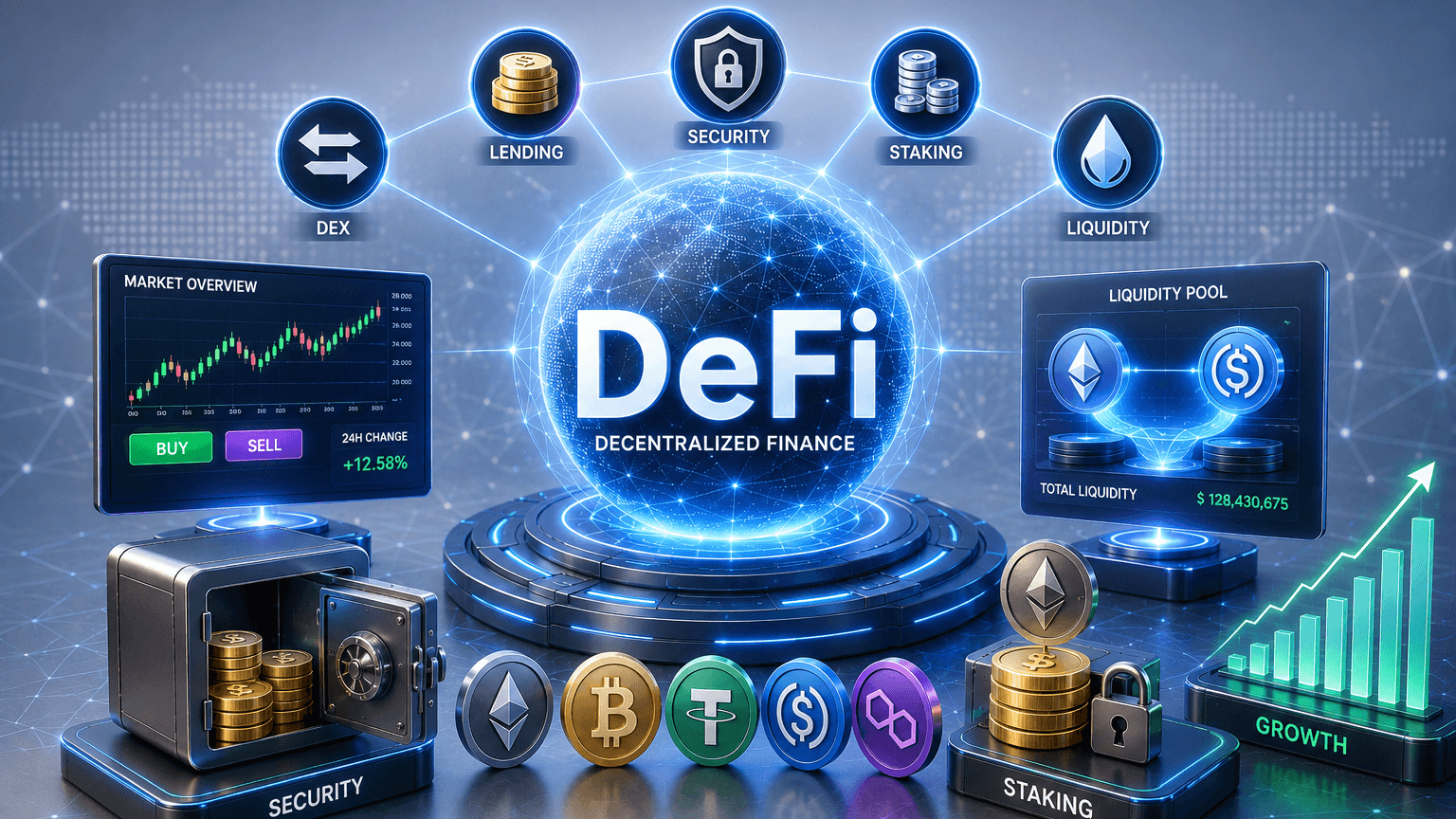
DeFi: What it is and how decentralized finance works
DeFi (Decentralized Finance) is a sector of the crypto industry where financial operations are carried out through code rather than bank employees or exchange operators. Currency exchange, lending, and interest-bearing deposits are all available directly between users, bypassing traditional financial infrastructure.
The name stands for “decentralized finance”: no single bank or regulator centrally controls the process. The rules are embedded in software code and applied equally to every participant in the network, while changing them retroactively is impossible.
The technological foundation of DeFi rests on three elements:
- Blockchain – a chain of blocks containing transaction records that cannot be rewritten or falsified. Anyone can verify the history of operations on the network.
- Smart contracts – computer code that automatically executes the terms of a transaction: transfers and credits assets, accrues interest, and opens or closes positions without human involvement at these stages.
- Wallet – a digital equivalent of a bank account through which users sign transactions and keep their assets under their own control.
The combination of blockchain and smart contracts eliminates the need to trust a third party: the code is open for verification, and the outcome of a transaction does not depend on the decision of an employee or organization.
How does DeFi work?

The interaction process with DeFi protocols is similar for most services, whether it involves swapping tokens, taking out a loan, or earning income from liquidity.
The first step is connecting a wallet such as MetaMask, Trust Wallet, or a similar solution. It is not simply a place to store funds: the wallet acts as the user's digital signature and replaces traditional login-and-password authentication.
Next, the user sends a request to the protocol's smart contract, specifying what they want to exchange, borrow, or deposit into a liquidity pool. The contract checks the conditions – for example, whether the collateral is sufficient or whether the exchange rate requirements are met – and executes the transaction.
At this stage, the need for a third party disappears: there is no clerk needed to process a loan and no exchange operator required to confirm a swap. All checks and calculations are handled by the protocol's code.
The final step is receiving the result: swapped tokens, interest from a deposit, or rewards for providing liquidity are automatically sent to the wallet according to the logic programmed into the contract in advance. There is no manual intervention or waiting for confirmation from third parties.
Decentralized Exchanges (DEXs)

DEXs are trading platforms where token swaps take place without a broker, a traditional order book, or exchange custody of funds. Assets never leave the user's wallet until the transaction itself, unlike centralized exchanges (CEXs), where users must first transfer cryptocurrency to the platform's balance.
Instead of matching buyers and sellers as on a traditional exchange, a DEX uses liquidity pools – shared “reservoirs” containing pairs of tokens, such as ETH/USDT. The transaction price is calculated automatically according to a formula embedded in the smart contract rather than manually set by traders.
The pools are funded by users who deposit pairs of assets in equal proportions. In return, they receive a share of the fees from every swap that passes through the pool – this is the primary incentive for liquidity providers.
On a DEX, users do not need to register, verify their identity, or trust a platform operator. The transaction takes place directly between the smart contract and the user's wallet, while responsibility for protecting funds and understanding how the protocol works rests entirely with the user.
Some of the best-known protocols include Uniswap, PancakeSwap, Curve, and SushiSwap. Each serves its own niche: some are optimized for swapping volatile tokens, while others focus on stablecoins with minimal price slippage.
Cryptocurrency and DeFi lending

DeFi lending is based on the principle of overcollateralization: to obtain a cryptocurrency loan, a user first deposits collateral into the protocol whose value exceeds the loan amount – usually by 130-150%.
This DeFi lending model replaces traditional credit checks and allows users to borrow cryptocurrency without a bank, anonymously and without paperwork, but it requires borrowers to constantly monitor the price of the collateral asset.
Protocols such as Aave, Compound, and JustLend operate using a shared liquidity pool model: some users deposit cryptocurrency and earn interest, while others borrow from the same pool. Cryptocurrency deposit and borrowing rates are determined algorithmically based on supply and demand for a particular asset.
If the value of the collateral falls and no longer maintains the required ratio relative to the loan, automatic liquidation is triggered. Part or all of the collateral is sold by the smart contract to repay the debt and protect the protocol from default.
The liquidation risk is what distinguishes cryptocurrency-backed loans from traditional bank loans: there are no extensions or calls from a bank manager – the code executes the conditions strictly according to the predefined formula, without exceptions.
At the same time, DeFi lending has an opposite side: users who act as lenders and contribute funds to a pool earn passive cryptocurrency income through interest, which accrues in real time as borrowers use the pool.
Staking

Staking is a way to earn income from cryptocurrency by locking assets in a blockchain network or protocol for a certain period. In networks using the Proof-of-Stake algorithm, such as Ethereum, Solana, and Cardano, staked coins participate in transaction validation and network security. In return, users receive rewards – essentially similar to a bank deposit, except that the yield is generated by the blockchain ecosystem rather than a bank.
There are several forms of cryptocurrency staking: solo staking through your own node, which requires technical knowledge and a minimum coin threshold; delegated staking through a validator; and exchange staking, where the platform handles the technical side in exchange for a portion of the income.
The yield from passive staking depends on the network, lock-up period, and total amount of staked coins. The more participants share the rewards, the lower the percentage received by each individual.
Some protocols offer liquid staking, where users receive a token representing their staked asset, such as stETH, which can be used in other DeFi protocols while the underlying asset remains locked.
Key risks include a decline in the price of the staked asset, the unstaking period during which funds cannot be withdrawn, and validator-related risks. If a validator violates network rules, part of the staked funds may be penalized through slashing.
Liquidity and liquidity pools

Liquidity pools are smart contracts into which users deposit pairs of tokens to enable swaps on decentralized exchanges without requiring a buyer and seller to be matched in the traditional way.
A user who contributes assets to a pool is called a liquidity provider (LP). In return, the provider receives a share of the fees from all transactions passing through the pool, as well as an LP token confirming their share of the overall reserve.
In most pools, pricing is based on an automated market maker (AMM) formula. The more the token ratio in the pool changes after a trade, the higher the price of one asset becomes relative to the other. This encourages arbitrage traders to bring the price back in line with the broader market.
The main risk of providing liquidity is impermanent loss: if the price of one deposited token changes significantly relative to the other, the value of the user's share in the pool may become lower than it would have been if the assets had simply been held in a wallet.
To compensate for this risk and attract more liquidity to DeFi, many protocols offer liquidity farming (yield farming) – additional rewards in the form of the platform's native tokens on top of standard trading fees.
The choice of a liquidity pool is usually based on a balance between annual percentage yield (APY), the volatility of the deposited pair, and the reputation of the protocol itself. Newer and riskier pools often offer higher yields specifically as compensation for the additional risk.
Which cryptocurrencies are used in DeFi?

Ethereum (ETH) remains the primary asset for most DeFi protocols – not so much as a source of income but as the fuel powering the entire ecosystem.
The Ethereum network is the platform where smart contracts originally emerged, which is why the majority of DEXs, lending protocols, and liquidity pools still operate on Ethereum or on compatible networks such as BNB Chain, Polygon, and Arbitrum.
ETH is used as collateral for cryptocurrency loans, as one side of trading pairs on exchanges, and as a staking asset. Following Ethereum's transition to Proof-of-Stake, staked ETH has become one of the most popular passive-income instruments in DeFi.
Stablecoins USDT and USDC serve as units of account within decentralized finance – similar to the US dollar but without the same level of price volatility as cryptocurrencies.
In DeFi, users most often use stablecoins to lock in profits after successful trades, move capital between protocols, and provide collateral for loans without being exposed to cryptocurrency market volatility.
USDT has the highest liquidity and broadest adoption across exchanges, while USDC is often preferred for its more transparent reserve structure and the active regulatory oversight of its issuer. This makes USDC a popular choice for institutional pools and protocols with higher reliability requirements.
Other DeFi tokens can be divided into several categories according to their function.
Governance tokens such as UNI, AAVE, and COMP give holders voting rights in the development of their respective platforms and are often used for farming and additional income.
Wrapped tokens such as WBTC and WETH allow assets from other blockchains – for example, Bitcoin – to be used in ecosystems that do not natively support those networks.
LP tokens form another category. Users receive them when providing liquidity to a pool, and they can themselves be used as collateral or as instruments in other protocols, creating multi-layered financial strategies within DeFi.
What are the risks of DeFi?

Smart contract vulnerabilities remain one of the main threats to DeFi users. A coding error in a protocol, even one that has undergone an audit, can give hackers access to funds held in a pool.
Over the years, smart contract exploits have resulted in billions of dollars in losses. This risk cannot be completely eliminated, but it can be reduced by choosing protocols with multiple independent audits and an established reputation.
Cryptocurrency volatility directly affects the stability of DeFi positions. A sharp decline in the price of collateral can lead to forced liquidation of a loan, while changes in the price of tokens in a liquidity pool can cause significant losses for liquidity providers.
For this reason, many users prefer to work with stablecoins whenever possible.
Impermanent loss occurs when the price of one token deposited into a liquidity pool changes relative to the other. As a result, the value of the user's share in the pool may be lower than if the assets had simply been held in a wallet.
This risk cannot be eliminated completely, but it can be reduced by choosing pairs with low volatility relative to each other, such as two stablecoins.
Fraudulent projects are another category of threats specific to DeFi. Anonymous development teams and a lack of regulation make it easier to launch scam protocols, rug pulls – sudden withdrawals of liquidity by developers – and fake tokens that imitate well-known projects.
Checking a contract on platforms such as Etherscan, researching the team's reputation, and reviewing the amount of total value locked (TVL) can help reduce the likelihood of losing funds.
Losing access to a wallet is a risk that rests entirely with the user. DeFi does not have a support service that can restore access using an identity document, as a bank might.
Losing a seed phrase, private key, or access to the device can result in the irreversible loss of all assets associated with that wallet.
Regulatory risks remain an uncertain factor for the entire industry. Different countries interpret the status of DeFi protocols, stablecoins, and cryptocurrency transactions differently, while tighter legislation may restrict access to certain services or affect their operation as a whole.
Users should consider the laws and regulations of their jurisdiction when interacting with DeFi protocols.
DeFi vs. traditional finance – what is the difference?

The main difference between DeFi and traditional finance is the absence of an intermediary between users and their money.
In a bank, decisions about loan approvals, deposit interest rates, and even the ability to carry out certain transactions depend on the institution's policies and employees. In DeFi, all conditions are defined in a smart contract and applied equally to everyone, without exceptions or individual decisions from a central authority.
Accessibility is another fundamental difference. Opening a bank account requires identification documents, proof of address, and sometimes proof of income. To interact with a DeFi protocol, however, users generally only need to connect a wallet – without identity verification, citizenship requirements, or approval from a centralized organization.
This makes DeFi accessible to people who may not have access to traditional banking, while at the same time removing the protocol's obligation to verify exactly who is using the service.
Speed and operating hours also differ significantly. A bank transfer can take several days, especially internationally, while banks operate according to schedules that include weekends and holidays.
DeFi transactions take place directly on the blockchain and can be processed within minutes regardless of the time of day, day of the week, or the country of the sender and recipient.
Transparency is one of DeFi's major advantages. Protocol code is publicly available, and all blockchain transactions can be viewed by anyone.
By contrast, when it comes to a bank's internal operations – reserves, lending, and risk distribution – users generally have to rely on the institution's reports without direct access to verify the underlying processes.
The downside of this transparency is responsibility. In a bank, funds may be protected by government-backed deposit insurance within certain limits. In DeFi, users are fully responsible for the security of their assets, their choice of protocol, and the protection of their wallet. Recovering funds after an error or hack is generally impossible.
DeFi outlook

Stablecoins already serve as a bridge between DeFi and the traditional economy, but their importance is likely to continue growing, especially as major financial institutions and some governments explore issuing their own regulated digital currencies.
Greater transparency of reserves and the emergence of stablecoins pegged not only to the US dollar but also to other fiat currencies could make DeFi a convenient tool for everyday payments rather than merely a platform for speculative activity.
Price stability may become the factor that brings users who are far removed from the crypto market into the DeFi ecosystem.
Tokenization of real-world assets (RWA) is another area that many consider the next major stage of DeFi growth.
Real estate, bonds, stocks, and even commodities are gradually being converted into tokens that can be traded, used as collateral, or deposited into liquidity pools.
This gives DeFi protocols access to trillion-dollar traditional financial markets while allowing owners of real-world assets to obtain liquidity without selling the entire asset. For example, a borrower could take out a loan secured by a tokenized share of a real estate property.
The development of blockchain infrastructure will directly determine whether DeFi becomes a mass-market product rather than a niche tool for technically advanced users.
Lower transaction fees through Layer 2 solutions, faster transaction processing, and simpler interfaces for interacting with protocols are gradually removing technical barriers to entry.
At the same time, cross-chain interoperability is developing. The ability to freely move assets between different blockchains without losing liquidity could unite today's fragmented DeFi ecosystem into a single environment where the choice of network is no longer a barrier for users.
Regulation will remain another major factor influencing the industry's future. The introduction of clear rules for DeFi protocols in major jurisdictions could open the door to institutional capital while also restricting some decentralized services.
The balance between these two scenarios will largely determine what DeFi looks like in the coming years.
