
Exchanging USDT for cash: how it works, is it safe, and what it costs
How exchanging USDT for cash works: the mechanics of a deal from request to payout
Exchanging USDT for cash is fundamentally different from a cashless payout, not just in how the money is received, but in the structure of the deal itself. A card transfer boils down to two steps – send the crypto, receive fiat in your account – while a cash exchange always involves an intermediate stage of a physical meeting or delivery, which adds a layer of logistics that affects both timing and terms.
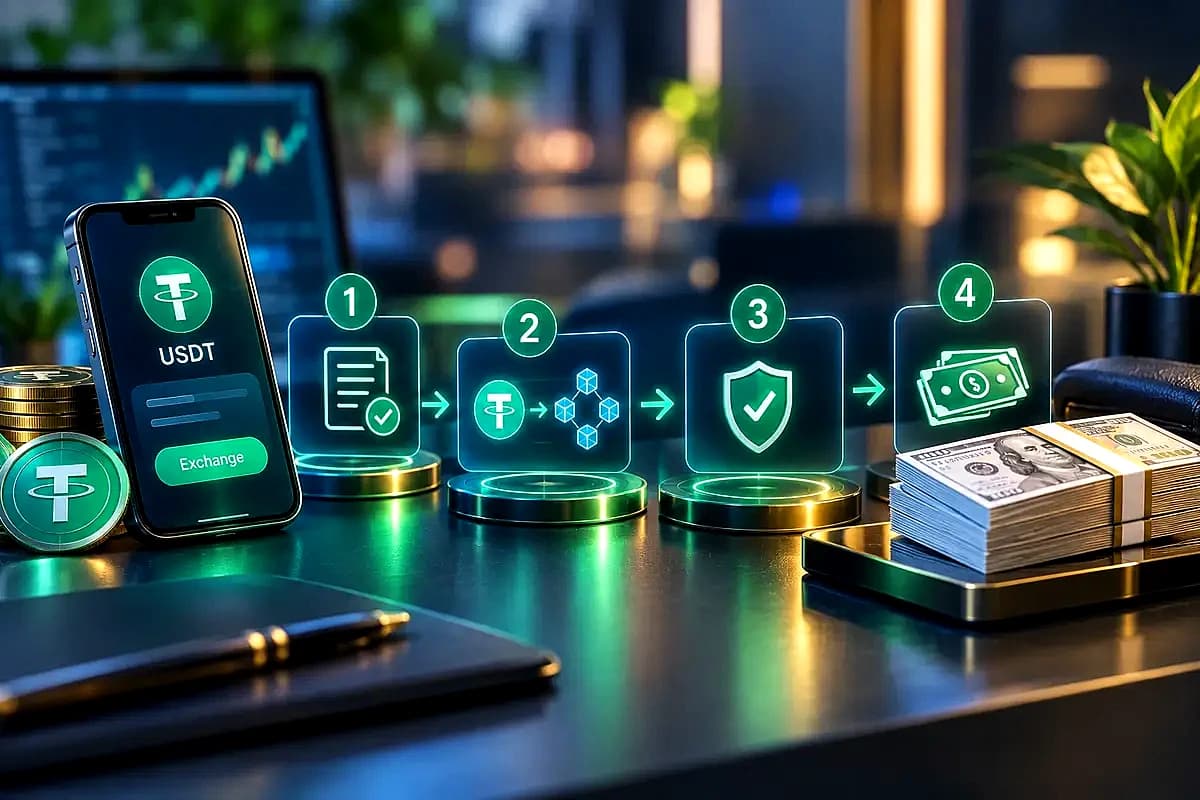
The first step is submitting a request. The client specifies the amount in USDT, the city or district where they want to receive cash, and their preferred method – a visit to an exchange point, a meeting at the service's office, or, if the platform offers it, courier delivery. In most cases, a preliminary rate is locked in at this stage already – but it's worth understanding that it's preliminary, not guaranteed, until payment is confirmed.
The second step is rate locking and receiving the wallet details. After a request is submitted, many services typically lock the rate for a limited window – anywhere from a few minutes to an hour, depending on market volatility and the platform's own policy. This is a key detail that's easy to overlook: if a client takes a while to send the transfer, the rate may update, and the payout amount can change – not through any fault of the service, but simply due to market movement. There are also services that lock the rate precisely at the moment the request is paid, with no advance locking, and instead display a live, minute-by-minute rate on a dedicated page for each currency. This is exactly the model Coinmoneyhub.com uses – locking the rate at the moment funds actually arrive in the platform's account – which in turn rules out unpleasant hidden markups, sudden pseudo rate spikes, and opaque exchange practices.
The third step is sending the USDT and confirming the transaction on the blockchain. The transfer needs enough network confirmations before the deal moves into processing status. On most networks (TRC-20, for example) this takes a few minutes, though it can take longer if the network is congested.
The fourth step is the actual cash payout. The scenario here depends on the format chosen: meeting a service representative at an agreed spot, a courier arriving at an agreed meeting location (a format whose demand keeps growing steadily as bank oversight tightens and interest shifts toward offline channels in general), or pickup through a partner cash point. The last option is considered the safest for the recipient, since the client receives verified banknotes directly at the exchange point, in a secure location, with a solid level of service.
Large amounts deserve a separate mention. The query "how to safely cash out a large crypto amount" is one of the most common among clients planning to exchange a substantial volume for cash, and for good reason: the larger the sum, the more it matters to arrange the meeting format, time, and place in advance, and to confirm whether the service can prepare the needed banknote denominations ahead of time rather than scrambling to put the sum together at the last minute.
The difference from direct P2P cash exchanges, which happen straight between two exchange users, is that when exchanging through a service, responsibility for fulfilling the terms of the deal, the safety of the meeting, and the accuracy of the amount rests with the service – not with a random individual. That structurally changes the whole logic of risk, which the following sections cover in more depth.
What formats exist for exchanging crypto for cash
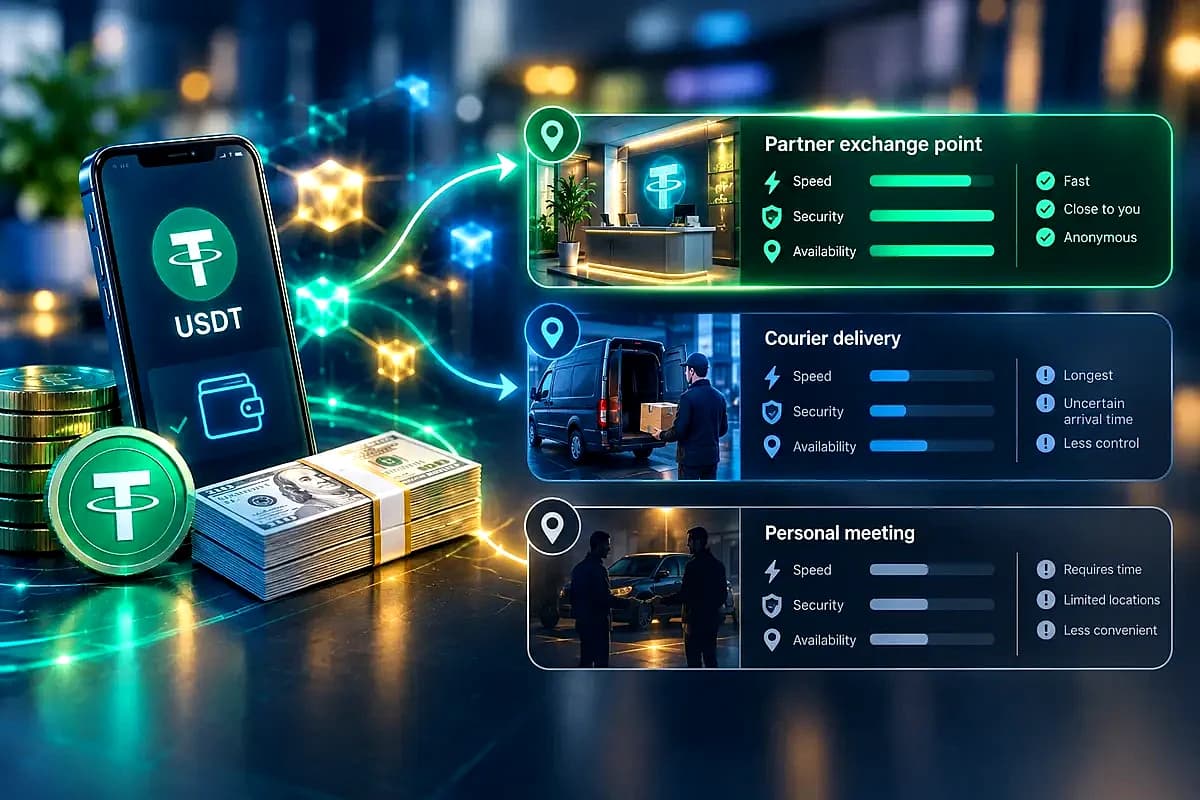
The format for receiving cash isn't a minor detail of the deal – it's a factor that directly affects speed, the level of control, and the final cost of the exchange. In practice, five established scenarios have taken shape, each with its own logic depending on the amount, urgency, and the client's personal preferences.
Meeting a service representative. The client picks a convenient location – a café, a business center, any busy public spot – and a service representative shows up there at the agreed time. The exchange happens right on the spot: the USDT transfer is confirmed immediately, and cash changes hands with no further waiting. This is the scenario most often behind the query "exchange USDT for cash" with a specific city attached – people specifically look for a stablecoin as the exchange instrument because the dollar-to-USDT rate stays the most stable among crypto assets, which reduces uncertainty for the whole duration of the deal. Meeting in person has a practical upside too: the client can count the banknotes on the spot, check the rate on the service's page, and ask questions directly instead of going back and forth in a chat.
Courier delivery. A format often confused with a meeting, though the logic behind it is different. The courier doesn't take part in negotiating the terms of the deal and isn't a representative the client discusses details with – their role is purely logistical: delivering an already-prepared, pre-agreed sum to a specified address, to a specific person. This is the scenario behind the query "crypto courier to my door," even though the delivery address can be anywhere – not necessarily someone's home. Demand for this format keeps growing steadily alongside the tightening of bank oversight over cryptocurrency transactions: the more people prefer to avoid routing the transaction through a bank account at all, the higher the interest in a scenario where money changes hands physically, bypassing the banking system at every stage of the deal.
Exchange through a partner payout point. In this scenario, the client doesn't receive cash directly from the service itself, but at a third-party location the platform has a partnership with. The mechanics resemble a money-transfer model: once payment is confirmed, the client is issued a code (or another transaction identifier) that can be presented at any point in the partner network – with no tie to a specific meeting time or a single address. This is exactly the model people are often searching for with queries like "crypto cash exchange without verification" or "best offline crypto exchangers ranking" – what clients care about here is flexibility of pickup: showing up whenever is convenient, at whichever network location suits them, rather than working around a single operator's schedule.
Crypto ATMs. A separate category, more often searched for as "crypto ATM near me." The terminal lets you exchange crypto for cash with no personal contact with an operator – the client scans a QR code, confirms the transfer, and gets banknotes straight out of the machine. In Europe, this is a genuinely mass-market format: the number of such machines runs into the thousands, especially in Spain, France, Austria, and Poland. In Ukraine, crypto ATMs are still scattered, mostly concentrated in major cities, and need to be checked carefully before use – not every terminal supports every stablecoin, and not every one displays a transparent fee on screen before the transaction is confirmed.
Transfer to a card with a subsequent ATM cash withdrawal. A format many people don't even register as "exchanging for cash," even though the end goal is the same – cash in hand. Here, USDT is converted into fiat that lands on a bank card (including via a P2P payment – hence the query "P2P cash exchange," even though it's technically a two-step operation), and the client then withdraws the needed amount from an ATM themselves. This path has its own logic: it's convenient when only part of the sum is needed in cash and the rest is better left on the card, rather than turning the entire deal into cash.
Comparing these scenarios against each other, each one strikes a different balance between convenience and risk. A meeting with a representative, for all its popularity, is the least secure of all the formats: the client and the operator both know the exact time and place in advance, which theoretically creates a vulnerability – the fact of the meeting exists as information known to the other party, and the handover of a large cash sum happens openly, at a specific point in the city. Courier delivery partially removes this problem (there's no need to travel anywhere yourself), but it keeps the same "known time and place" principle, just with one more intermediary involved. Crypto ATMs offer anonymity in the sense of no personal contact with an operator, but they require physically showing up at a specific, fixed machine whose location is known in advance to anyone. A card transfer with an ATM cash-out removes the question of a personal meeting entirely, but adds an intermediate banking step – and with it, all the risks tied to financial monitoring covered in the previous article. Against this backdrop, exchanging through a partner payout point with code pickup remains the only format with no structural downsides: the client arranges everything remotely, from home, without tying themselves to a specific meeting time or place, and picks up the cash whenever convenient at any point in the partner network – no one knows in advance who's coming, when, or with how much money, or when they're leaving. That's the maximum level of anonymity and control, with the fewest points where anything could go wrong.
Before settling on a specific format, it's also worth checking reviews and the platform's reputation rather than relying only on the terms stated on the website – this matters especially for large amounts, where picking the wrong service costs far more than it would for a small one-off deal.
What the price is made up of: rate, fee, spread
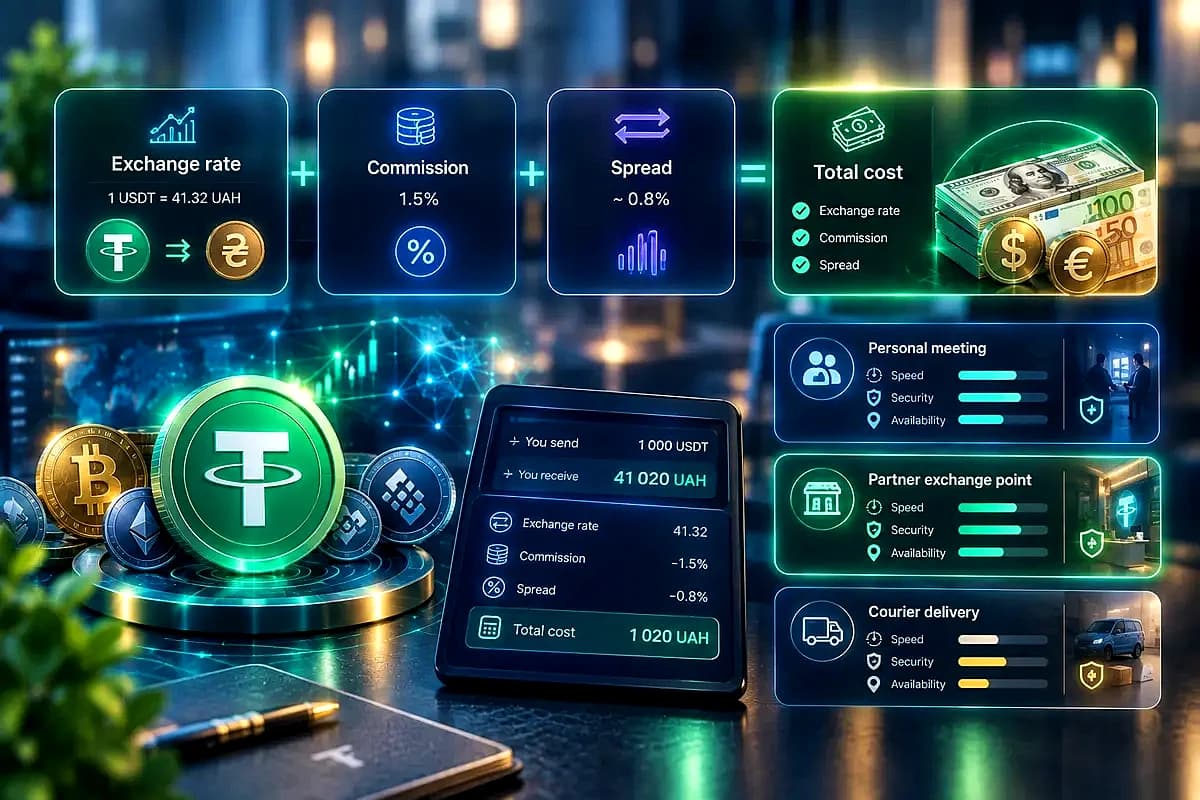
The gap between the rate advertised on a website and the amount a client actually ends up with is one of the main sources of frustration for newcomers. To avoid it, it helps to understand what the final exchange price is actually built from, rather than treating "the rate" as the only variable in the equation.
Rate. The baseline figure reflecting the ratio of USDT to the needed fiat currency at the moment of the deal. A nuance rarely spelled out directly: the rate for a cash exchange almost always differs from the rate on an exchange or in an online calculator, and that's not a sign of a service being dishonest – it's a consequence of the cost structure the offline format carries: logistics for the payout point, handling physical banknotes that still need to be properly prepared (more on that in the next section).
Fee: a percentage and a fixed component. This is exactly what people search for with the query "crypto cash exchange fee" – they want to know the real cost of the deal before it starts, not after. Here's a detail worth knowing that often causes confusion: at many services, the fee consists of two parts – a fixed constant and a percentage of the amount. The constant is a flat charge for processing the transaction itself, independent of the deal's size: it's the same whether you're exchanging 100 USDT or 1,000 USDT. Because of this, on smaller amounts the total fee visually looks much higher as a percentage – for example, on 100 USDT the fixed portion can "eat up" a noticeable share of the sum, while on 1,000 USDT that same constant barely registers. It's not that the service charges more on small amounts – the actual fixed fee doesn't change, only its share relative to the size of a given deal does.
Spread. The gap between a given service's buy rate and sell rate for an asset. The wider the spread, the more the platform earns on every transaction – and the worse the terms are for the client, even if the stated rate looks market-aligned at first glance. Spread is rarely listed as a separate line item, so the only reliable way to gauge it is to compare the buy rate and the sell rate for the same pair at the same service.
The price gap between old and new banknotes. Another factor worth knowing in advance rather than finding out after the fact: when exchanging into certain foreign currencies, dollars in particular, the rate for newer-series banknotes is usually a bit higher than for older ones. This isn't an artificial markup invented by any one service – it's standard practice across the currency market as a whole: newer notes trade with a tighter spread on any subsequent exchange or acceptance, while some points accept older series at a discount or with restrictions altogether. A sensible service flags this in advance, before the request is paid, rather than confronting the client with it at the payout stage.
How these elements add up to the final amount. The formula is straightforward: USDT amount × rate adjusted for spread – (constant + percentage) = final payout amount. The problem is that not every service shows this calculation fully transparently from the start – some advertise a "rate with no fee," and the client only finds out the real amount after submitting the request.
Why cash exchanges are usually more expensive than cashless ones. This is a general pattern, not an arbitrary decision by any particular service: any operation involving physical banknotes adds costs that don't exist with a card transfer – preparing the right denominations, payout-point logistics, handling cash itself. The price difference between a cash and a cashless payout is, in essence, the cost of the format – not a markup on the fact of exchanging USDT itself.
That's exactly why Coinmoneyhub builds its calculation on one principle: the calculator on the site immediately shows the final amount factoring in the rate, the constant, the percentage, and all related costs – with no hidden add-ons that surface only at payout. The amount the client sees on screen before confirming the request is the exact amount they'll receive – bill for bill, with no surprises at the final stage of the deal.
Risks when exchanging for cash, and how to reduce them

The conversation about risk is worth having concretely rather than turning into a list of vague scare tactics. Exchanging for cash has specific vulnerable points, and each one has a specific way to close it – not just "be careful."
Risk at an in-person meeting: tying a specific time and place to a specific person. This is the core vulnerability of the meeting format already discussed in the section on exchange formats – the simple fact that both sides know the exact time, location, and approximate deal size in advance creates a theoretical opening for third parties to find out about it. This risk is reduced in several ways: choosing a busy, well-observed location (a shopping center, an area covered by security cameras – not an empty courtyard), avoiding any discussion of deal details in open chats or on social media, and sensibly splitting very large sums into several separate visits instead of one meeting with the maximum amount of cash changing hands at once.
Risk of counterfeit or damaged banknotes. A separate issue specific to exchanging for physical currency – receiving worn, torn banknotes that are later hard to deposit at a bank or elsewhere, or, in rare cases, running into counterfeit bills from a dishonest operator. This risk is reduced with a simple rule: count and visually inspect the banknotes right there on the spot, before the deal is finalized, not after – most reputable services aren't just fine with this check, they actually build time for it into the payout process.
Risk of terms changing at the last moment. This covers everything discussed in the previous section – an unannounced surcharge for newer banknotes, or a rate that wasn't clearly locked in. This risk is reduced by choosing a service where the calculator's figures match the actual payout with no discrepancies, and where terms around banknote type are spelled out in advance rather than mentioned verbally at the meeting. A key safeguard here is having a request on the exchange service's website that clearly states the payout amount and currency type.
Risk specific to large amounts. The query "how to safely cash out a large crypto amount" isn't among the most common by accident – the larger the deal size, the higher the cost of any mistake. For large sums, it makes sense to confirm with the service in advance whether they can prepare the needed banknote denominations, split the payout into several tranches, or use the code-based pickup format through the partner network instead of an in-person meeting – as already noted, this format structurally removes most of the risks listed above all at once, since it takes the factor of a pre-known meeting time and place out of the equation entirely.
Risk of running into a dishonest service in the first place. This is a risk that can't be reduced through any technique during the deal itself – it can only be closed at the stage of choosing the service, before submitting a request. A separate section further in the article covers this with specific vetting criteria.
The overall logic for reducing risk when exchanging for cash comes down to one principle: the fewer unknowns remain at the start of the deal – clearly locked-in terms, a transparent amount calculation, a verifiable service reputation – the less room there is for unpleasant surprises at any stage.
Hidden conditions clients often aren't aware of in advance

Beyond the price structure and the obvious security risks, exchanging for cash has another layer of nuance – less visible, but the one that most often becomes the source of unpleasant surprises once a deal has, seemingly, already been agreed on.
The gap between the day of payment and the day of pickup. One of the most common scenarios that causes frustration: a client pays for a request today, but can only come to collect the cash tomorrow or the day after – say, because the payout point isn't open around the clock, or the meeting isn't scheduled right away. If the service doesn't lock the rate at the moment payment arrives, and instead recalculates it at the moment of actual payout, the amount received can end up different – not out of bad faith, but simply due to market movement over that time. This is exactly the kind of thing worth confirming in advance: is the rate locked on the date of payment, or on the date of actual payout. The difference in wording may look minor, but on a large sum it turns into real money.
Availability of the needed denomination at a specific location. A point that isn't always obvious: not every payout location or partner cash point keeps an arbitrarily large denomination of banknotes on hand in sufficient quantity at all times. If the sum is substantial, it's worth confirming in advance, not after the fact – otherwise there's a risk of getting the right total amount, but in a scattered pile of small bills, which isn't always convenient and sometimes comes with extra counting or even a surcharge for an "inconvenient" denomination.
Operating hours of the payout point and the code-pickup format. When collecting cash through the partner network via a code – the format already mentioned as the safest in terms of anonymity – it's worth confirming the operating hours of the specific network location in advance, especially if the plan is to pick up the money on a weekend or at an unusual time. The code itself usually doesn't have a strict expiration, but the specific location servicing it may run on its own schedule, which is worth checking ahead of time rather than showing up at random. All top-ranked exchange services display all the necessary information in the request details, which is convenient – the client decides for themselves when to stop by and collect the cash.
Additional clarifications on a request that come up after payment. Occasionally, a service may ask for additional identity confirmation or clarification of deal details after payment has already gone through – this isn't always a sign of a problem; sometimes it's a standard procedure for certain amounts. But a reputable service communicates this condition in advance, at the stage of filling out the request, rather than introducing it suddenly while the client is waiting for payout. In general, any well-ranked exchange service lays out all its rules and exchange terms, along with the exchange procedure itself, in a separate document on the site, which the client can review – and by checking a box when creating the request, agrees to all of the service's terms and rules, as well as the exchange procedure.
The one principle that protects against all of these surprises at once: confirm the key terms of the deal – the moment the rate gets locked, denomination availability, the payout point's schedule – in writing, before paying for the request, rather than relying on unstated assumptions or verbal agreements along the way. It's precisely the absence of this kind of vagueness that separates a service you can trust with a large sum from one you should approach with caution.
How to vet a service before exchanging for cash: specific criteria
Choosing a service is the stage where more risk gets eliminated than through any amount of caution during the deal itself. Below are specific, checkable criteria – not vague phrases like "pick a reliable one."
Public reputation and review history. This is exactly what people search for with the query "best online crypto exchangers ranking" – aggregators and monitoring sites that collect real user reviews over an extended period. What matters is looking not at a handful of one-off positive reviews, but at the overall trend: a service that's been consistently operating has a review history spanning months and years, not a sudden burst of activity in the last week. It's also worth paying attention to how a service responds to negative reviews – ignoring complaints or mass-deleting them is itself a red flag.
Transparency of the calculation before the request is paid. A good sign is when the calculator on the website shows the full payout amount – factoring in the rate, fee, and constant – before the client has even interacted with support. If the final amount can only be found out after a back-and-forth with a manager or after payment, that's reason to be cautious and confirm the terms separately before sending funds. A very common sign of a bad exchanger is actually a fairly simple thing – the banknote type (new or old) affects the price. By default, when a request is created, you get the rate for older banknotes, and once you've paid, support informs you it'll cost more – or you can take the old-format notes instead.
Clear terms on banknote type and condition. As already covered in the section on hidden conditions, the price gap between new and old banknotes is normal market practice – but it should be available as a selectable option when creating the exchange request, not announced verbally at payout. The absence of this option before payment is a red flag. Plenty of dishonest exchangers rely on exactly this trick – they aren't outright scam projects, but they count on clients' inattention to keep recirculating outdated banknotes.
Method of rate locking. It's worth understanding in advance whether the rate is locked at the moment the request is paid, or at the moment the request is created, for a set window of time – this directly affects how much the client ends up receiving if time passes between creating the request and paying it.
Speed and quality of support responses. A simple but effective test: ask a clarifying question about the terms before submitting a request and see how quickly and substantively it gets answered. Evasive answers, stalling, or pressure to pay quickly without actually answering the specific question is a bad sign, regardless of how polished the service's website looks. A very slow support response is also a warning sign in its own right. An active service always answers a client's question – sometimes even outside business hours.
Availability of a pickup format with no tie to a specific meeting time or place. Services that offer a flexible format – such as code-based pickup through a partner network – generally tend to have a more mature operational infrastructure overall, since that model requires established partnerships across a network of payout locations, rather than a one-off arrangement with a single operator.
Checking through the query "crypto cash exchange without verification." Worth addressing separately: the wording of this common query reflects a normal market practice – no mandatory verification for small amounts – but it's important to distinguish a service that clearly explains its no-verification limits from one that doesn't mention any limits at all. The latter is more often a sign of an underdeveloped security policy than an advantage for the client.
Taken together, these criteria make it possible to evaluate a service before any real money changes hands – and that's exactly the stage worth spending time on, rather than saving time by going with the first appealing link in the search results.
Bottom line: when exchanging for cash makes sense, and when a cashless payout is the better call
Choosing between cash and a cashless payout is, at its core, a choice between two different sets of trade-offs, and there's no universally correct answer – there are situations where each format is objectively the stronger option.
Cash makes sense where what matters is genuine physical independence from the banking system – when a client doesn't want the transaction to run through an account at all, when the sum involved risks drawing the attention of financial monitoring if sent through a cashless transfer, or when getting the money right now matters more than anything, without waiting on a deposit to clear or potential delays on the bank's end. In those cases, paying extra for the format – through the rate, the fee, or the constant – isn't wasted cost, it's a reasonable price for control over exactly how and when the money ends up in hand, with no additional oversight attached.
A cashless payout, in turn, wins out where convenience and minimizing physical risk matter more: no need to travel anywhere, no counting banknotes, no working around a payout point's schedule. For relatively small, regular transactions that stay within the bank limit that could raise questions, a cashless format is usually faster and simpler precisely because it removes all the logistics that come with handling physical money.
To put it as a practical rule of thumb rather than a vague "it depends" – there's really one key question worth asking before choosing a format: what matters more in this particular deal, full independence from the banking channel, or the fewest possible steps to getting the money. The answer to that question, not the size of the sum on its own, is what determines which path turns out to be the better one – and not just in terms of the final figure, but in terms of how much hassle the process itself takes.
The market for exchanging USDT for cash keeps growing alongside the tightening of bank oversight over cryptocurrency transactions, and the gap keeps becoming more visible between those looking for the simplest way to get cash at any cost, and those who check the service first, understand how the calculation works, and only then hit "confirm request." The second approach takes a bit more time upfront, but it's exactly what avoids most of the surprises covered throughout this article.
