
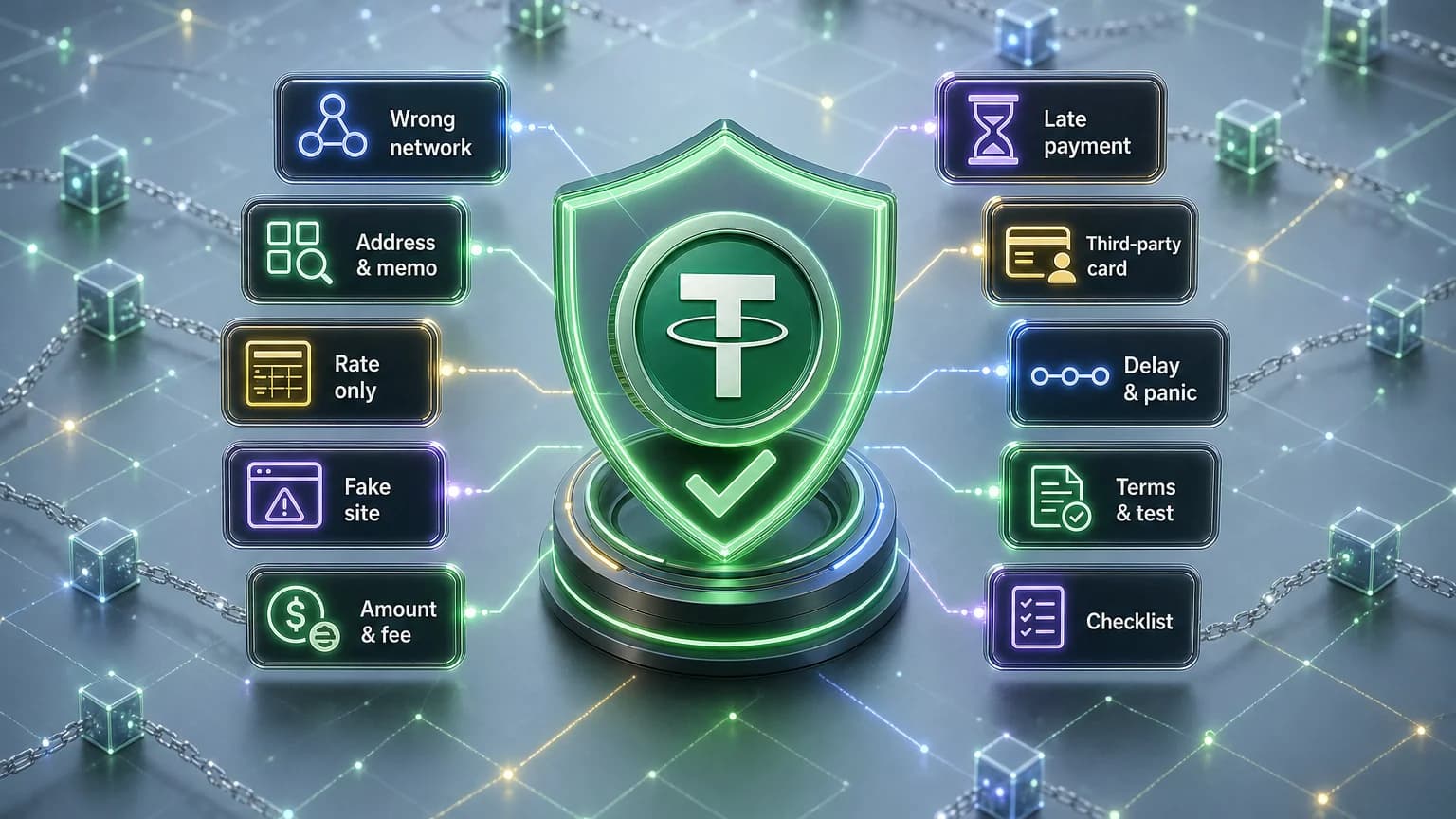
Top crypto exchange mistakes and how to avoid them
Sending USDT on the wrong network (TRC-20, ERC-20, BEP-20): what happens to the money and when it can be recovered
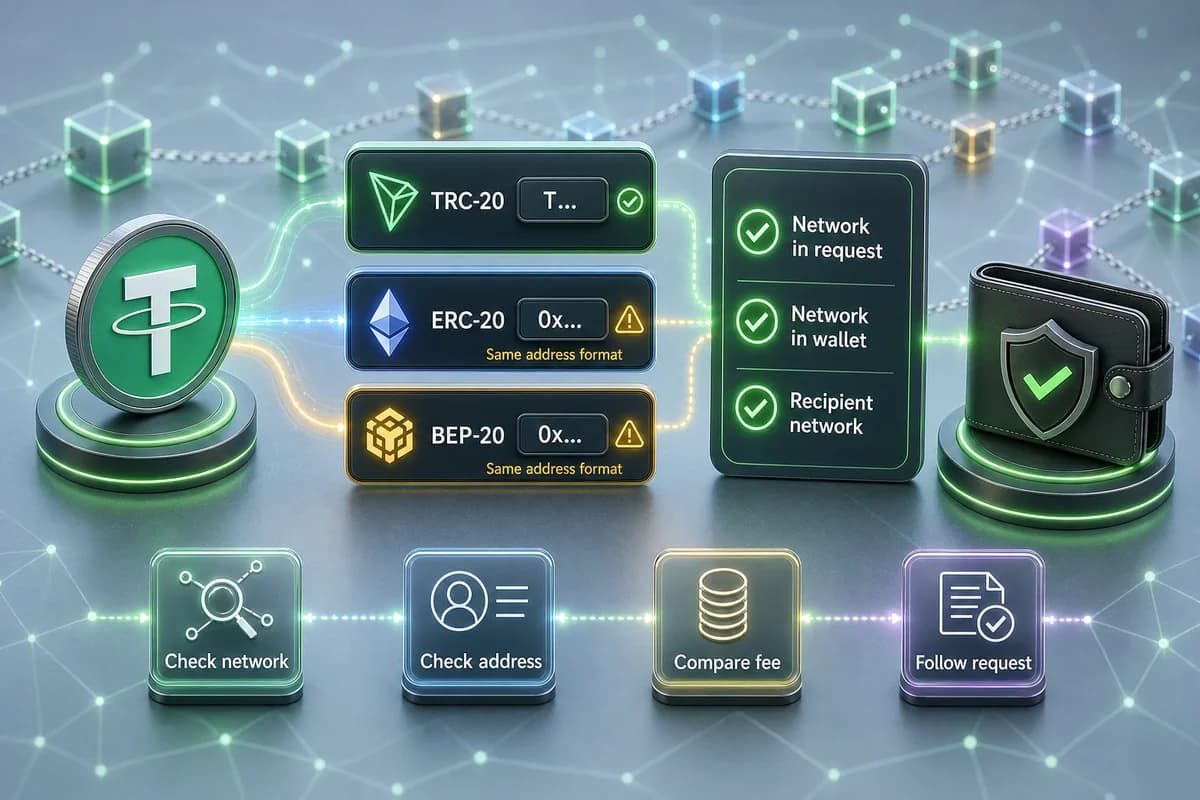
USDT exists on several blockchains at once, and for a wallet these are different assets that merely share a name. The token on TRON (TRC-20), the token on Ethereum (ERC-20) and the token on BNB Smart Chain (BEP-20) live in separate ledgers and cannot see each other. That is why sending USDT on the wrong network happens more often than any other exchange mistake: the money is gone, the transaction is confirmed, and the request is still waiting for payment.
Where the mistake really happens. The difference between TRC-20 and ERC-20 starts with the address itself: on TRON it begins with the letter T, on Ethereum and BNB Smart Chain – with 0x. So mixing up TRC-20 with the other networks is almost impossible: most wallets check the address format and will not let such a transfer through. The real trap is the ERC-20 and BEP-20 pair. Addresses on these networks look identical: 0x followed by forty characters. The wallet sees no mismatch, the transfer goes through without a single warning, and the tokens land on the same address but on a different network. The service that expected payment in ERC-20 receives nothing, even though the transaction shows as successful on the network.
What happens to the money after sending. It does not disappear, but it does not come back either. The tokens stay on the network you sent them to, at the recipient's address, and the transaction will show as successful on that network. The problem is that nobody can use them: you do not have the key to someone else's address, and the service has no tools to see and process a payment on a network it does not accept. The funds are stuck on the network, and in the vast majority of cases nothing can be done with them. A confirmed transaction cannot be reversed by the service, by support or by the blockchain itself, so recovery is blocked not by unwillingness to help but by technical impossibility. The rare exceptions do not depend on the client: they only happen where the recipient technically supports both networks and agrees to investigate the payment manually, and you should not count on that outcome.
Real cases confirm exactly this picture. Recoveries have been described, but they are isolated stories involving large platforms, manual investigation, a recovery fee and weeks of waiting, with no guarantee. For services that issue a separate address for each request, such a scenario essentially does not exist.
What you can do if you sent USDT on the wrong network:
- Do not send again and do not create a second request: it doubles the problem and complicates the investigation.
- Compare the network specified in the request with the network selected in your wallet when sending. All the details of the operation are already in the request, there is no need to collect them separately.
- Do not count on a refund through the exchanger: a service that does not accept the network you sent on cannot see such a payment and cannot process it.
- Read the clause in the service's terms about sending on another network: it states in advance what happens to such funds.
- If you sent to your own wallet, check whether the same address is available on the right network. Often it is enough to add the network to the wallet or import it into an app that supports it, and the tokens will become visible.
What cannot be fixed. Neither a bank, nor support, nor the blockchain itself can cancel a confirmed transaction. Tokens sent to an address whose key nobody controls, to a smart contract address or to a network the service does not support cannot be recovered. A separate danger is "recovery specialists" who write in messengers offering to retrieve the funds for an upfront fee or asking for a seed phrase. That is a scheme, not a service.
How to choose the network without making a mistake. The network in the request, the network in the send window and the network the recipient accepts must match completely. After that, the choice comes down to the fee and where your funds already are. USDT transfer fees differ noticeably between networks: on TRC-20 and BEP-20 they are usually low and stable, while on ERC-20 they depend on network load and at peak hours can be several times higher than the others. That is why the question "USDT TRC-20 or ERC-20: which network to choose" is more often answered in favour of TRC-20: the transfer is fast and cheaper. But the network for exchanging USDT to UAH is determined not by personal preference but by what is specified in your request.
You can read more about how to send cryptocurrency safely in a separate article – "How to avoid losing cryptocurrency during a transfer: 7 rules". If the network was chosen correctly but the error is hidden in the address itself, the situation is different, and the next section covers it.
A wrong wallet address and a missing memo/tag: why the transfer cannot be found and what to do after sending
If the network was chosen correctly but the request still does not see the payment, the cause is almost always the address or the extra field that goes with it. This is the second most common exchange mistake, and here the chances of recovery depend on where exactly the money went: to someone else's address or to the service's address without the required tag.
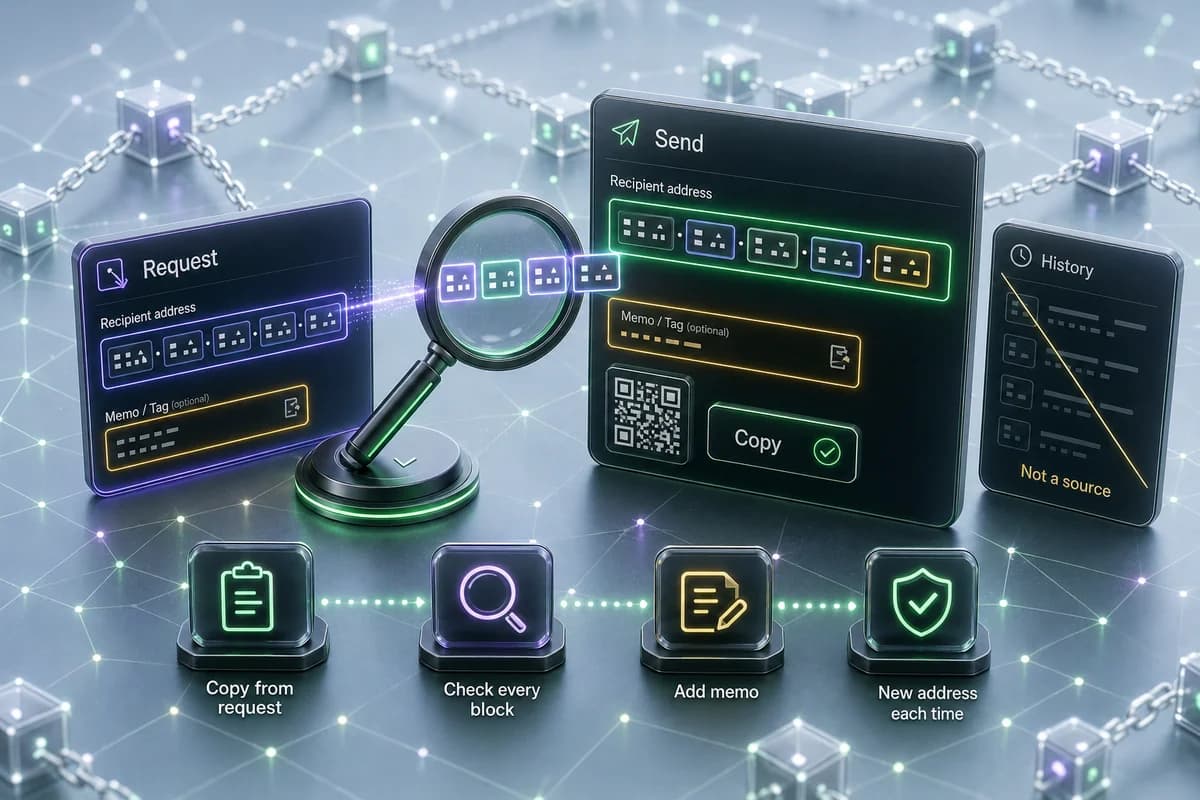
An address that was swapped. Hardly anyone types an address by hand: it is copied from a chat, notes or transfer history, and this is exactly where two schemes work. The first is called address poisoning: an attacker sends a tiny transaction to your wallet in advance from an address whose first and last characters match a recipient address from your history. You open the history, copy the "familiar" address and send the money to a stranger. The second scheme is malware that replaces the clipboard contents at the moment of pasting. The usual check of the first and last characters does not protect against either scheme, because those are exactly the characters that are faked. The address must be taken from the request page and checked in full, block by block, and transfer history should never be used as a source of payment details at all.
An address from a previous request. Some services issue a separate payment address for each request. If you save it in your wallet's address book and reuse it, the payment will arrive at the old address and will not be linked to the new request. So the address is taken anew for every request, even if the exchange is for the same amount and on the same network.
Memo and tag: when an address is not enough. When exchanging coins such as XRP, XLM, TON and some others, the service accepts payments to a shared address, and the specific request is identified by a memo, tag or comment. If the field is left empty, the money will arrive and the transaction will be confirmed, but the system will not know which request it belongs to. The search "what is a memo and tag in a transfer" comes from exactly this situation: a person sees a successful transfer in the wallet and does not understand why the exchange does not start.
What you can do if the transfer cannot be found:
- Open the transfer in your wallet history and see which address and network the funds went to.
- Compare the recipient address in the transaction with the address in the request, character by character.
- If the address is correct and only the memo is missing, this is the most solvable case: the money is already on the service's side and can be linked to the request. The procedure, timing and conditions for this are described in the service's terms, and all the details of the operation are already in the request.
- If the address belongs to another service or a person who can be found, write to the owner. They may return the money, but whether they are obliged to is a matter of their goodwill.
- Do not send the amount again and do not create a second request until the situation is clear.
What cannot be fixed. Neither support, nor a bank, nor the network itself can cancel a confirmed transaction. If the money went to someone else's wallet whose owner is unknown, it cannot be returned. If the memo was entered incorrectly rather than left out, the payment may be linked to someone else's request, and the investigation takes longer. A separate warning: "recovery specialists" who write in messengers and ask for an upfront fee or a seed phrase are the next scheme, not help.
How to protect yourself in advance. Copy the address with the button on the request page or scan the QR code, check the whole address after pasting, never use transfer history or chats as a source of payment details, check whether the request requires a memo, and paste it together with the address.
The address, the network and the memo make up the technical side of mistakes. The next mistake happens earlier, before the request is even created: when choosing a service by a single number in a rate table.
Choosing an exchanger by rate alone: how the advertised benefit turns into losses and what to check before paying
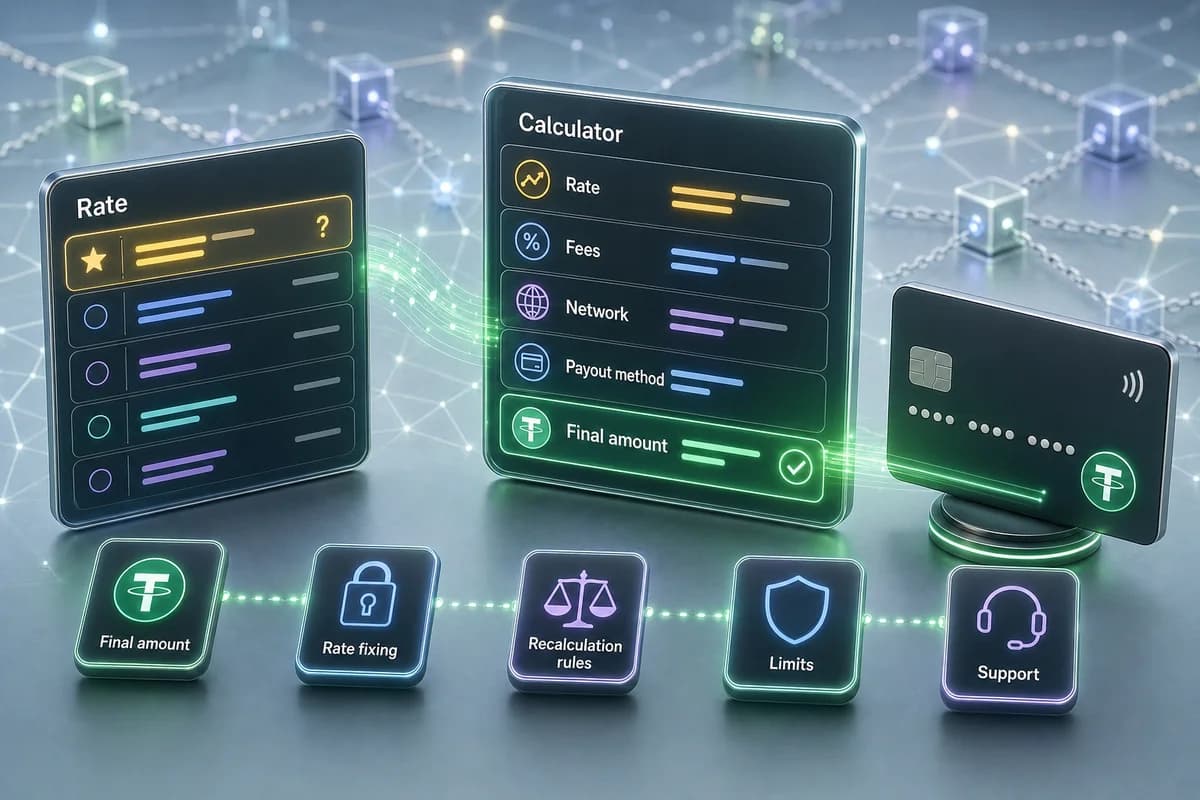
The first two mistakes happen at the moment of sending, while this one happens earlier, before the request is created. Exchanger monitoring sites rank services by rate, and the top line with the best number catches the eye more than the rest. But the rate in the table is only one of the variables, while what matters to the client is how much finally arrives on the card. A crypto exchange rate that looks too good is almost always explained by one of two things: conditions you cannot see in the table row, or the fact that this rate exists only in the shop window.
How a good rate gets lost on the way to the card. The number in the table is calculated under ideal inputs, and a real request differs from them:
- The rate applies to a certain range of amounts. If your amount falls outside it, the calculation uses a different number.
- The rate is tied to the payout method. A payout to one bank's card and to another bank's card may be calculated at different rates.
- The network fee and the payout fee are shown as a separate line only inside the request. Hidden fees in crypto exchange surface at the last step, when the client has already set their mind on the number.
- The rate is not locked. Between creating the request and receiving the money it is recalculated, and the payout uses a value the client never saw.
- The receiving bank may charge its own fee or apply limits that the exchanger is not obliged to warn about.
A special case is the bait rate. If a crypto exchange rate that looks too good is clearly detached from other offers with the same parameters, someone pays the difference: either you, through extra conditions and recalculation, or a service that has no margin for payouts at that price. The catch in an exchanger's rate is easiest to spot by comparison: enter the same parameters (network, amount, payout method) into the calculators of two or three services within one minute. A gap of fractions of a percent is the normal working picture of the market. A noticeable gap is a reason to find out why before paying, not after.
What to check before paying. The final amount of a crypto exchange is the main guide, and that is what you should look at, not the "rate" line. Checking an exchanger before the exchange takes a few minutes and covers most of the risk. How not to lose money when exchanging cryptocurrency, if the number in the table turned out to be incomplete, comes down to five points:
- What the amount to be received consists of: rate, fee, network and bank costs.
- When the rate is locked: when the request is created, for the payment window or when the funds arrive.
- What the terms say about recalculation. The clause on changing the amount after payment is read in advance, not during a dispute.
- What minimum and maximum amounts and limits apply to the chosen payout method.
- How clearly the conditions are described. If the calculator and the terms answer these questions, the service works transparently.
The criteria for choosing a service go beyond this list. You can read more about how to choose a reliable service in a separate article – "How to choose a reliable cryptocurrency exchanger in Ukraine". Here we need the minimum that closes the rate trap specifically.
What to do if less than expected arrived on the card:
- Save screenshots of the request with the amount and rate at the time of creation and the payment confirmation.
- Open the terms and find the clauses on rate locking and recalculation: they decide who is right.
- Compare the amount to be received in the request with the amount credited: the request shows the rate, the fee and the final amount.
- If there is no answer or the calculation does not explain the difference, leave a complaint on the exchanger monitoring site where the service is listed, and a review. The reputation channel really does affect how services behave.
- Separately find out whether the cryptocurrency can be refunded. A refund is only possible under the terms and, as a rule, minus the network fee.
What cannot be fixed. If the recalculation conditions are set out in the terms and consent was confirmed with a checkbox when the request was created, the recalculation is hard to dispute: the client accepted these rules. Money sent to a fake website that copies the interface of a well-known service cannot be returned either. A blockchain transfer is irreversible, and fake platforms and fake support are the topic of the next section, because the biggest losses are tied to them.
Fake websites and fake support in messengers: how to spot swapped payment details and what to do if the money has already been sent
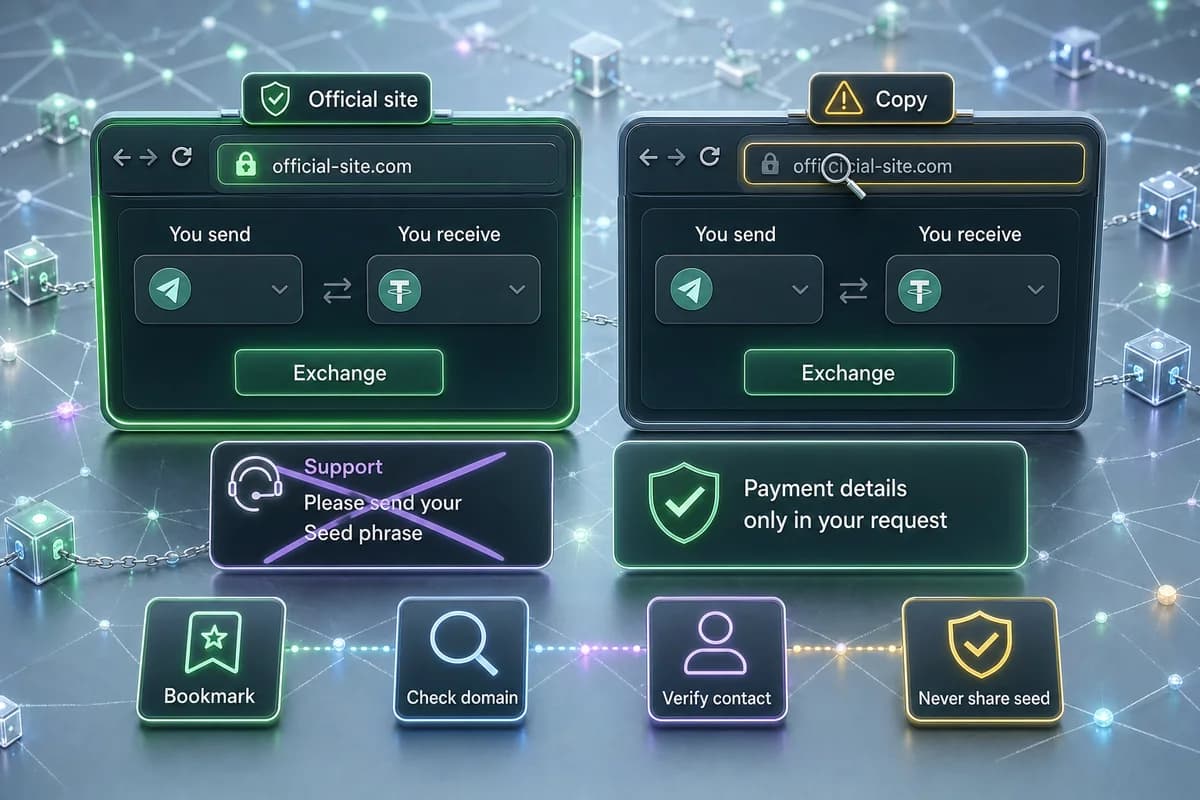
The previous mistake costs the client a few percent of the amount. This one costs the entire amount, because behind it is a person who decided in advance to take the money. A fake crypto exchanger does not offer worse conditions than a real one: the conditions are the same, and it differs in one decisive way – the payment details on the payment page do not belong to the service.
What the swap looks like. Scammers in crypto exchange fake either the place the client goes to or the person the client talks to. In the first case, the design of a well-known service is copied, a domain is registered that differs by one character or uses another domain zone, and the link is promoted through search ads, comments under reviews and topical chats. A person types the service name, sees an ad block above the main results, clicks through and creates a request on a page indistinguishable from the original. The calculation shows the usual amount, payment details are issued, the payment goes out, and the request is "being processed" right up to the moment the client realises there will be no processing. The padlock next to the address guarantees nothing: a certificate encrypts the connection but does not confirm the owner's honesty, and any website can get one.
In the second case, a person does the work. The client asks a question in an open chat or under a post, and within minutes a "manager" with an avatar and a name resembling the official ones appears in private messages. Fake support in Telegram keeps the conversation competent and quick, sends "updated payment details because the main ones are under maintenance" and hurries the client with a link to a good rate. Heavier variants are rarer: install remote access software "for diagnostics", read out a code from a text message or hand over a seed phrase "to link the wallet". Any of these steps turns the loss of one payment into the loss of the entire wallet.
How to spot the swap before paying. A fake crypto exchanger is almost impossible to tell apart by appearance, so the check is built on rules, not impressions. Swapping payment details during an exchange always comes down to one thing: the client is asked to take the address from somewhere other than the request. Payment details exist only on your request page on the official website, and a manager has no reason to send them in a private message. A "backup wallet", "another address" and "a quick workaround" are a reason to stop, not to hurry. The second boundary: support never needs a seed phrase, a private key, a password, codes from messages or access to your device, and no reason changes that. The third: urgency that does not follow from the request itself is also a signal. A real request's deadline is shown on its page, not in a chat message.
How to check an exchanger's official website so as not to land on a copy: open the service from a bookmark saved after checking, not from an ad and not from a chat link; check the domain character by character; on monitoring sites, go through the service's listing and compare the address. The same goes for messengers: support contacts are taken from the official website, not from a conversation. Checking an exchanger's contacts is easier when the service has a dedicated tool for it. At Coinmoneyhub, this is the contact verification page: before trusting a manager in a messenger, you can compare their account with the official one.
What to do if the money has already been sent. The question "what to do if I sent cryptocurrency to scammers" comes up in the first minutes, so the main point first: there is no set of actions that guarantees a refund. A blockchain transfer is irreversible, and the money is with a person whom nobody can force to return it. But a lot depends on the first hours.
First of all, stop communicating and do not send anything else: no "unlock fee", no "tax", no "wallet verification". This is the second wave of the same scheme, aimed at a person trying to get back what was lost. Then save screenshots of the request and the conversation, the website domain and the account ID. If a seed phrase or wallet access was given to the scammers, urgently create a new wallet with a new phrase on a clean device and move everything left on the old one there before it is used. After that, write to the real support of the service whose name was used, file a report with the cyber police with the collected data, and complain to the domain registrar, the hosting provider and the messenger. This will not bring the money back, but it will stop the next victims.
The blockchain is public, and the path of the funds can be traced. If stolen funds reach services that verify their clients, they can be frozen at the request of law enforcement, and the earlier the report is filed, the higher the chance. But scammers usually split the amount and move it on within minutes, so it is best to assume that not everything can be returned and not always. Any offer to return the money for an upfront fee or a seed phrase is another stage of the same scheme.
This mistake makes the client a victim of someone else's actions. The next one happens without scammers, because of arithmetic: the amount the client sent did not match the amount the request expects.
The transfer amount did not match the request: where the network fee goes and how an exchanger handles underpayment and overpayment
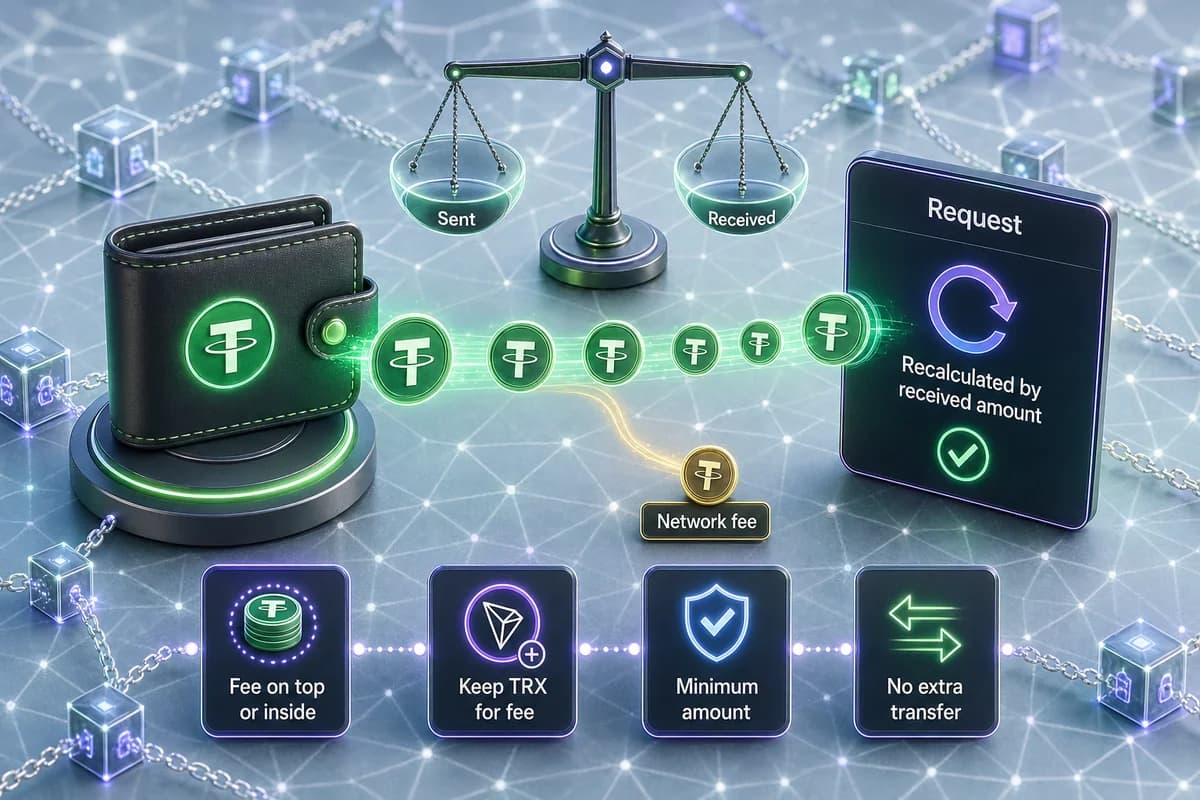
This mistake looks harmless: the client sent exactly what the request said, but less arrived at the service. The cause is almost always the fee. If the wallet or platform the transfer is sent from deducts the network fee from the amount itself, then out of 100 USDT only 99 or less arrives. The client is sure everything was done right, while the system sees an underpayment. "I sent less than the amount in the request" also happens through inattention: the amount was rounded, sent according to an old calculation, or the rate was estimated by eye.
How services handle it. Most exchangers are strict: the amount in the request and the amount at the address must match. When a request is underpaid, such a transaction usually gets an error status or hangs until a manual review. The money does not disappear, it stays on the service's side, but it can only be returned under the terms: most often minus the network fee and not immediately. An overpayment is handled the same way: the excess is either returned manually or sits idle until the client writes to support.
Coinmoneyhub has a more convenient scenario: if the amount received differs from the one in the request, the request is not cancelled but recalculated based on the amount actually received. The client does not have to wait for a refund or create a new request, and the exchange goes through for the amount that really arrived.
How to get the amount right. The main thing is to understand what exactly you enter in the field on the sending side: the amount that will be debited or the amount that will arrive. If the fee is deducted from the transfer, you need to either add it on top or reduce your calculation by its size. The network fee for a USDT transfer depends on the network and its load, so it is better to check it before each transfer rather than remember it from last time. For TRC-20, your wallet needs a reserve of TRX or energy: the fee on the TRON network is paid in TRX, and without it the transfer usually will not go through. Deducting the fee in USDT is only possible in certain wallets with such a feature, and then less arrives at the address. Another pitfall is the minimum USDT exchange amount. If less than the minimum arrives at the address after the fee is deducted, the request may fail even if every other parameter matches, and the conditions here depend on the specific service's terms.
What to do if less arrived than you sent. The question "why did less USDT arrive than I sent" is easy to resolve: compare the amount debited in your wallet with the amount shown as received in the request. If the difference equals the fee, the mistake is in the calculation, not in the transfer. Topping up the missing part with a separate transfer without agreement is not a good idea: the second payment may not be linked to the request and will create additional confusion.
What cannot be fixed. A confirmed transfer cannot be cancelled, and the network fee has already gone to the validators and is not refunded in any case. A refund, if needed, will always be smaller than the original amount by the size of that fee.
If the amount is right, time remains: a request is valid for a limited period, and the final calculation depends on when the payment arrives. That is the next section.
Paying a request late: how the rate is locked and why the final amount may change
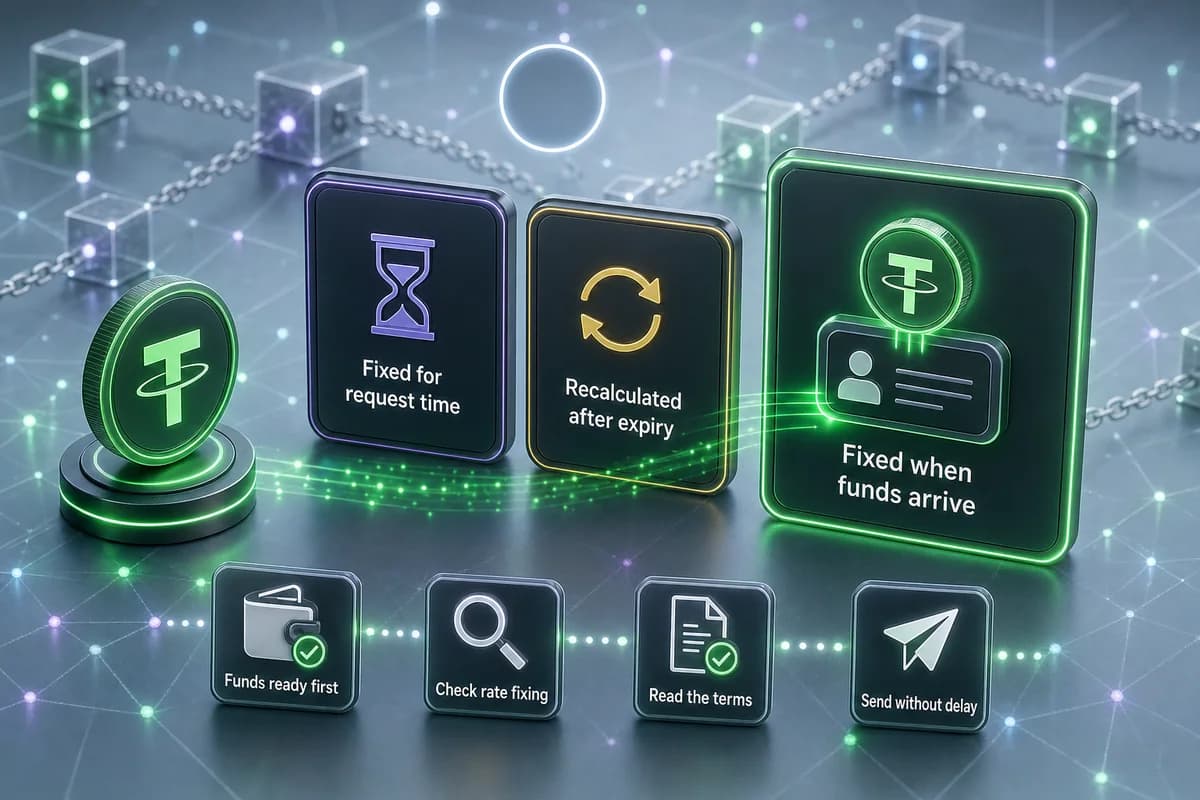
A client created a request, saw the amount to be received, and paid an hour later. Now they are sure they will get exactly that number, while the service will calculate everything according to its own rules. Rate locking in crypto exchange works differently from service to service, and the mistake starts where the client treats the calculation in the request as guaranteed without reading the conditions.
Three models of rate locking:
- For the request period. The rate is frozen when the request is created for a limited time, from a few minutes to an hour. As long as the client stays within that time, the amount does not change.
- For the request period with recalculation. If the payment arrives after the period has expired, the service recalculates the amount at the current rate or cancels the request. This is where questions like "the exchange request has expired" or "I paid the request after it expired" come from.
- At the moment funds arrive. The rate is set when the money reaches the platform. The request period creates no pressure, and the calculation does not become outdated while the client is getting ready to send.
What causes a difference between the request and the payout. Being late is not the only reason. Network confirmations also take time: if a transfer was sent on time but the network is congested, it may arrive after the period ends. When exchanging USDT to UAH the difference is usually small, since the stablecoin stays close to the dollar and it is mainly the hryvnia rate that moves. For volatile assets such as BTC and ETH, the price can shift noticeably within the same hour, and on a large amount the difference turns into real money.
What to do if the amount has changed:
- Compare the time the request was created, the time the transaction arrived and the rate's validity period. All of this is in the request.
- Find the clause on rate locking and recalculation in the terms. It determines which calculation is considered correct.
- If a recalculation is provided for and was done according to the rules, accept it or decline the exchange on those conditions. If the service cancelled the request, find out how the funds are returned and what deductions apply.
- If the calculation contradicts the service's own terms, dispute it by referring to the specific clause: all the details of the operation needed for this are already in the request.
What cannot be fixed. A sent transfer cannot be recalled, and you can only demand the rate at the time of creating the request where the terms guarantee it. If recalculation is written into the rules and the client ticked the checkbox when creating the request, disputing it is almost impossible.
How not to fall into this trap. Create the request when the funds are already in your wallet and the sending fee has been taken into account. Find out in advance when the rate is locked and how long the request is valid. Send volatile coins without a pause.
At Coinmoneyhub, the rate is locked at the moment the funds arrive in the platform's account, with no advance locking. Current values for each currency are updated on a separate rates page.
Paying from and receiving funds to third-party details: why an exchange is delayed or refunded and how to avoid it
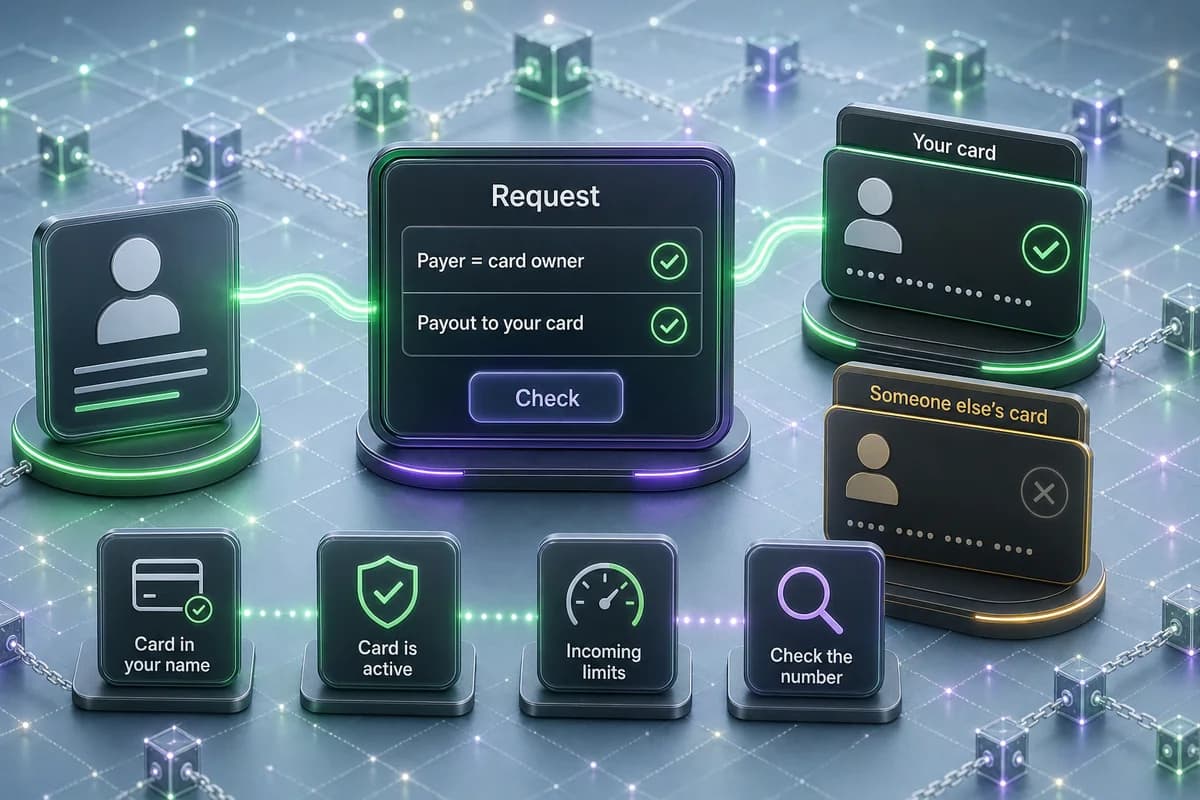
When a request is created by one person but paid from another person's card, or the payout is to be sent to a relative, this is when the exchange most often stops. From the client's side everything looks logical: the money is on the spouse's card, and their own is temporarily unavailable. For a service, paying with someone else's card in a crypto exchange is a typical sign of schemes using front details, and AML control reacts to it first.
Where the mismatch arises:
- one person filled in the request and passed verification, but the payment came from another person's card;
- the payout was requested to a card not registered to the client;
- there is a typo in the card number, and the money goes to a stranger;
- the card is blocked, has reached its incoming transfer limit or is restricted by the bank;
- the name in the request does not match the name on the card (transliteration, change of surname).
What happens next. The service may suspend the request and ask for confirmation of the card owner's identity, or return the payment to the original details. Exactly how is defined by the terms: somewhere the refund comes minus a fee, somewhere the request is rejected, somewhere the payment waits for a manual review. It usually takes from a few hours to a few days, so for an "urgent" exchange this mistake is especially costly. Why an exchanger returned the money can be seen from the request status and the terms' clauses on third-party payments.
What you can do:
- If the payment from someone else's card has already gone out, do not create a new request. Check the request status: if an additional check is needed, the service will tell you what confirmation is required. Often confirmation from the card owner is enough.
- If the payout did not arrive because of a typo in the number, contact the receiving bank right away. The bank will not return the money without the consent of the owner of the card it was credited to, but it can contact them.
- If the card does not accept the transfer, find out the reason from the bank and check in the terms how payout details can be changed to another card registered to you.
- If a refund for the exchange request is needed, find out which details it goes to: as a rule, only to the ones the payment came from.
What cannot be fixed. Money credited to someone else's card because of a wrong number cannot be forcibly returned by the service or the bank without the owner's consent. Nor can the payer be rewritten after the fact: the data used for verification must match reality.
How to avoid this situation. Use a card in your own name for the request. Before sending, check the number, make sure the card is active and accepts incoming transfers, and check the incoming transfer limits in your banking app. If you plan to exchange USDT to a card regularly, it makes sense to understand in advance how your bank treats such a flow. You can read more about why banks block cards in a separate article – "Card blocked over cryptocurrency transactions".
But even with correct details and the exact amount, an exchange does not always go through immediately. How to act when a transaction is delayed is covered in the next section.
Exchange delays and panic: repeat requests, repeat transfers and where to find the operation details
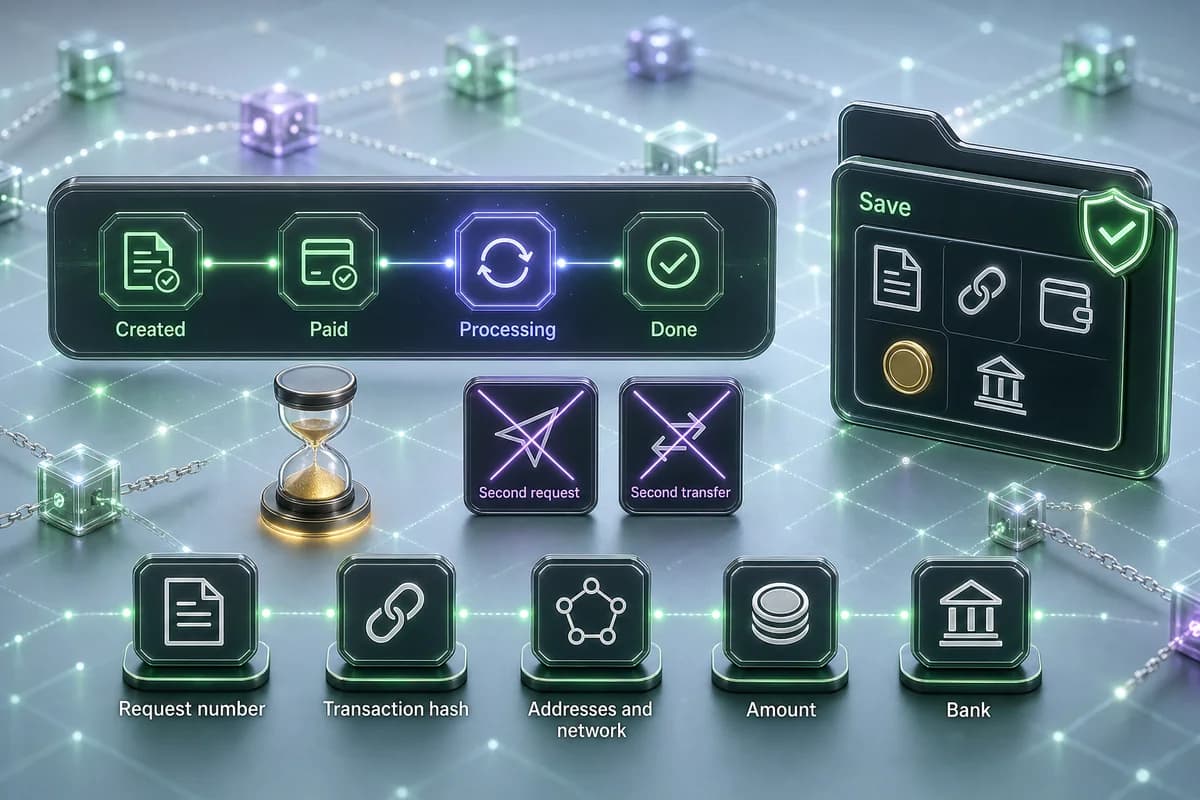
The money has been sent, but the request status is not changing. After ten minutes the client feels something has gone wrong, and after twenty they are already creating a second request or sending the transfer again. A crypto exchange delay is most often explained by the normal mechanics of the process, and the client's intervention at this moment often creates a problem where there was none.
Why an exchange may take longer than usual:
- Network confirmations. The service starts processing once the transaction has collected the required number of confirmations. How many confirmations USDT needs is determined by the service's terms and the network. On TRC-20 and BEP-20 it is usually minutes, on ERC-20 the time depends on network load and the fee the sender paid.
- AML check. A request may go for an additional check because of the amount, the history of the sender's address or mismatched data. This is a standard procedure, and its timing depends on the terms. You can read more about how it works in a separate article – "AML verification for cryptocurrency exchange".
- Load on the network and payment systems. At peak hours, transfers take longer to be confirmed and credited.
- The bank side of the payout. The service has already sent the money, but the receiving bank credits it with a delay. In this case the request shows as completed in the system, but the funds are not on the card yet.
What not to do:
- Create a repeat request. The first one is not cancelled, and the client ends up with two requests for the same money.
- Send the transfer a second time "to be safe". The second transaction will not be linked to the request automatically, and returning the extra amount takes time and usually comes minus a fee.
- Pay anyone who promises to speed up the exchange. Real support never asks for an extra payment for speed.
- Hand over a seed phrase, passwords or codes under the pretext of "wallet verification".
Where to find the operation details. Is the exchange request taking a long time? There is no need to worry: different directions have different processing times, and they are stated in the terms. There is no need to collect data separately, it is all already in the request details:
- Request number;
- Transaction hash;
- Address and network;
- Exact amount sent and time;
- For a card payout: card number.
If a question does come up, the request number is enough: all the other data can be found by it.
If the service has marked the payout as sent but there is no money on the card. First check your statement and bank notifications: crediting sometimes comes with a delay of a few minutes to a few hours, especially at night and on weekends. Then contact the bank with the details from the request: amount, date and card. The bank will find the transfer and tell you what stage it is at.
What cannot be fixed. A duplicate transaction can no longer be recalled, and neither the service nor the client can speed up the blockchain or the bank. But with correct data, a delay almost always ends with the funds being credited without the client's involvement.
Most of these situations can be prevented before sending: find out the timing, limits and verification conditions in advance.
A first exchange without reading the terms or a test transaction: which limits, payout times and AML check conditions to find out in advance
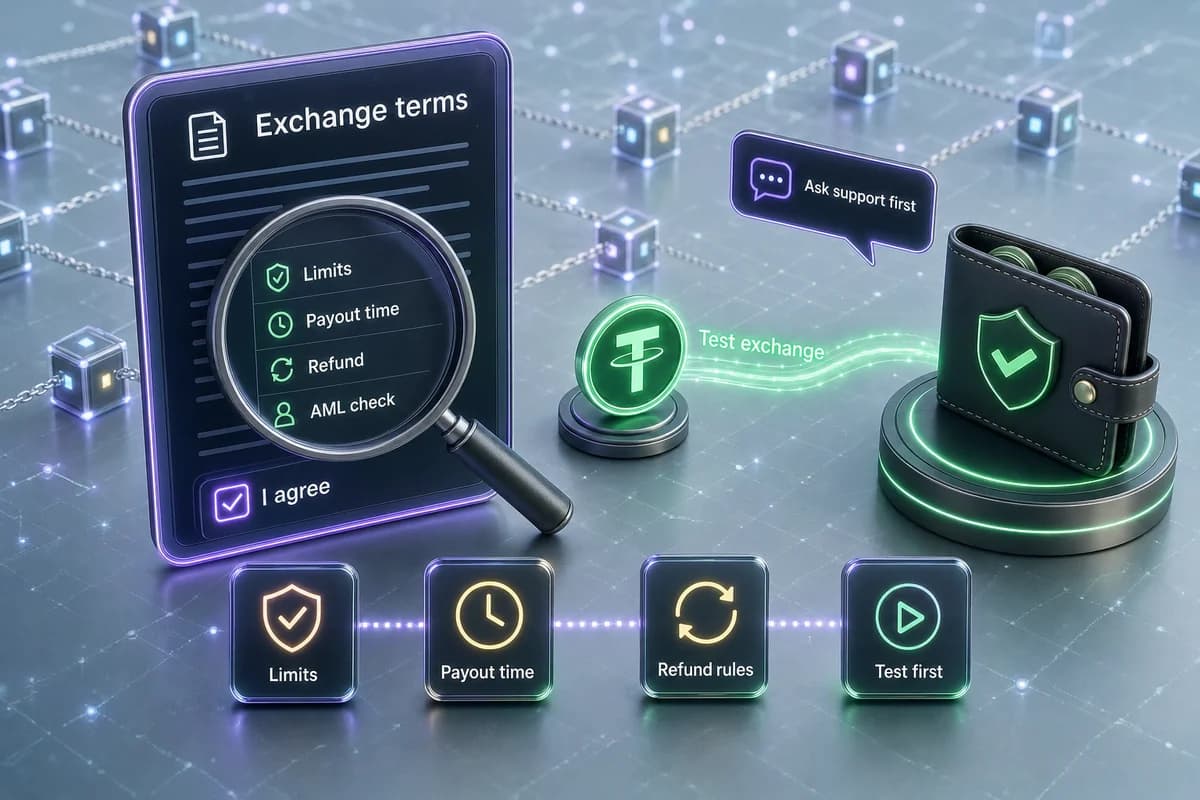
Most disputes between a client and an exchange service revolve around things that have long been written in the rules. Recalculation of the amount, a refund minus a fee, a pause for verification, a limit restriction: the client accepts all of this with a checkbox when creating the request but only reads it once something has gone wrong. The crypto exchange rules should be opened five minutes before the first operation, not during a conversation with support.
What to look for in the terms. USDT exchange limits are set per request, per day and per payout method, and they do not always coincide: the minimum amount for one payout method may be higher than for another. Payout times when exchanging USDT to UAH are counted from a certain moment (from the arrival of funds, from the required number of network confirmations or from the end of a check), and that determines when the client can expect the money. The refund conditions are read separately: in which cases a refund is possible, with what deductions and to which details. And the clause on the AML check: when the service may request confirmation of identity or the source of funds, and what happens to the money if the check is not passed. A verification request in itself does not mean the client has a problem, it is a standard procedure. Each service has its own timing and triggers, and there is no need to guess them: they are written in the terms, and if they are not, that is a reason to ask support before paying.
Why a small test exchange is needed. It shows the service at work, not in the shop window. A single small operation shows how quickly statuses change, whether the calculator's figure matched the actual payout, how the money reached the bank and how support answers if you ask a question along the way. Judging a test operation by the percentage fee is not worth it: on a small amount the fixed part of the fee looks bigger, but that is arithmetic, not a sign of a high price. Focus on the process and speed, not the percentage.
How to exchange a large amount of USDT. A large exchange adds two restrictions that are not noticeable on small amounts. First, the service is more likely to request an additional check. Second, the receiving bank has limits on incoming card transfers, and they determine how quickly and in what form it is convenient to receive the money. So it is better to write to support about a large amount in advance: find out how the service works with such volumes and agree on a payout method that fits your card's limits, rather than sending USDT and figuring everything out afterwards. A request the client came to with questions already answered goes smoothly, while a request where questions started after payment turns into waiting.
At Coinmoneyhub, the rules and terms are set out in a separate document on the website, and consent to them is confirmed with a checkbox when creating a request: the conditions can be read in full before paying rather than searched for during a dispute. The service works around the clock, and support answers daily from 08:00 to 24:00 UTC+2, so a question about limits or timing can be asked before creating a request.
Once the terms have been read and the questions asked, all that remains is to put everything into an order of actions that will not let any of the mistakes above happen.
How to set up an exchange so that mistakes do not have time to happen: the order of actions before confirming a request
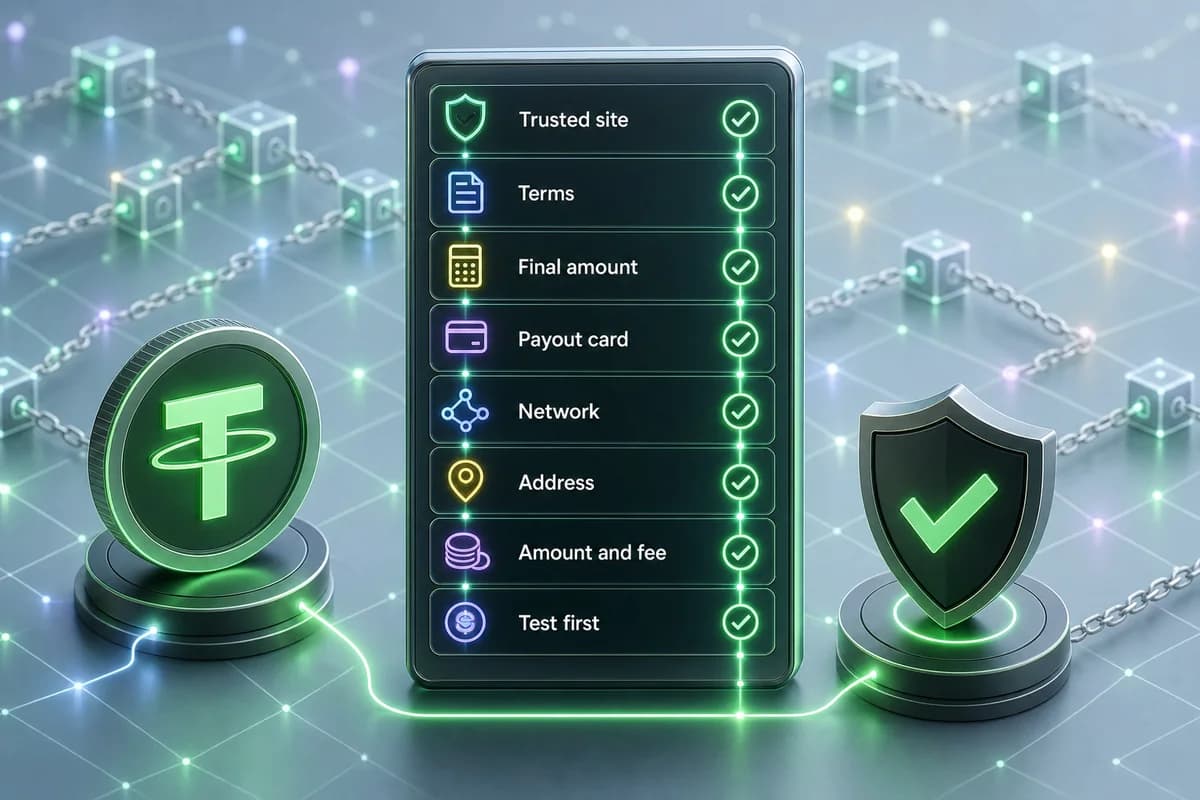
All the mistakes in this article have one thing in common: they happen in the short interval between creating a request and pressing the send button. They are hard or impossible to fix afterwards, but they can be prevented in a few minutes if the checks are done in the right order. The order matters because some checks are only possible before paying: the network and address can no longer be rechecked after sending, and the refund conditions are learned from the terms, not from a dispute.
A safe USDT to UAH exchange fits into the following sequence:
- Open a service with an established reputation. Not from a dubious offer, not from a chat and not from a link sent by a random person. Check the domain character by character, and take support contacts only from the official website.
- Read the terms and sort out your questions. Limits, payout times, the moment the rate is locked, refund and AML check conditions. If something is not described, ask in writing before paying.
- Enter the parameters into the calculator and look at the final amount. Not at the "rate" line. The network, amount and payout method must be the ones you will actually use.
- Check the payout details. The card is registered to you, active, accepts incoming transfers and does not hit the bank's limits.
- Create the request and check three things. The network in the request matches the network in the send window. The address is taken from the request page and checked in full. If a memo or tag is needed, it has been added.
- Calculate the amount to send, including the fee. Find out whether the fee is charged on top or deducted from the transfer, and make sure exactly the amount shown in the request will arrive at the address.
- Send and wait for the status. All the details of the operation are in the request. Do not create new requests and do not send repeat transfers to the same details.
- For a new service or a large amount, start small. A test exchange will show how fast statuses change, whether the calculation matches the payout and how support works, and it takes from a few minutes to a few hours.
The first and fifth points close off the most expensive losses, while the second, third and sixth close off the most frequent ones. If you remember only one rule from the whole list, let it be this: the payment details exist on your request page and nowhere else.
At Coinmoneyhub, the calculator on the website immediately shows the final amount including the rate, fees and all costs, and there are no discrepancies between the calculation and the payout: what the client sees on the screen before confirming is what they receive. The rate is locked at the moment the funds arrive, the request is recalculated if the amount does not match, and the rules, terms and contact verification are on separate pages of the website. You can read more about how to exchange USDT to UAH in a separate article – "How to exchange USDT to UAH?".
