
Anonymous crypto exchange: myths and reality
What anonymous cryptocurrency exchange means: anonymity, privacy and blockchain pseudonymity
The search query "anonymous cryptocurrency exchange" covers three different expectations. Some people mean that nobody will ask for their passport. Others want the bank not to see the operation. Still others are convinced that blockchain transfers cannot be traced at all. These expectations do not match, and mixing them up is exactly what gives rise to most of the myths discussed below.
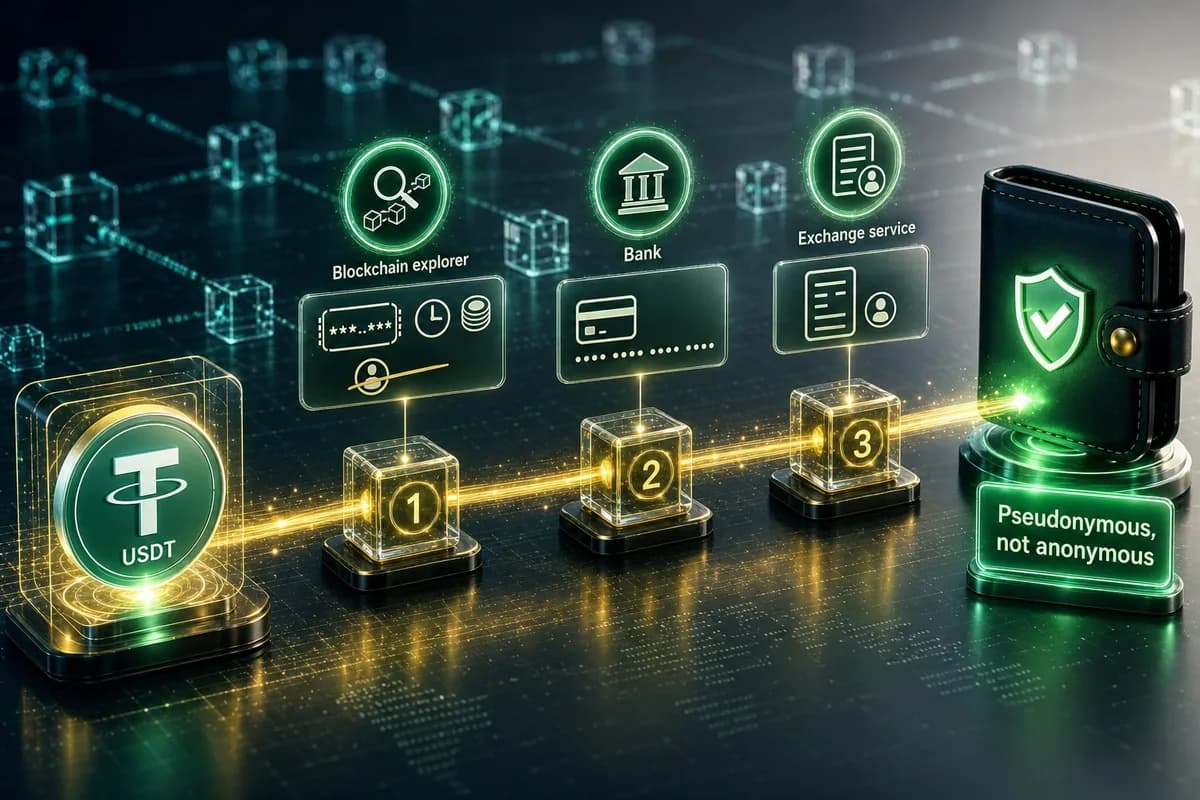
Three concepts that get confused. Anonymity means that your identity is known to no one: not the service, not the bank, not the other party. Privacy is when your identity is known to a narrow circle, and outsiders see nothing beyond what is necessary. Blockchain pseudonymity means that an identifier – a wallet address – is used instead of a name. As long as the address is not linked to a specific person, the identity stays hidden, but every action under that address is recorded. This is exactly how a blockchain works: it is pseudonymous, not anonymous. How such a ledger works and why nothing in it can be erased retroactively is explained in detail in the article "Blockchain and its role in cryptocurrency".
Who sees what. The same operation looks different to different participants:
- anyone with a blockchain explorer sees the sender and recipient addresses, the amount, the time and the fee, as well as the entire history of the address, but not the names;
- the bank sees only its own part of the chain: a transfer between cards, the amount and the time, but not the history of the address on the blockchain;
- the exchange service sees the request data: the account, addresses, amounts and payout details.
None of them has the full picture at once: each sees its own fragment. This is what gives an ordinary exchange its privacy. But privacy is not the same as invisibility.
Can a USDT transaction be traced? Yes, and there is nothing unusual about it. USDT on the TRC-20 network is a public token: anyone can open an explorer, paste a transaction hash or an address and see the path of the funds. Tracking USDT transactions is a routine tool both for analysts and for users themselves, who check whether a transfer has arrived. The link between an address and a person appears at the entry and exit points: when coins are bought with a card, withdrawn to a card or exchanged on a service with an account. In addition, USDT is issued by a company that can technically freeze individual addresses. It is a stable and convenient coin for payments, but not a tool for staying hidden.
What "anonymous" means in practice. In anonymous cryptocurrency exchange, the point is almost always the amount of data requested, not invisibility. In an ordinary exchange no passport is requested, no documents are needed to receive cash, and registration comes down to a name and an e-mail. This is privacy within reasonable limits. Complete invisibility does not exist: if someone has a lawful reason to look into an operation, the chain can be reconstructed from the blockchain and the records of the parties to the transaction. This is how any financial system works, and there is nothing specific to cryptocurrency about it.
Coins created for secrecy. Anonymous cryptocurrency exists as a separate class: Monero and Zcash are designed to hide the amounts and participants of transfers. That is why exchange services treat them more carefully than USDT, BTC or ETH: such assets are subject to enhanced checks of the source of funds and risk assessment. For a stablecoin and other transparent coins the picture is the opposite: they are convenient precisely because everything about them can be verified.
KYC, AML and KYT in simple terms: which of them concern a client of an exchange service
These three abbreviations come up most often in conversations about anonymity, and people usually take them to mean one thing: "they want my documents". In reality they are three different things, and they affect an ordinary client in different ways.
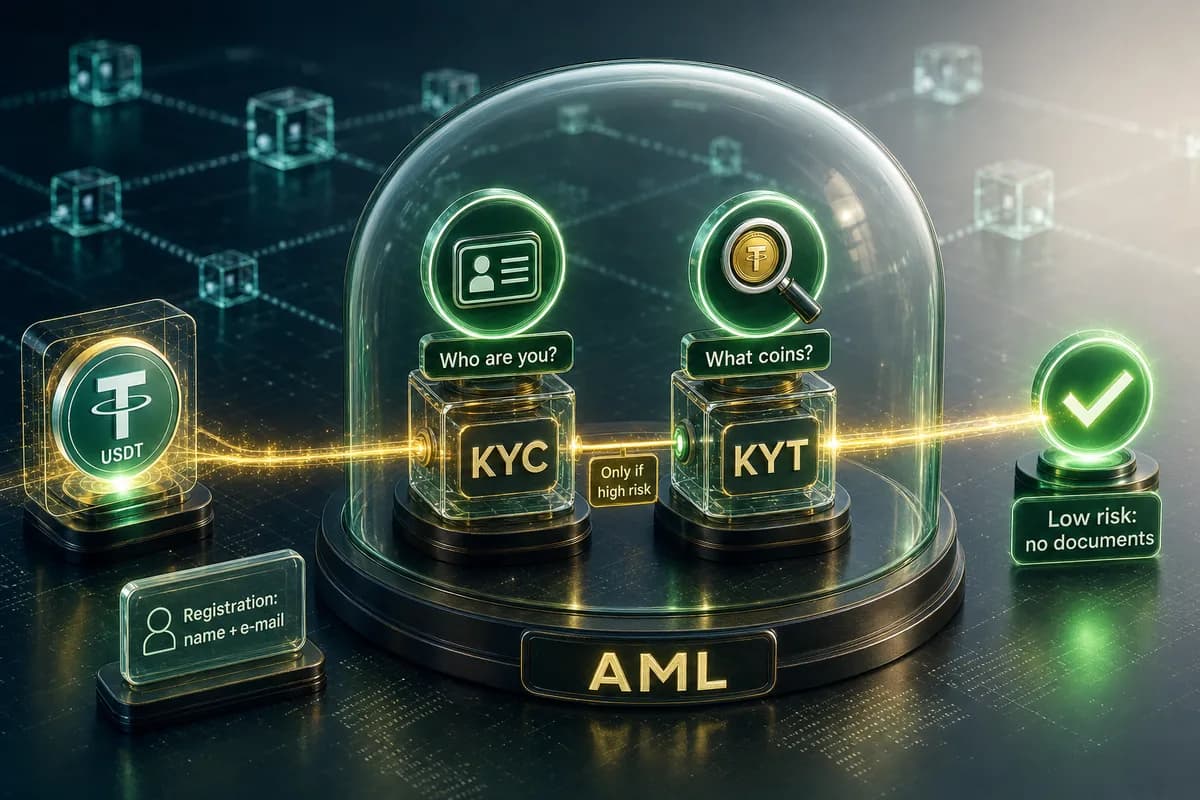
What KYC is. KYC (Know Your Customer) is an identification procedure: the service establishes who is carrying out the operation using an identity document and a photo. It is the most visible part, which is why it is mistaken for the whole system. A short definition is available in the Crypto Guide. The main thing to know: KYC is a tool that is applied when needed, not a form you fill in at the entrance.
What AML is. AML (Anti-Money Laundering) is the general name for measures against money laundering and the use of a service for unlawful purposes. It is not a single procedure but a system: rules, checks and monitoring. The full set of measures a service is entitled to apply is described in the AML policy. It includes the strictest tools as well, but they are meant for complex situations that require a full investigation. An ordinary exchange never gets that far.
What KYT is. KYT (Know Your Transaction) checks not the person but the transaction itself: where the coins came from, which addresses they are linked to and what their risk level is. The easiest way to understand the difference: KYC answers the question "who are you", and KYT answers "what are these coins". The check runs automatically, the client fills in and uploads nothing, and for coins without red flags it goes unnoticed.
KYC vs AML: the difference. AML is the umbrella that covers KYC (checking the person), KYT (checking the transaction) and the service's internal rules. That is why an "AML check" in search queries can mean anything from a document check to an analysis of the coins. It is important for the client to tell these levels apart, because the burden they impose differs.
Which of this concerns a Coinmoneyhub client. Registration consists of a name and an e-mail, and enabling two-factor protection for the account is recommended. This is identification by e-mail, and it does not require documents. Transaction screening is enabled for every request and usually goes unnoticed. Identity verification with documents, that is, full KYC, applies only in an exceptional case – when the coins have red flags and a high risk score. If there are no red flags, nobody asks for documents. A separate case is paying in hryvnia, that is, buying with a card: the service confirms once that the card belongs to you, and this is not full KYC but a card check. What this looks like step by step is covered in the next section.
Why would an exchanger need your passport? In an ordinary exchange with clean coins it is not needed. A document becomes necessary when the coins arrive with a high risk: the service has to make sure that the funds are handled by the person themselves and not by an intermediary in someone else's scheme. For a client whose coins raise no questions, all of this remains background that is not felt in any way.
What an exchange actually requires: registration, card verification and when identity verification is not needed
The idea that a cryptocurrency exchange begins with uploading a passport and waiting for a decision has nothing to do with reality. What exactly is required depends on the exchange direction and on the coins themselves, and in most cases the list is very modest.
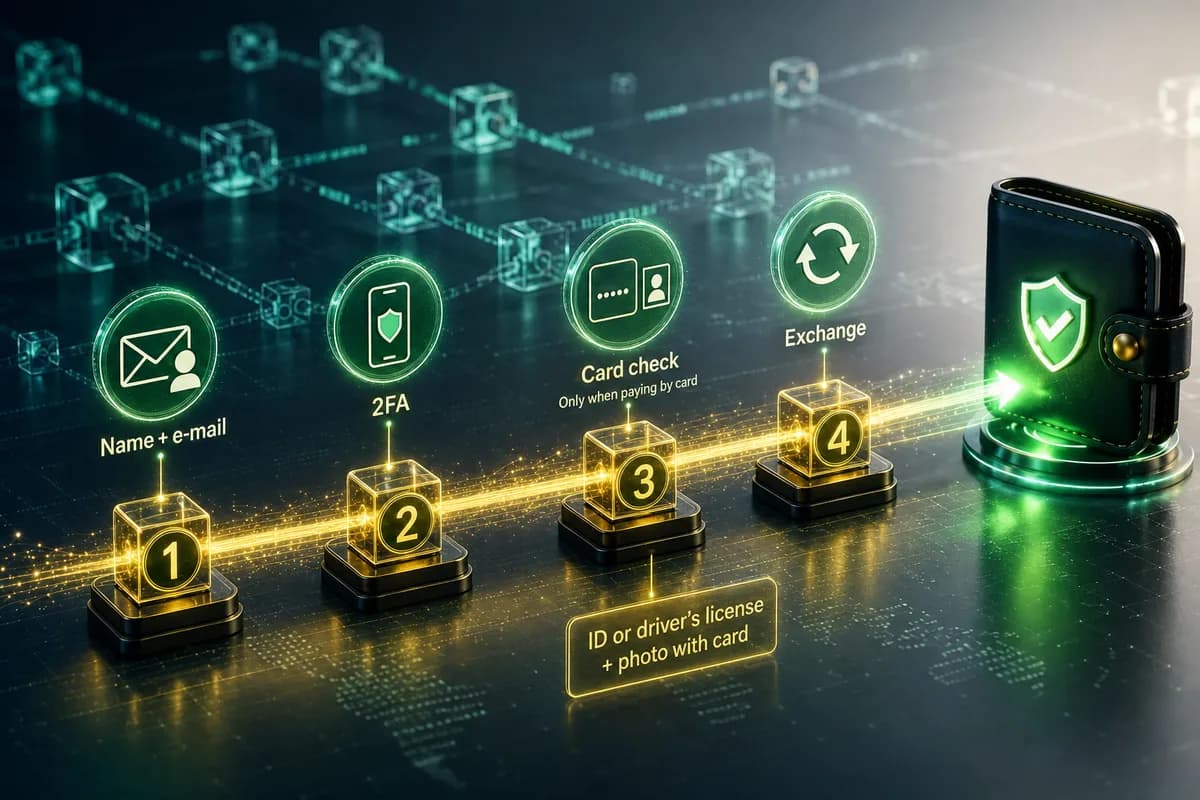
Registration: a name and an e-mail. There is no exchange without registration: a request must belong to an account so that the client can see its status and history and get support by the request number. Creating an account takes a couple of minutes: a name and a valid e-mail, or, if you prefer, one-click sign-in with Google. Two-factor authentication is recommended right away, as it protects the account from unauthorised access. This is identification by e-mail, it does not require documents, and the answer to the question "exchange without registration" is simple: it is not possible, but the registration itself asks almost nothing of the client. More on this and other account questions in the service FAQ.
Card verification: when it is needed and how it works. The only situation where a client is asked for something beyond registration arises when paying in hryvnia, that is, when buying cryptocurrency with a bank card. The service confirms once that the card belongs to you: this requires a document (a passport or a driving licence) and a photo with the card. This is not full KYC but a check of the card as a payment instrument, so there is one rule: you can only pay with a card in your own name, and third-party cards are not accepted. Card verification is done once, without unnecessary forms, and is a natural procedure. How buying USDT with a Ukrainian bank card works, from choosing the amount to receiving the coins, is described in the article "Buy USDT with UAH".
When identity verification is not needed. When exchanging cryptocurrency for cryptocurrency, withdrawing to a card or receiving cash, identity verification is not required. This holds as long as everything is in order with the coins themselves.
What can change the picture. The exception, regardless of the direction, is coins with a high risk score: if they have red flags, verification becomes mandatory, and this is covered in the next section. For all other clients the minimal set stays minimal.
The bottom line: everyone registers with a name and an e-mail, card verification is needed only when paying in hryvnia, and identity verification is triggered only when questions arise about the coins. For an ordinary exchange with clean coins, this means the process is no more complicated than an ordinary online purchase.
When identity verification does kick in: AML frozen status, coin risk and addresses
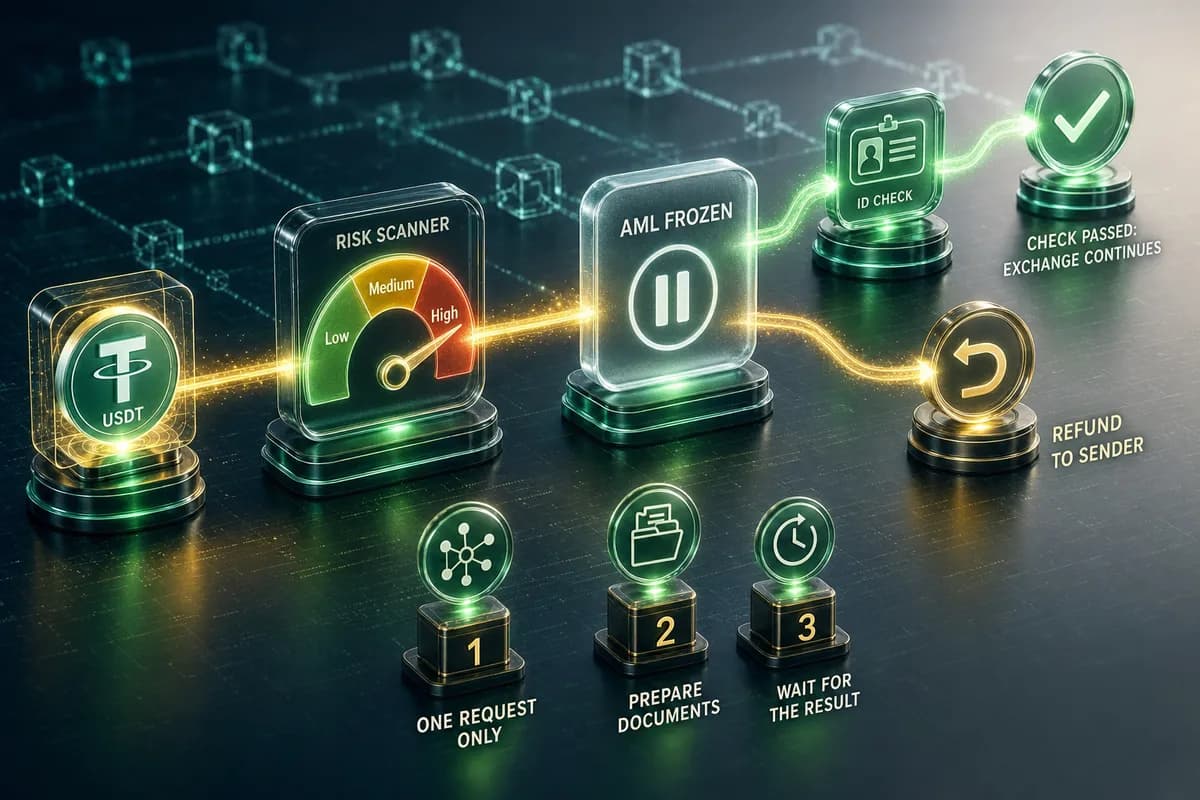
Identity verification at an exchanger starts not with the client but with the coins. As long as they arrive clean, the client does not notice that anything is being checked. When questions arise about the coins, the scheme changes, and everything that follows stems from a single indicator – the risk score.
What is assessed automatically. For each request, the address the funds came from and the history of the coins' movement on the blockchain are analysed: which addresses they were linked to and whether there is any connection with fraud schemes, hacks or sanctioned transfers. Wallet address screening during an exchange is exactly this automatic assessment. It requires no action from the client and stays unnoticed for ordinary transfers. The result is a risk level: low, medium or high. Such checks are mandatory for all services that do not operate in the shadows.
What AML frozen status means. If the risk score turns out to be high, the request receives the AML frozen status: it is suspended, and the exchange does not continue until the check is completed. This is not an account block and not an accusation against the client; it concerns a specific transaction. The question "why was my exchange frozen" most often has a single answer: the coins have a history that the service is not entitled to ignore.
What happens next. Identity verification – full KYC – comes into play: a photo with an identity document. It is needed because, when funds have a risky origin, the service must understand who is in control of them. In some cases the origin of the coins themselves may also be clarified. The review time depends on how complete the submitted data is, and the service reports the result in the request.
How it ends. As a rule, there are two outcomes:
- the check is passed and the red flags are cleared – the request continues and completes as usual;
- the check is not passed or the risk score is too high – the exchange is unavailable and the transaction is stopped. The cryptocurrency is returned to the sender's address minus the network fee.
The second outcome is rare, but it is exactly what makes checking your coins before sending more important than any other precaution.
What to do if your request gets AML frozen:
- Do not create a second request and do not send the coins again: it will not speed up the check.
- Wait for the service's message about what data is needed.
- Prepare the document and photo in advance: the more complete the set, the faster the decision.
- If the decision seems wrong, submit a request through support: the terms give the client the right to appeal the decision and receive a reasoned answer.
How to avoid this situation in advance. The risk score depends primarily on the history of the coins, not on the amount. So it is best to send coins whose origin you know. Do not send coins received from unclear sources and do not run them through mixers: this makes the address history risky, and the client only finds out about it at the exchange stage. The list of platforms from which funds are not accepted and the verification procedure are set out in the exchange rules and terms. But even with clean coins there is a second question: how much can be exchanged at once.
Exchange limits: where to find them, what they depend on and why splitting a payment does not help get around the rules
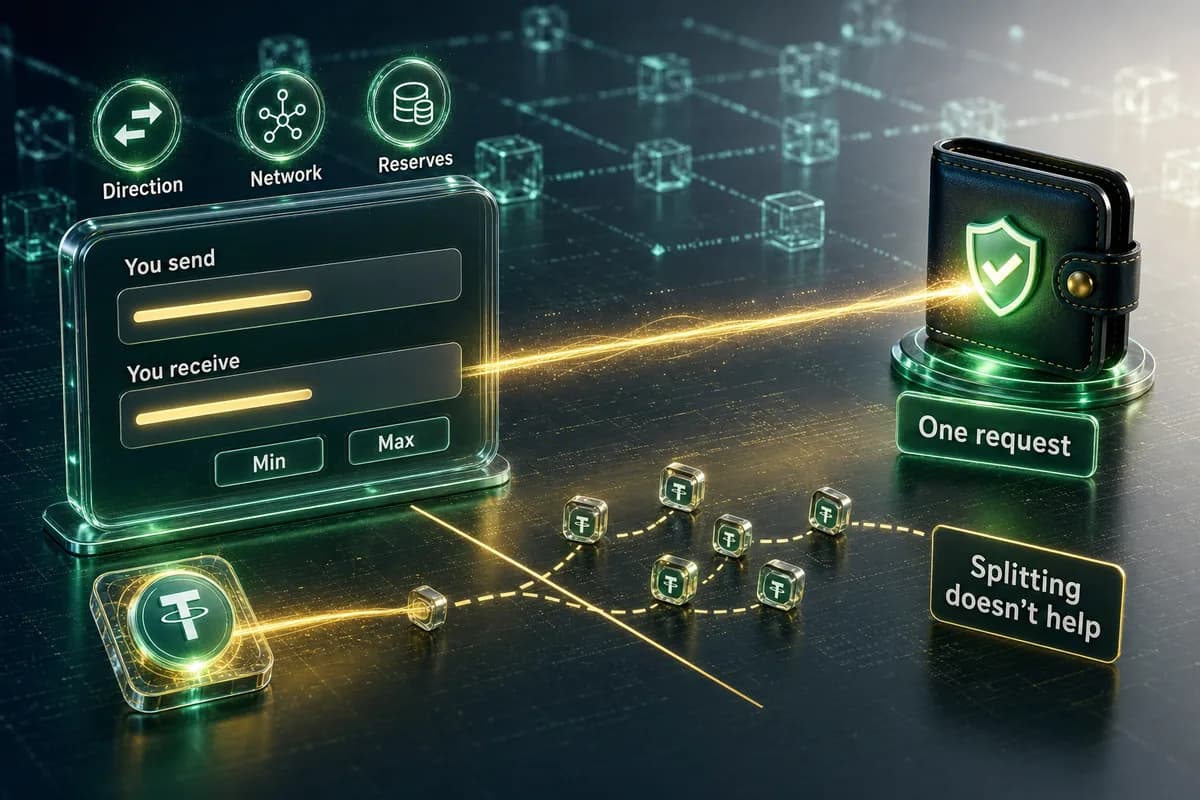
The topic of limits comes up for everyone planning to exchange a significant amount, and it most often boils down to how much can be exchanged without identity verification. It is worth starting with a distinction: a limit restricts the size of a request, while identity verification is triggered only by the risk score of the coins. These are two different mechanisms, and neither replaces the other.
Where the limits are shown. The minimum and maximum are shown right in the calculator, under the "You give" and "You receive" fields, and change immediately when you select a direction. They are visible before the request is created, including for cash exchanges. The figures are tied to a specific pair, and the service is entitled to change them without prior notice, so this article gives no values: they would go out of date faster than the text. The exchange calculator shows the current amounts for your direction.
What the limits depend on. On the exchange direction, the network used to transfer the assets and the available reserves. The limits for exchanging cryptocurrency to a card, for cash and for another coin differ, and cards, IBAN accounts and cryptocurrency each have their own requirements and fees. So the maximum USDT exchange amount is not a single figure but a set of values that depend on the combination.
The minimum amount. This is the threshold below which a request is not processed. If less than the amount specified in the request arrives at the address but it is still above the minimum, the exchange is recalculated based on the amount actually received. If it is below the minimum, processing is impossible. Check the minimum USDT exchange amount against your wallet's fee: when the fee is deducted from the transfer, less arrives at the address than you entered, so calculate the amount with a margin.
Amount and verification. A persistent belief holds that an exchanger asks for verification after a certain amount. The calculator has no such threshold, and the amount on its own does not trigger a passport request: identity verification is tied to the risk score of the coins. However, among the indicators the monitoring system reacts to is a sharp deviation from usual activity, for example a jump in volume compared with previous operations. With clean coins and usual volumes this does not happen.
Splitting a payment. The idea of breaking an amount into parts so as not to attract attention works the other way round. The terms explicitly prohibit splitting a payment into several transfers, and the AML policy treats a series of frequent small operations as one of the indicators that send requests for manual review. Instead of one simple request you get a chain in which any link can be suspended, and the client ends up exactly where they tried not to be – with attention on the operation. The bank sees the same picture: a series of small transfers looks atypical for an individual's account.
When the maximum is not enough. There is no universal way to increase the exchange limit: it is determined by the direction, the network and the reserves. It is more practical to compare neighbouring options in the same calculator. The maximum for a card, for cash and for exchanging into another coin may differ, and the values are visible as soon as you switch direction. One request for the full amount is simpler and more reliable than a series of several. It is worth checking the limit from time to time, because it may change.
Myths about anonymous exchange and what lies behind them
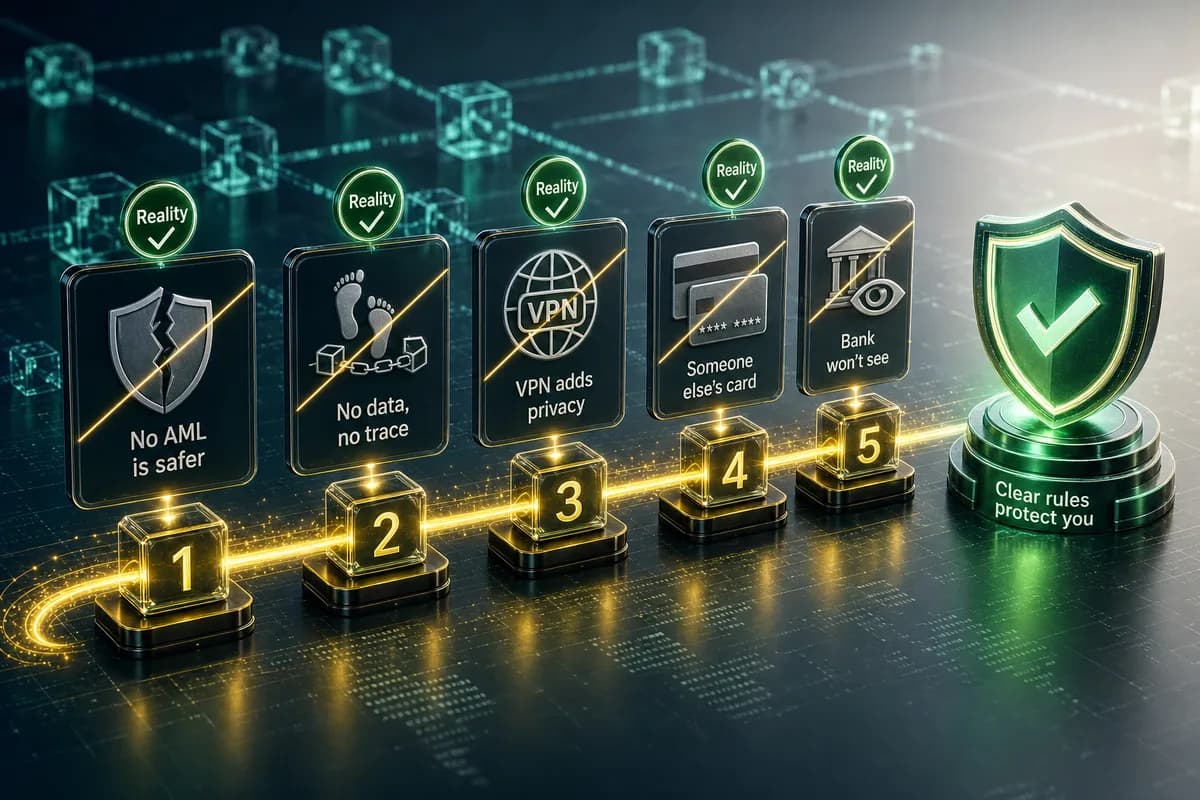
Ideas about anonymity in cryptocurrency exchange are pieced together from fragmentary information and often diverge from how services actually operate. The gap costs the client time and, in some cases, money. Below are the most common misconceptions: what exactly is claimed, how things really are and what this means for a safe cryptocurrency exchange.
"It's safer without AML": the risks of an exchanger with no checks. The absence of checks does not protect the client; it means there is no control over what funds pass through the service. An exchanger without AML accepts any coins, including assets with a risky history, and the consequences come later: funds that have passed through such a service may attract attention in subsequent operations. In addition, a service without monitoring, as a rule, has no terms, no refund procedure and no process for resolving disputed requests, which means that if something goes wrong, the client has nothing to rely on. This is what explains the increased risk of such platforms: it comes not from anonymity as such but from the absence of procedures that protect both sides. Scammers running exchangers are happy to exploit this myth: the phrase "no AML, no questions asked" attracts an audience convinced that the absence of rules means freedom.
"No data – no trace". A trace remains at three levels at once. The blockchain is public: the addresses, amounts and times of transfers are available to anyone. The bank records card transfers independently of the service. The service keeps the request in the account. Complete confidentiality does not exist in such an exchange: an ordinary operation provides privacy within reasonable limits, because in the usual case no passport is requested and nobody collects unnecessary data, but where there are lawful grounds, the chain is reconstructed from the blockchain and the parties' records. For a client with clean coins this changes nothing, but it is not accurate to call the exchange anonymous in the literal sense either.
"VPN and Tor add privacy". The AML policy treats the use of anonymisers as one of the indicators that can lead to an additional check of an operation, and the terms classify using a VPN to mask your location and registering with false data as a violation of the rules. Instead of privacy, such a tool has the opposite effect: it increases the likelihood of the request being checked and creates a risk of the account being blocked. An ordinary connection without anonymisers does not create these indicators.
"Paying with someone else's card will keep me private". The service does not accept third-party cards and payment details: payment is allowed only from a card belonging to the client, and this is exactly what the card verification confirms. The result of such an attempt is predictable: the request is cancelled and the funds are returned minus fees. No privacy is achieved, while time and part of the amount are lost.
"Anonymous coins make exchange easier". Monero, Zcash and similar assets were created to hide the amounts and participants of transfers. For an exchange service this means increased risk, which is why such assets are subject to an enhanced check of the risk score and the source of funds. If the check does not confirm that the coins have a clean origin, there will be no exchange. A safe cryptocurrency exchange is built on transparent assets, where every operation can be verified, not on coins that make verification harder.
"Without verification the bank won't see anything". The bank sees card transfers regardless of whether the service verifies your identity: this is its own data. Within the bank's permitted limits for individuals, ordinary operations do not trigger a reaction. What attracts attention are atypical patterns: a series of small transfers from different people, a sharp increase in the amount, immediate cash withdrawal. Which signals banks pick up and how to structure your operations to avoid unnecessary questions is covered in detail in the article "Card blocked over cryptocurrency transactions".
Trusting an exchanger that does not ask for documents up front. Whether such an exchanger can be trusted is not decided by the presence or absence of a form. Not verifying a client's identity during ordinary operations is a common and normal practice. The criteria of reliability are different: published rules and terms, a clear moment when the rate is fixed, a transparent calculation of the amount, a history of reviews, and working, verifiable contacts. All these criteria are covered in the article "How to choose a reliable cryptocurrency exchanger in Ukraine". Privacy remains achievable all the same. Next, let us look at which payout format offers the most of it.
Where privacy is greatest: cash pickup by code and other formats
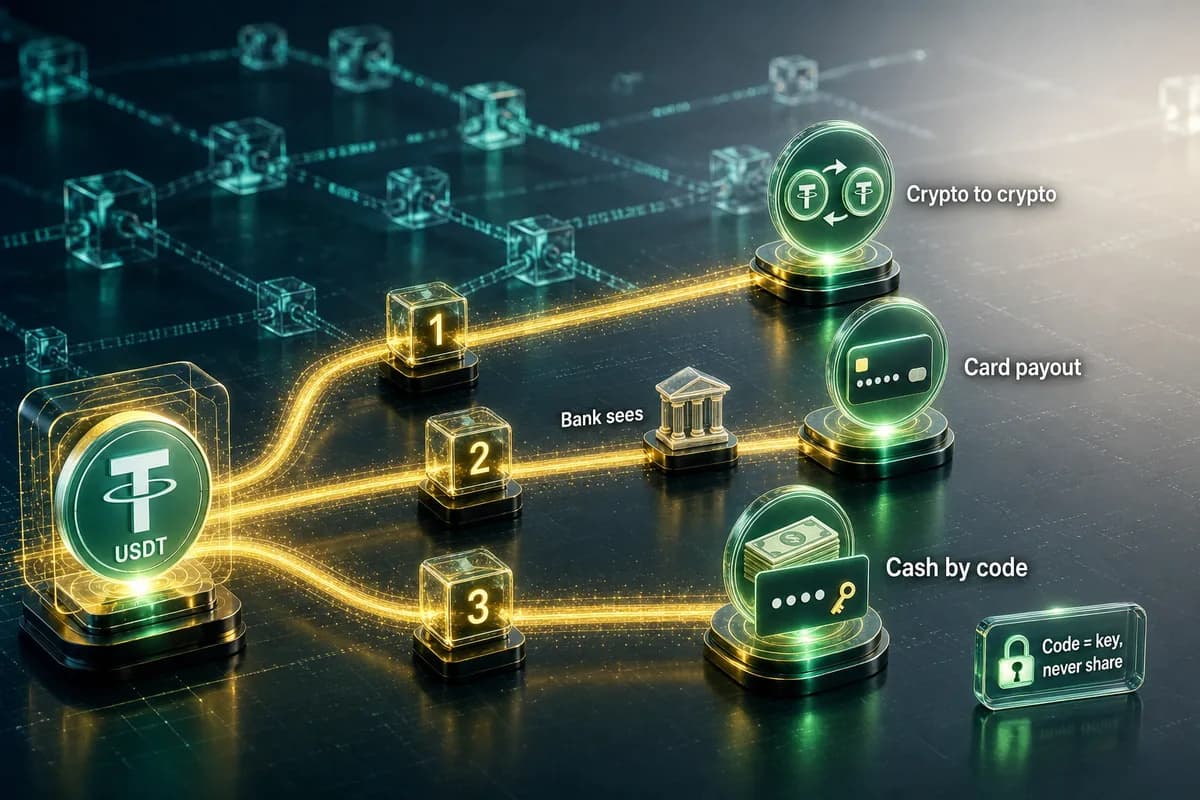
Anonymous cryptocurrency-to-cash exchange does not exist in the literal sense, but privacy in it is achievable. It is determined by how many parties see the operation and what exactly they know: the shorter the chain and the fewer the participants, the fewer the traces. This is the principle by which payout formats differ.
Cryptocurrency-to-cryptocurrency exchange. No bank and no fiat payment details are involved in the operation. The transfer is visible on the blockchain, like any other, and in the service's request. For a client who wants to keep the bank out of it, this is the shortest chain.
Withdrawal to a card. The payout goes through the bank, which records the incoming payment, its amount and time. At this stage privacy is determined not by the service but by the rules and capabilities of the bank itself.
Cash pickup by code. In this format the bank is not involved at all: there is neither a card credit nor a transfer between accounts. Cash is paid out when exchanging USDT TRC-20 in the cities on the list of directions. After the request is paid, a manager agrees the pickup point with the client, and the request details show the amount to be paid out, the address of the exchange point and the pickup code. The point does not belong to the service, no passport is requested at pickup, and no documents are needed. The client comes to the point specified in the request during the exchange point's working hours (the schedule is shown in the request details), and the money is handed over against the code. Payout formats, pickup points and the exchange procedure are described in detail in the article "Exchanging USDT for cash".
What remains in the system. The request exists in the account: the name and e-mail, the amount, the code and the statuses. No documents are requested, but this does not make the operation invisible. Privacy is achieved through a minimal set of data, not through its absence. If the competent authorities have lawful grounds to look into an operation, it can be reconstructed from the blockchain and the parties' records: this is how any financial system works. For a client whose coins raise no questions, this remains a theoretical possibility.
The code as the only key. The pickup code works as access to the money: whoever knows it can claim the payout. That is why it is never shared with anyone, including people who introduce themselves as service staff. The service never asks for pickup codes, passwords or two-factor authentication codes. This rule protects privacy more reliably than any technical measures. A minimal chain helps keep your privacy when exchanging cryptocurrency: the fewer intermediaries and intermediate payment details, the fewer parties know anything about the operation.
What happens to your data after verification and how to tell a genuine check from phishing
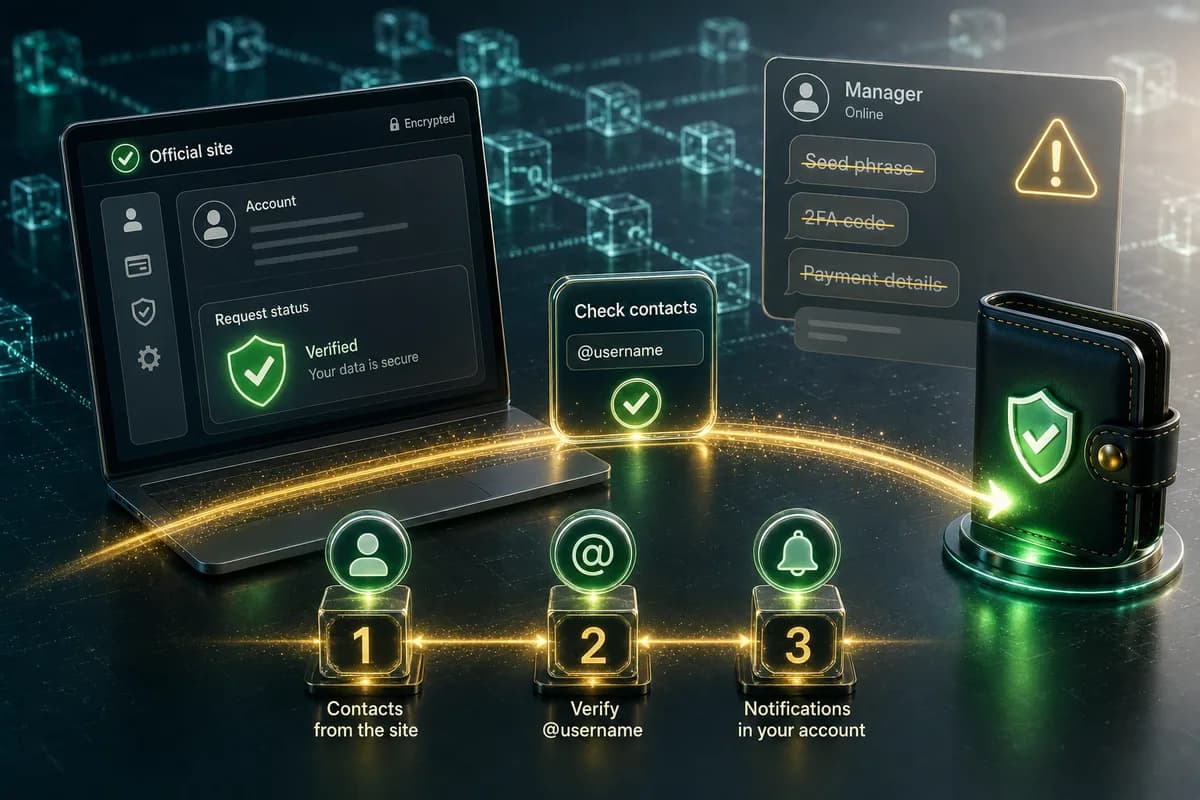
Privacy depends not only on how much data is requested but also on how it is handled and who else may try to obtain it. So the question has two parts: how the service uses the information and how not to hand it over to those who imitate a check.
What data the service collects. The list is given in the privacy policy: name and e-mail, request data (amounts, wallet addresses, card details where necessary), and technical data such as IP address, browser and device. They are used to process requests, protect against fraudulent operations and run the service, and they are not sold or shared for commercial purposes. Complete confidentiality does not exist in the financial system: data is needed for the service to work and may be provided upon a lawful request from the competent authorities. For a client whose coins raise no questions, this means the data is used in the normal way within the request.
Data protection. Data transmission is protected by encryption, and only authorised employees have access to personal data. On the client's side, protection is strengthened by two-factor authentication, which is recommended to be enabled at registration. The categories of data, the purposes of processing and users' rights are fully described in the privacy policy.
Is verification safe? The question of whether it is safe to go through verification comes down to whether the request is genuine. A check that comes from the service and is tied to your request is a normal working process. The threat arises when a check is imitated.
Verification phishing. Typical scenarios look like this: a message from a "manager" in a messenger urging you to pass a "mandatory check" via a link; a page that copies the service's interface and asks for a photo of a document, card details or codes; a "wallet check" asking for a seed phrase. The goal is the same: to obtain documents and access to funds. The deception relies on urgency and visual similarity: fake copies of support accounts differ from the original by a single inconspicuous letter or character.
What the service never asks for. Managers do not send payment details in Telegram: they are shown only in the request details on the website. Secret codes are not requested: two-factor authentication codes, account passwords or cash pickup codes. The manager plays a coordinating role and does not process payments manually via messengers. A seed phrase and a private key are not needed for an exchange either: the coins are sent to an address, and no access to the client's wallet is required for that. Any request from this list means a fake, no matter how convincing it looks.
How to check authenticity. Three steps cover almost all schemes:
- Take contacts only from the official website and, if necessary, open a chat yourself via the official contact and give your request number right away: this guarantees that you reach a member of the service's staff.
- Check the username of an account that contacts you on the contact verification page: just paste the @username and get the result instantly.
- Rely on notifications in your personal account and to the e-mail you registered with: request statuses are sent there, and messages from other channels demanding urgent action should be checked against these notifications.
With this set of checks, verification goes through without unnecessary risks. What remains is to look at how the asset itself affects privacy.
Privacy by type of cryptocurrency: how USDT, Bitcoin, Ethereum and anonymous coins differ
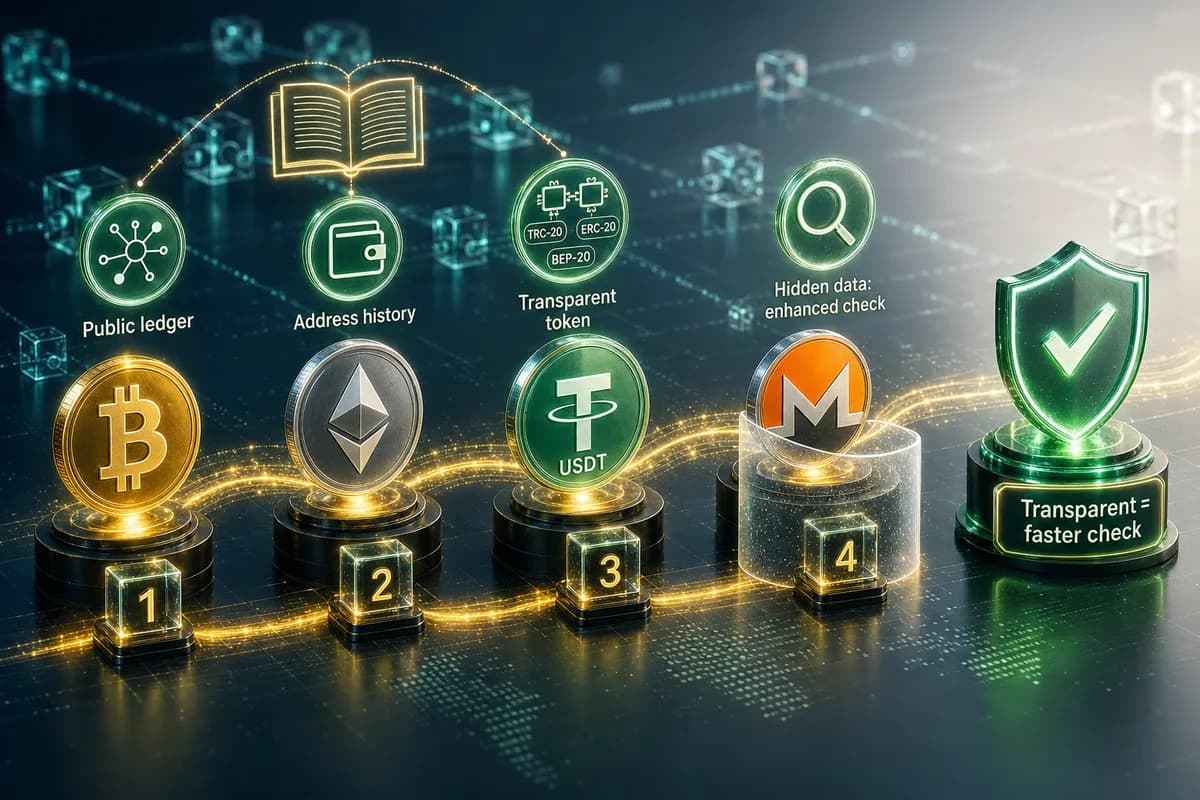
The level of privacy is determined not only by the service but also by the asset itself. The design of the blockchain sets what can be learned about an address and the movement of coins, and this determines how easy it is to assess their origin during an exchange. The more data is visible, the faster the check goes, and the more is hidden, the stricter the approach to it. That is why anonymity in cryptocurrency exchange needs to be considered by type of asset.
Bitcoin: a shared ledger and separate addresses. All Bitcoin transactions are public. Wallets, as a rule, create a new address for each incoming payment, which makes it harder to link payments to one another. But analytics groups addresses by the common inputs of a transaction: if one transfer spends funds from several addresses, they are attributed to a single owner. So the answer to the question of whether bitcoin is anonymous is no: it is pseudonymous, and privacy depends on address discipline. An address that is used repeatedly links together all the payments that have passed through it.
Ethereum and networks based on it: an address as accumulated history. Here the design is different: an address is an account with a balance and a full history of operations, and it is preserved for as long as you use it. Addresses on the ERC-20 and BEP-20 networks look the same and are controlled by the same key, so activity on these networks can be linked through a single address if someone wants to. The longer an address is used, the more is known about it: which addresses it interacted with, where the funds came from, how often operations were made.
USDT: a transparent token on several networks. USDT runs on the TRC-20, ERC-20 and BEP-20 networks and inherits each network's model, meaning the address history is open. The choice of network determines the fee and speed but does not affect privacy: on all three, transfers are public. USDT is not anonymous by design: the asset was created as a stable unit of account, not as a tool for staying hidden. In return, its verifiability makes assessing the origin quick, so a USDT exchange with a clean history goes through without additional questions. The article "What is Tether (USDT)" explains how the asset works and who issues it.
Anonymous coins: secrecy built into the protocol. Monero hides the sender, the recipient and the transfer amount by default. Zcash supports shielded transactions with encrypted data, but transparent addresses exist alongside them, and privacy there is optional. Dash has a transaction mixing mode, which is also enabled at the user's choice. What all three have in common: some of the data on which an origin assessment is based is deliberately unavailable. The list of privacy-enhanced cryptocurrencies is not limited to these three, but they are the ones most often meant when people talk about anonymous cryptocurrencies.
Why the type of asset affects the exchange. The risk score check is based on the history of the coins: analytics traces the path of the funds and assesses the address's connections. With transparent assets the whole path is visible, and the assessment takes mere seconds. With anonymous coins part of the path is hidden, and assessing the risk is difficult. That is why the AML policy provides for enhanced measures for such assets: in-depth analysis of the origin, additional identity verification and behavioural assessment. If the source of funds cannot be reliably established, the service is entitled to reject the operation. The practical conclusion for the client: a privacy-enhanced coin does not increase the privacy of the exchange but raises the likelihood of an additional check.
Asset privacy and client privacy. These are different levels. The secrecy of a coin relates to the blockchain, while the client remains the same: the account, the request and the payout details do not depend on the chosen coin. That is why transparent assets with a clear history are the right choice for an exchange with a minimum of questions. A comparison of BTC, USDT, ETH and TRX by liquidity and use cases is given in the overview of popular cryptocurrencies for exchange.
How to use these differences in practice:
- For payments and withdrawals to fiat, choose transparent assets with a known origin: USDT, Bitcoin, Ethereum.
- In Bitcoin, the wallet itself issues new addresses for incoming payments, and that is normal. Keep a separate wallet for exchanges that is not used for other payments.
- On networks with a permanent address (Ethereum, TRON and those compatible with them), set aside a separate address for exchanges so that your exchange history does not mix with personal operations.
- When dealing with anonymous coins, allow for an enhanced check of their origin: the timing and the outcome depend on its result.
User privacy: how it differs from invisibility and how to keep it after an exchange

Most people take the word "anonymous" literally: you made an exchange, and no one will ever find out you were involved. Cryptocurrency exchange does not deliver that result, and expecting invisibility leads to mistakes: users relax where they need to ensure privacy themselves and worry where there is no danger. Anonymity in cryptocurrency exchange and user privacy are different things. Privacy is the ability to decide who knows what about you, and how much.
What trace remains after an exchange. The operation is recorded in several independent places at once. The blockchain stores the addresses, amounts and time of the transfer. The bank, if it is involved in the operation, sees its own segment: a card credit or debit. The service keeps the request in the account: name, e-mail, addresses, statuses and technical connection data, including the IP address and browser information, as stated in the privacy policy. Finally, the user also leaves a digital trace: correspondence, screenshots, wallet history. These records belong to different parties and are not linked to one another by themselves. This separation is what privacy rests on: it is based on the fragments being stored separately, not on their absence.
Three parameters of privacy. It is convenient to assess it by three indicators: the circle of those who know anything, the amount they know, and the possibility of linking scattered pieces of information together. The first two are limited by the nature of an ordinary operation. The third depends almost entirely on the user. It is enough to link an address to a name once, for example by publishing it on a personal page or sharing it in an open chat, and the entire history of that address becomes the history of a specific person. This happens not at the moment of the exchange but in the habits around it.
Where privacy is lost in practice:
- the wallet address is published under your own name: in a profile, a comment or on a payment page;
- one address is used for personal payments, work settlements and exchanges: the histories mix, and any part of them can be used to reconstruct the rest;
- screenshots of the request end up in open chats or with outsiders: they show the address, the amount and, for a cash payout, the pickup code;
- details of operations are discussed in public channels: such messages are read not only by the participants of the conversation but also by those looking for victims for fraud schemes;
- one e-mail is used for all services: it becomes a common identifier through which accounts are linked to one another;
- unexpected micro-transfers arrive at the address: they are sometimes sent to match addresses based on your response, and there is no need to interact with them.
What makes privacy sustainable. The foundation is separation. A separate address is set aside for exchanges and used consistently, but only for that purpose, while personal and work operations go through other addresses. The address is not published or shared unless necessary. A separate e-mail with two-factor authentication is created for accounts on services, and passwords are not reused across services. Protecting the funds themselves is just as important: the seed phrase is stored only offline, never forwarded and never photographed. Safe storage of cryptocurrency and the different types of wallets are covered in the article "What is a crypto wallet and how to choose a reliable one". General rules for handling addresses during transfers are collected in the article "How to avoid losing cryptocurrency during a transfer: 7 essential rules".
Correspondence and request materials. The status and details of the request are available in your personal account, so there is no need to forward them to third-party channels. If a screenshot is still needed, remove the address and the pickup code from it. Questions about the request are discussed in a private conversation, not in group chats or in comments under posts: protecting personal data when exchanging cryptocurrency starts with keeping payment details out of places where anyone can read them.
Privacy and your own records. Privacy does not require destroying the traces of your operations. It is worth keeping your request history and confirmations for yourself: if the bank or another party has a question about the origin of funds, an exchange you can prove remains your argument. Privacy protects you from outsiders, not from those who are entitled to ask questions within the law, and that is exactly how it should be understood: as control over who knows what, not as an attempt to hide the very fact of the operation.
The practical meaning of the word "anonymous". In an exchange, it means a limited circle of informed parties and a minimal set of data, not the absence of a trace. This level is set by the exchange format itself and maintained by the user's habits: separate addresses, private correspondence and careful handling of payment details. This way, user privacy stays predictable and does not depend on how many people have seen the request.
How to choose an approach for your task: scenarios and steps

Private cryptocurrency exchange does not come down to a single method: the right format is determined by two things – from whom exactly privacy needs to be kept and what amount goes through the operation. Outsiders, the bank and the service's records see different parts of the chain, so the measures for each party are different too. Below are four typical scenarios and what matters in each of them.
A one-off exchange of a small amount. For such an operation, registration with a name and an e-mail is enough. Identity verification is not requested. If you pay in hryvnia with a bank card, it is confirmed once that the card belongs to the client: this requires a document (a passport or a driving licence) and a photo with the card. The bank sees only its own segment of the chain, the blockchain remains pseudonymous, and your identity is not revealed to outsiders. A confidential USDT exchange in this scenario requires no additional measures. It is enough to check the final amount in the calculator, the network and the address specified in the request itself.
Regular exchanges. With recurring operations, privacy is determined by the consistency of your actions. It is best to work with a single account: the terms prohibit multiple accounts and sharing access with third parties. It is better to keep one permanent wallet for exchanges: the AML policy lists frequent changes of addresses and payment instruments without an apparent reason among the indicators that require additional analysis. Two-factor authentication is enabled right away, and the connection stays ordinary, without a VPN. The request history is kept in your personal account. Such a profile looks predictable, and neither the service nor the bank has grounds for extra attention.
A significant exchange amount. With a substantial amount, two factors come to the fore: the origin of the coins and the payout format. The history of the coins determines the risk score, and that determines whether the request goes through without stops, so only send assets whose origin is known. The payout format is chosen according to the task. If the bank has to stay outside the operation, cash pickup by code or an exchange into another cryptocurrency is suitable. Withdrawal to a card adds the bank's segment of the chain with all its rules. The minimum and maximum are checked in the calculator before the request is created, and the amount is submitted in a single request, without splitting it into parts: a series of small operations is one of the indicators that send a request for manual review.
Receiving cash. This is the format with the fewest participants. No bank is involved in the operation, no passport is requested at pickup, and the exchange point does not belong to the service. After payment, the request details show the amount to be paid out, the address of the point and the pickup code, and the point's opening hours are shown there too, so the visit can be planned in advance. Only the request itself remains in the system, in the account. The pickup code works as the only key to the money: it is not shared or disclosed to anyone, including people who introduce themselves as service staff.
Privacy with respect to different parties. It is convenient to divide it into three levels, because the measures differ:
- Outsiders. The blockchain is public, and protection comes down to not linking your address to your name: do not publish addresses, do not forward documents and screenshots of requests to open chats, and do not reveal payment details to third parties.
- The bank. It sees card transfers independently of the service. Its involvement can be excluded by formats without a banking segment: exchange into cryptocurrency and cash pickup by code.
- The service's records. A request and an account always exist. Privacy here is achieved through a minimal set of data, not through its absence.
Checks before creating a request. Whatever the scenario, the steps are the same:
- The origin of the coins is known and raises no questions.
- The payout format matches your privacy goal.
- The minimum and maximum have been checked in the calculator, and the final amount has been verified.
- The card is in your name, and the address and network are taken from the request.
- The rules and terms have been read before confirming: you agree to them by ticking a checkbox when creating the request.
Typical failures that most often occur at these steps, from choosing the wrong network to substituted payment details, are collected in the article "Top crypto exchange mistakes". The easiest way to assess the reputation of the service itself is through the history of client reviews: they show how requests go in practice and let you compare the stated conditions with the real ones.
Privacy in an exchange is determined not by the absence of traces but by control over who knows what about you. It is achieved through a short chain, transparent coins and discipline in the details, and then the exchange goes through without stops or unnecessary requests.
