
Solana (SOL): the speed and low fees of a new-generation blockchain
The crypto market has long stopped being a territory reserved for traders and enthusiasts. Today’s users need networks where a transfer is confirmed within seconds and the fee does not eat a noticeable share of the amount. This demand is exactly what Solana (SOL) grew on – a blockchain often called one of the fastest public networks. In this article, we look at how Solana works, why its transactions cost fractions of a cent, what the Alpenglow upgrade changed in autumn 2026, what is happening in the network’s ecosystem, what the risks are, and how to exchange SOL for hryvnia in practice.
What Solana is and why it was created
The idea behind Solana belongs to Anatoly Yakovenko, a former Qualcomm engineer who published the technical paper for the future network in 2017. The mainnet went live in March 2020. The Solana Foundation supports the ecosystem, and since 2024 the main validator client has been developed by Anza, a company spun out of Solana Labs. From the very beginning, the team set itself a goal that seemed almost impossible at the time: to build a blockchain able to process thousands of transactions per second without losing reliability and without moving part of the activity to additional scaling layers.
The network is named after Solana Beach, a coastal town in California where the project’s founder lived. From a small experimental blockchain, Solana has grown into one of the most prominent platforms in the industry, with a large community of developers and users around it. The general principles of distributed ledgers are covered in our article on blockchain and its role in cryptocurrency.
The blockchain scalability problem. Early blockchains deliberately chose security and decentralization at the cost of speed. Bitcoin processes about seven transactions per second, and Ethereum’s base layer a few dozen. During periods of high demand, this led to queues and sharp fee spikes. Experts call this the “blockchain trilemma”: it is extremely hard to deliver high speed, strong security and genuine decentralization at the same time. Solana takes its own path – optimizing the layer-1 architecture itself instead of building add-ons on top of a slow foundation.
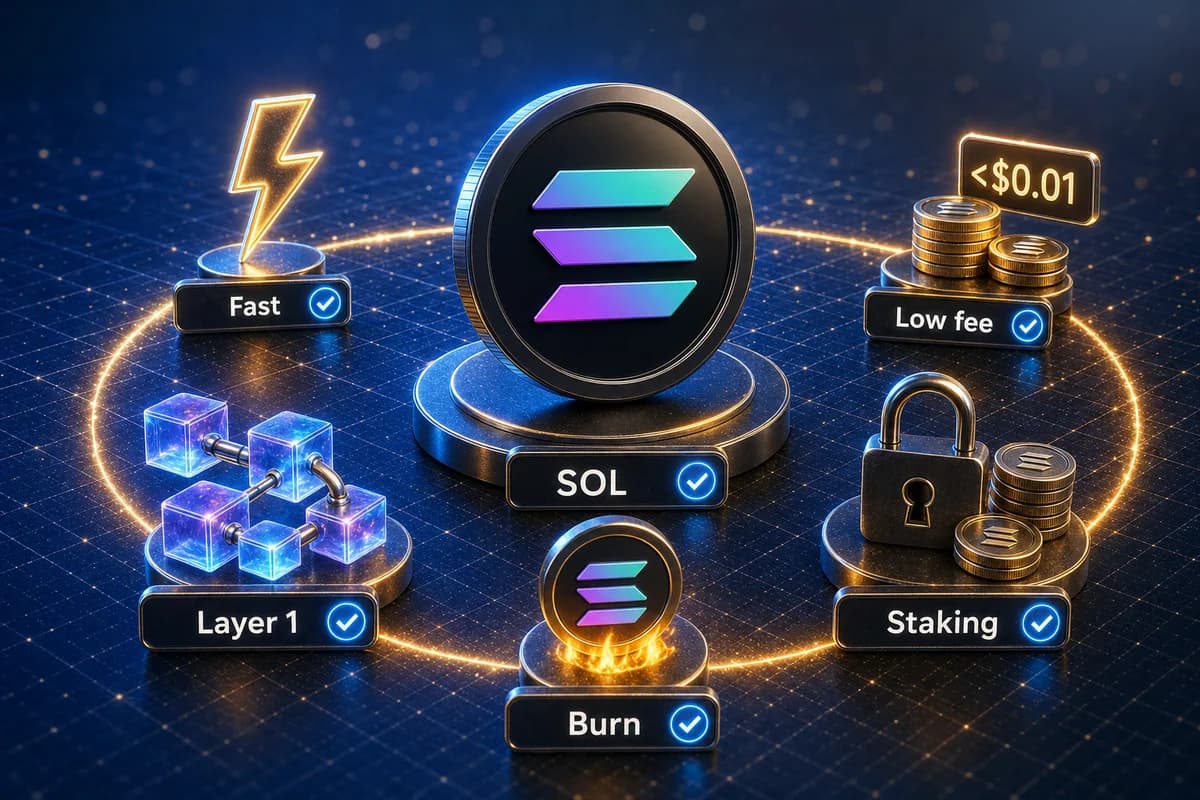
The role of the SOL token. SOL is the network’s native cryptocurrency. It is used to pay transaction fees, it is locked in staking to secure the network and earn rewards, and token holders take part in votes on key protocol changes. The smallest unit of SOL is called a lamport (1 SOL equals one billion lamports), named after Leslie Lamport, a pioneer of distributed systems theory. SOL is one of the best-known and most highly capitalized cryptocurrencies on the market, so it is easy to find on exchanges, in wallets and at exchange services.
Half of the base fee of every transaction is burned, meaning it is permanently removed from circulation, and the other half goes to the validator. As a result, SOL works both as a means of payment and as a tool for taking part in the network’s economy, not just as an object of trading.
How Solana works: Proof of History, Proof of Stake and Alpenglow
Solana’s main technical distinction since launch has been Proof of History (PoH). In most blockchains, nodes constantly have to agree on when exactly a given event happened, and that takes precious time. Solana solved the problem differently: the network creates a cryptographically verifiable “clock” that records the sequence of events. Every transaction gets a timestamp in a single chronology, so validators do not need to spend resources agreeing on the order – it is already known and easy to verify.
Put simply, PoH is a sequence of hashes in which each next value depends on the previous one. Such a chronology cannot be forged without recalculating the entire chain, so the timestamps remain reliable and do not require constant coordination between nodes. This is what allowed the network to produce new blocks roughly every 400 milliseconds.
Proof of Stake and validators. PoH does not replace consensus – it complements it. Network security is provided by the Proof of Stake model: validators lock SOL in staking, verify transactions and vote on blocks. The more coins are staked and the more widely they are distributed, the harder it is for an attacker to influence the network. Ordinary holders can delegate their SOL to validators and receive part of the rewards without running their own node. That is why the number of validators and the distribution of stake are considered key indicators of Solana’s “health”.
Alpenglow: new voting and finality. From the mainnet launch in 2020, validator voting was handled by the Tower BFT protocol, and it took around 12–13 seconds for a block to be finally confirmed. On 21 October 2026, the Alpenglow upgrade was activated on mainnet – the biggest protocol change in Solana’s history. Its first part, Votor, replaced Tower BFT: validators now vote directly, and the target finality time has dropped to about 150 milliseconds. The second part, Rotor, is meant to replace the Turbine block propagation protocol, but there is no firm launch date for it yet. Independent measurements of real-world speed after the upgrade are still being collected, so 150 milliseconds is the developers’ target rather than a figure guaranteed at every moment.
For the user, the difference between block time and finality matters. A block is the moment a transaction enters the chain. Finality is the moment it can no longer be reversed. The shorter the finality, the sooner the recipient – including a crypto exchange service – can safely treat the transfer as complete.
Sealevel, Turbine and other speed components
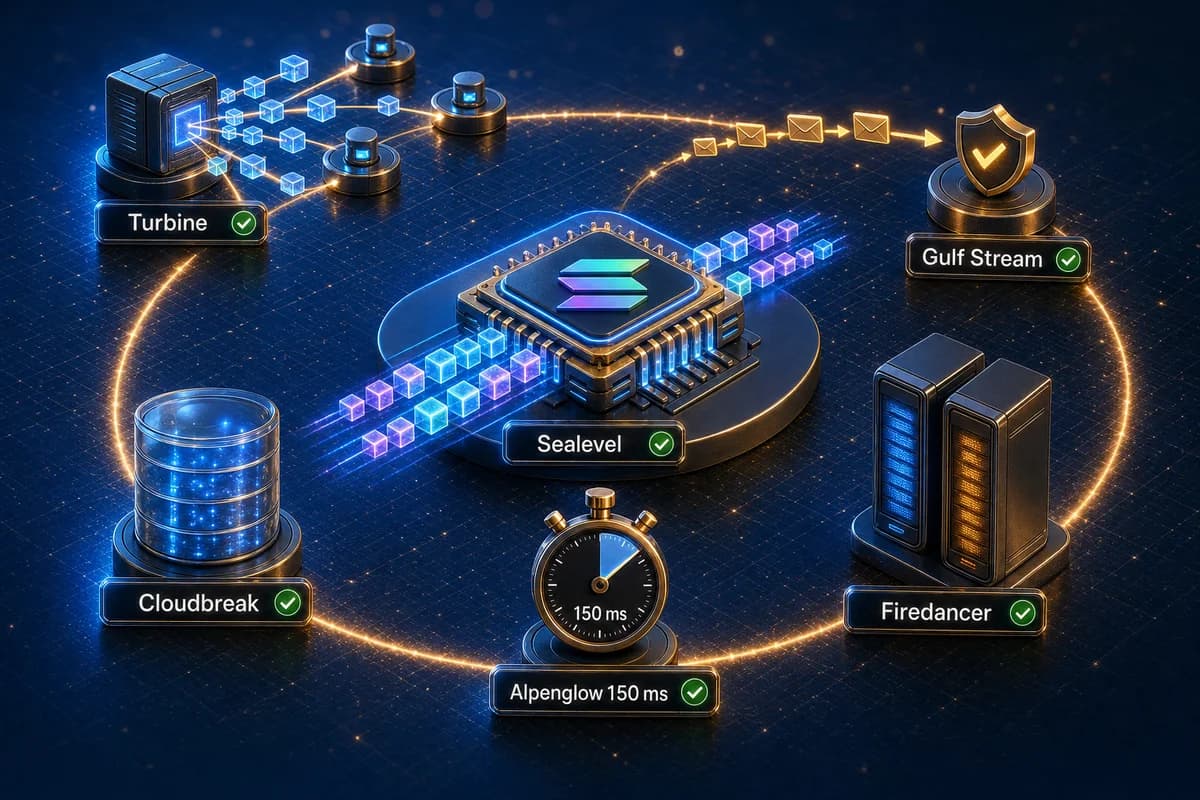
Sealevel and parallel transaction processing. Most blockchains process operations sequentially, as if in a single queue at a checkout. Solana’s Sealevel engine works differently: every transaction declares in advance which data it will access. If operations do not touch the same accounts, the network executes them in parallel, using several processor cores. For the user, this means heavy activity in one application does not necessarily slow down the rest of the network.
This model requires smart contract developers to describe in advance which accounts an operation involves. It is an extra constraint during development, but it brings a significant gain in speed and lets the network make efficient use of modern hardware.
Turbine, Gulf Stream and Cloudbreak. Speed also relies on several supporting solutions. The Turbine protocol splits block data into small packets and passes them between nodes peer to peer, which reduces the load on communication channels. Gulf Stream lets transactions be forwarded to validators even before a block is formed, and Cloudbreak optimizes how account data is stored. Individually, these technologies look complex, but together they work as a single system tuned for minimal delays.
Firedancer and client diversity. For a long time, almost all Solana validators ran a single software client, and a bug in it could halt the entire network. The independent Firedancer client from Jump Crypto is already running on mainnet: the full version and the hybrid Frankendancer together secure a noticeable share of the stake. The more different clients there are on the network, the lower the chance that a single bug affects every participant at once.
Solana’s speed: numbers and real-world performance
The developers claim a theoretical throughput of up to 65,000 transactions per second, while in real use the network consistently handles thousands of operations. Overall statistics often include validators’ voting transactions, so comparisons between blockchains should be made with care. For the user, the practical side matters much more: a transfer on Solana is confirmed in seconds, not minutes.
An approximate comparison of popular networks looks like this:
- Bitcoin – about 7 transactions per second, a block roughly every 10 minutes, fees depend on network load;
- Ethereum (base layer) – 15–30 transactions per second, a block roughly every 12 seconds, fees from cents to a few dollars and more at peak times;
- TRON – hundreds to thousands of transactions per second, a block roughly every 3 seconds, transfer cost depends on “energy” and bandwidth;
- Solana – thousands of transactions per second (theoretically up to 65,000), a block roughly every 400 milliseconds, finality after Alpenglow – a target of 150 milliseconds, fees – fractions of a cent.
All figures are approximate and change with network load; up-to-date statistics are published by block explorers.
For crypto exchange, speed has a direct practical meaning: the client does not have to wait hours for confirmation, and the order moves to payout faster. That is why networks with short confirmation times are increasingly chosen for regular deposits and withdrawals.
Low fees as Solana’s main advantage
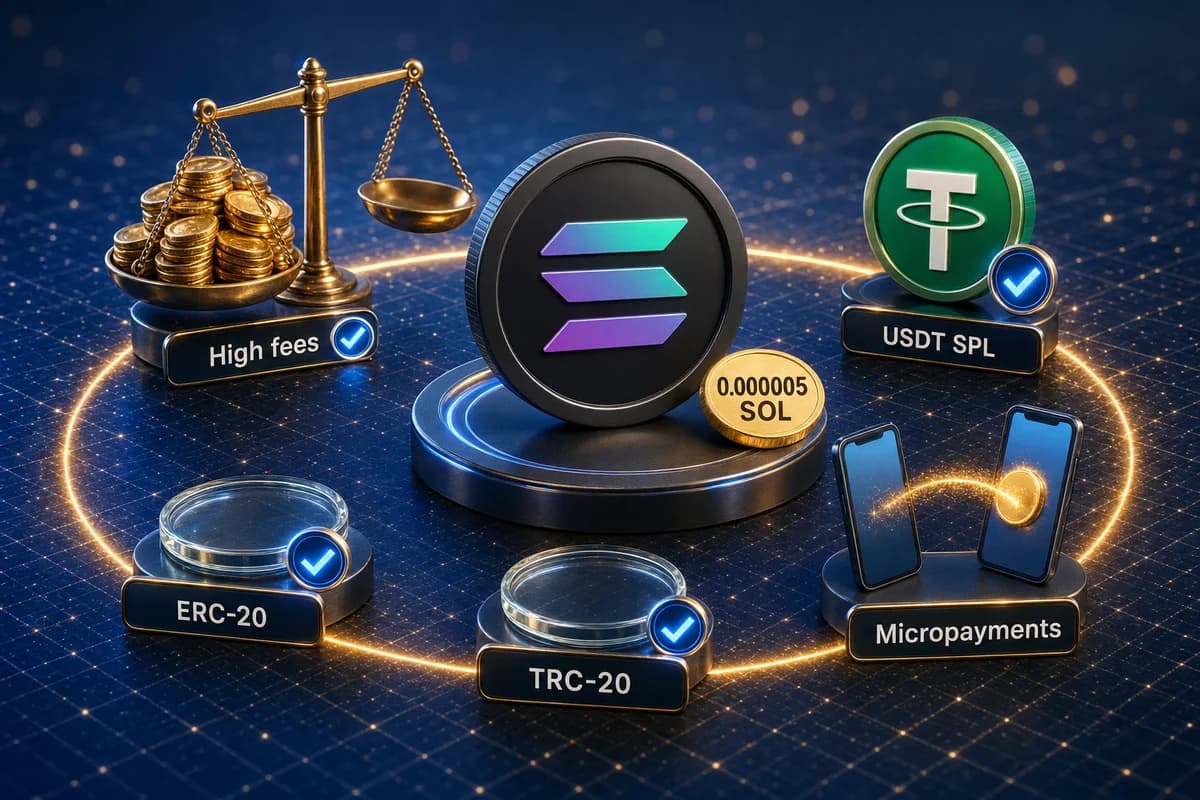
The base fee on Solana is 5,000 lamports per signature, or 0.000005 SOL. In dollar terms, this is usually a fraction of a cent, even when the SOL price rises significantly. Under heavy load, the sender can add a priority fee to get the transaction into a block faster, but for an ordinary transfer it usually stays tiny as well. By comparison, at peak periods in past years an Ethereum transaction could cost tens of dollars. Such a difference fundamentally changes the rules of the game for small amounts and frequent transfers.
The base fee does not depend on the transfer amount: sending the equivalent of 10 dollars or 10,000 costs the same. For the user, this is a predictable model that makes costs clear in advance.
What this gives users. Low fees open up options that are not viable on expensive networks: micropayments, regular transfers, active use of decentralized applications, and sending small amounts to friends and family. For businesses, these conditions make it possible to process large volumes of payments without budgeting heavily for network fees. The more often you move funds, the more noticeable the accumulated difference compared with more expensive networks.
Comparison with ERC-20 and TRC-20. Ukrainian users most often deal with the TRC-20 and ERC-20 networks when transferring USDT. The first is popular thanks to its relatively low costs, the second thanks to its wide recognition and compatibility, but it is noticeably more expensive. Solana offers a third option: stablecoins in the SPL token format move quickly and almost for free. So for those who move funds regularly, the choice of network becomes a matter not just of convenience but of real savings. For more on the networks USDT exists on and how they differ, see our article on Tether (USDT).
An important detail: even when transferring stablecoins on Solana, your wallet needs a small SOL balance, because that is what pays the fee. Without it, the transaction simply will not go through, so keep a few hundredths of a coin in your account in advance.
The Solana ecosystem: DeFi, NFTs and memecoins
DeFi protocols and decentralized exchanges. A wide decentralized finance ecosystem has grown around Solana. It includes decentralized exchanges and aggregators such as Jupiter, Raydium and Orca, liquid staking protocols such as Marinade, and lending platforms. Low fees make it possible to carry out dozens of operations without noticeable network costs, and fast confirmation makes working with protocols more convenient. If you want to understand the concept itself in more depth, read our article on DeFi and decentralized finance.
A user can swap tokens, provide liquidity or take out a loan simply by connecting a wallet. At the same time, all responsibility for keeping keys safe and acting correctly lies with the user, so it is wise to approach DeFi gradually and with small amounts.
NFTs and Web3 applications. Solana has become one of the main platforms for NFTs: minting and trading digital collections here costs far less than on networks with high fees. The Magic Eden and Tensor marketplaces have gathered a large community of collectors, and developers of games and social apps increasingly choose Solana for blockchain features. Beyond collectible art, NFTs on Solana are used for tickets, community membership cards, in-game items and digital proofs of attendance at events. We explained how such tokens work in detail in our article what is an NFT. The NFT market remains volatile: interest in individual collections rises sharply and fades just as quickly, so such assets should be treated with caution.
Memecoins on Solana. Token launch platforms such as Pump.fun have made creating a new coin a matter of minutes, and the network has become one of the main hubs for memecoins. This attracts a huge flow of users but calls for caution: alongside popular projects there are many empty tokens and schemes built to enrich their creators quickly, up to a classic rug pull. The value of many memecoins rests solely on community attention, so sharp rallies are often followed by equally sharp falls. Experienced users advise checking who controls most of the tokens, whether liquidity is locked and how long the project has existed, and never investing more than you can afford to lose. Learn more about this segment in our memecoin overview.
Stablecoins and payments on Solana
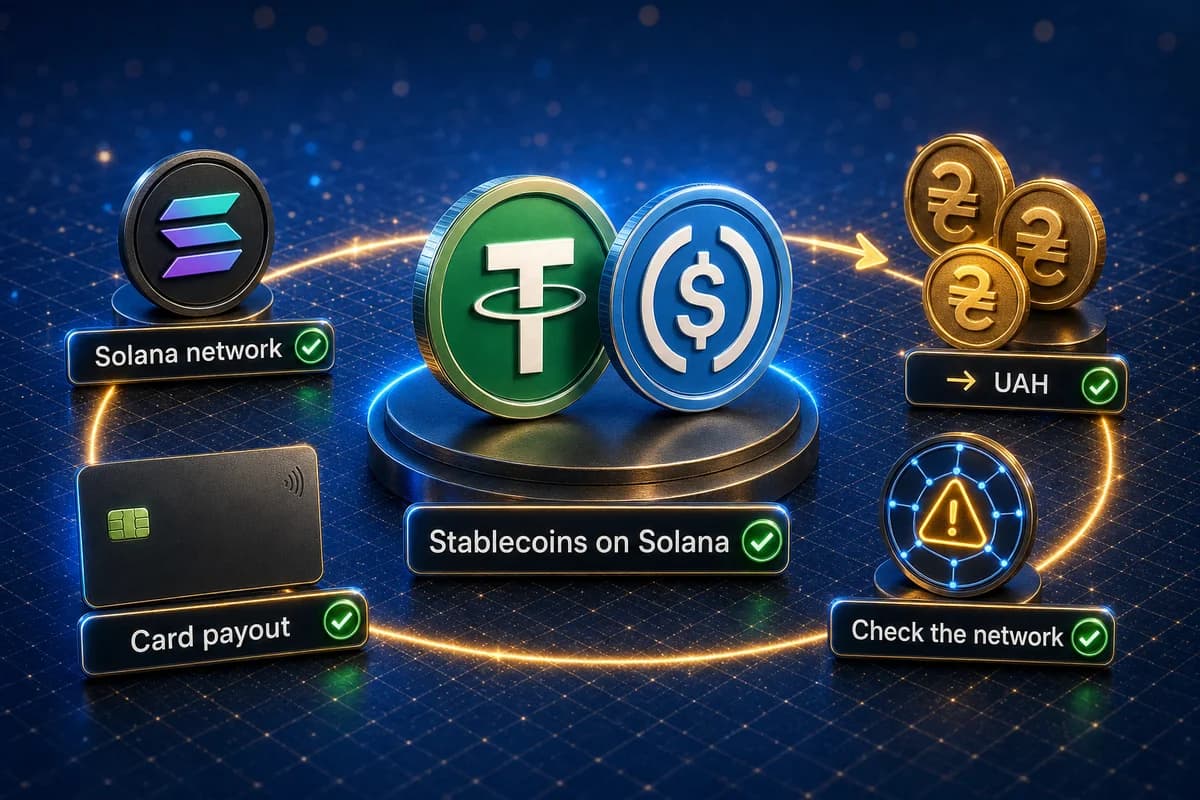
USDT and USDC are available on Solana as SPL tokens, and major payment companies are testing and rolling out stablecoin settlements on exactly this infrastructure. For users, this means fast and cheap transfers of digital dollars. That is why Solana is increasingly seen not only as a venue for speculative activity but also as a convenient payment layer for everyday use.
This is especially relevant for Ukrainian users: a stablecoin transfer on Solana feels like a fast electronic payment, but without being tied to banking hours. Once digital dollars are in the wallet, a person can keep them as savings, use them for payments or exchange them for hryvnia. At Coinmoneyhub, USDT and USDC on Solana can be exchanged for hryvnia straight away with a payout to a Ukrainian bank card, and USDT (SOL) can also be paid out to an IBAN account. We explained how such an exchange works and what to look at when choosing a rate in our article on how to sell USDT for hryvnia.
Before every transfer, make sure you have selected the Solana network: the same stablecoin exists on several networks, and a TRON or Ethereum address looks completely different from a Solana address. Sending to the wrong network is one of the most common reasons funds are lost.
Risks and weaknesses of Solana
Outages and network halts. The network has experienced halts and periods of instability, especially in 2021–2022, and the last full halt happened in February 2024. The team responded with client software updates, better load management and new congestion-protection mechanisms, and the launch of Firedancer has reduced the network’s dependence on a single client. There have been no full halts since then, but the history of outages remains an argument for caution, especially for large transfers during periods of heavy demand. For the user, an outage means a temporary inability to send or receive funds. In such a situation, do not panic and do not repeat the transfer several times in a row: it is better to wait for the network to recover and check the transaction status in a block explorer.
The decentralization question. Hardware requirements for Solana validators are high, which makes it hard for small participants to run a node. Critics point to the concentration of stake among a limited number of large validators. Supporters of the network respond that the number of participants keeps growing and that a second independent client makes the network more resilient to bugs in any single piece of software. The debate has no simple answer: high hardware requirements deliver speed but narrow the circle of those who can run a node. Solana deliberately trades some ease of entry for validators for performance, and everyone decides for themselves how acceptable that is for their needs.
User security. The most common threats to Solana users come not from technical flaws of the network but from the human factor: phishing sites, fake tokens appearing in a wallet, and requests to sign suspicious transactions. To protect your funds, never share your seed phrase with anyone, check addresses before sending, do not follow suspicious links, and use hardware wallets for large amounts. Useful tips are collected in our article on seven rules that help you avoid losing crypto during a transfer, and choosing a wallet is covered in how to choose a reliable crypto wallet.
Pay special attention to the permissions you grant to decentralized applications: after connecting a wallet, check what exactly you are signing, and periodically revoke access for services you no longer use. For regular operations, it is convenient to have two wallets: a main one for storage and a separate one for experimenting with new projects, holding only small amounts.
Solana compared with Ethereum, TRON and TON
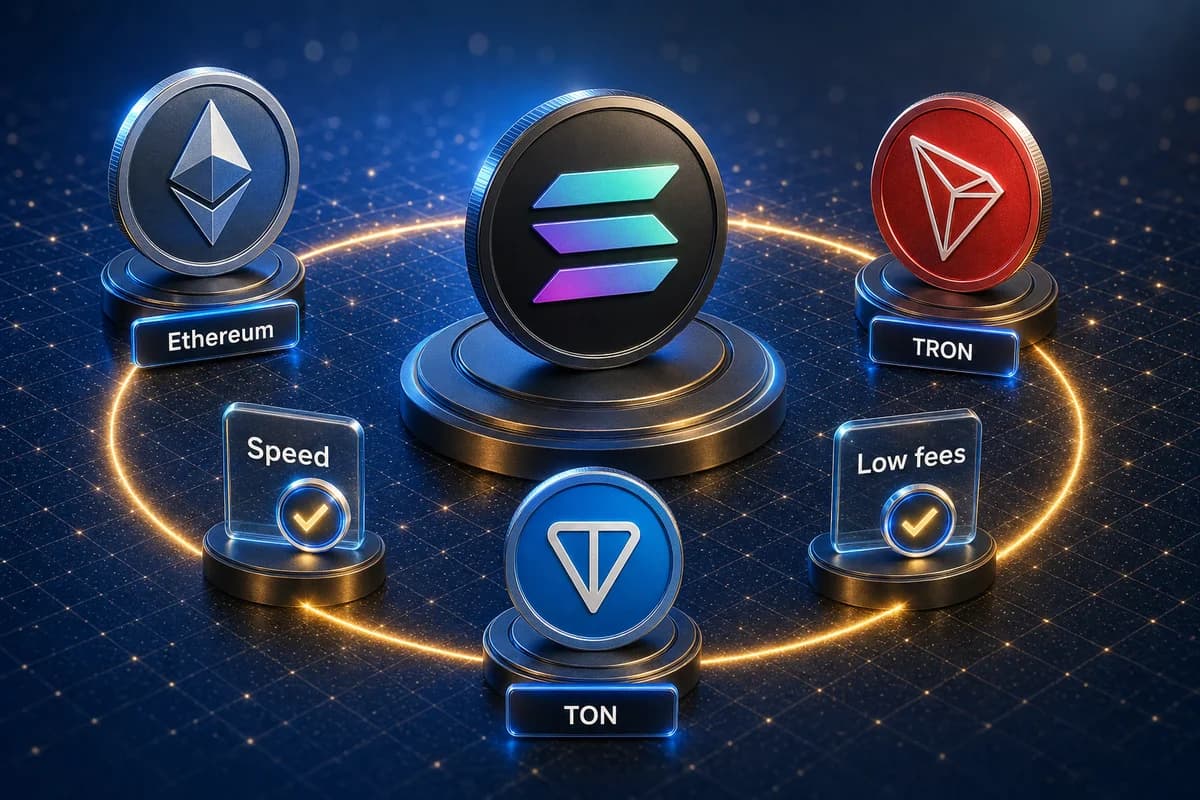
Each popular network has its own specialization. Ethereum remains the largest smart contract ecosystem with a high level of decentralization, but its base layer falls behind in transfer speed and cost, so it scales through layer-2 solutions. TRON became popular thanks to USDT transfers: the TRC-20 network is the one Ukrainian users most often choose for stablecoin exchange. TON is closely tied to Telegram and is building an ecosystem of apps inside the messenger. Solana, in turn, offers high speed and minimal fees on layer 1 and focuses on DeFi, payments and mass consumer services.
There is no universal “best” network: the choice depends on the task. For daily transfers of small amounts Solana looks attractive, for complex financial protocols many choose Ethereum, and for simple USDT transfers TRON remains relevant. You can read more about other networks in our articles on Ethereum, on the TRON network and the TRX coin and on the TON token.
For a user who simply transfers funds and exchanges them for hryvnia, what matters most is the fee, the confirmation speed and whether the chosen service supports the network. These are the parameters worth comparing before choosing a network for a specific transfer.
How to get SOL and exchange it for hryvnia
Where to get SOL. You can buy SOL on a cryptocurrency exchange or swap another cryptocurrency for it at a crypto exchange service. At Coinmoneyhub, you can get SOL in exchange for USDT, bitcoin, ether and other coins – for example, via the SOL to USDT TRC-20 direction and the reverse one. An exchange service is simpler than an exchange: there is no trading interface to learn and no orders to place – you just choose a direction and enter an amount. Read more about this approach in our article how to buy cryptocurrency without an exchange.
Exchanging SOL for hryvnia via Coinmoneyhub. You can sell SOL with a hryvnia payout to a Ukrainian bank card: Monobank, PrivatBank, PUMB, Oschadbank or any Visa or Mastercard card. The exchange takes four steps:
- in the calculator, choose the SOL → hryvnia direction for your bank’s card, enter the amount and create an order;
- receive the payment details – the address for sending SOL on the Solana network;
- send SOL to that address;
- receive hryvnia on your card once the transaction is confirmed on the blockchain.
The rate is fixed at the moment your SOL arrives, and the amount you will receive, the minimum amount and the payout fee are shown in the calculator before you create the order. If you send less than stated in the order, the payout is automatically recalculated based on the amount actually received. Registration takes a minute – a name and an e-mail are enough – and no identity verification is required to sell SOL.
Your main protection is the address and network from the order. Send SOL only on the Solana network and only to the address shown in your order: a transfer on another network may lead to the loss of funds. If you are sending SOL from an exchange, choose the Solana network when withdrawing as well, and keep in mind that the exchange charges its own withdrawal fee. Check your card number carefully before creating the order – a mistake in the details will delay the payout.
Exchange security and transparency. A reliable service openly publishes its terms and explains why checks are needed. At Coinmoneyhub, the exchange rules are available on the website at any time, support works daily from 08:00 to 24:00, and all operations go through an AML check that protects clients and the platform from funds of questionable origin. We explained how to tell a reliable exchange service from a dubious one in our article how to choose a reliable crypto exchanger.
Use only the service’s official website, not its copies: scammers often create similar domains and ask you to send funds to a third-party address. Before sending SOL, double-check the address against the one shown in your order.
Solana’s prospects
In autumn 2026, Solana went through the biggest upgrade in its history: Alpenglow cut the target finality time to a fraction of a second, and the Firedancer client is already running on part of the validators. The next steps are the second part of Alpenglow (Rotor) and a further spread of stake across different clients. Institutional investors are showing growing interest in the ecosystem, including through investment products linked to SOL. At the same time, competition between blockchains remains intense, and Solana’s success will depend on network stability, growth in real users and practical use cases. No forecast guarantees a result, so it is better to make decisions based on your own analysis.
A separate line of development is stablecoin payments and settlements, as well as the issuance of tokenized real-world assets. If these scenarios scale up, the load on the network will grow, and that is when it will become clear how well the new architecture copes with growth. For the user, this is a reason to follow developer news, but not a reason to count on a guaranteed outcome.
Solana is not a universal solution for every task, but for fast and cheap transfers it remains one of the most attractive options. When choosing a network, start from your goal: whether you need speed, whether maximum decentralization comes first, and whether the service you will use to exchange funds supports the network. A clear understanding of these criteria will help you avoid unnecessary costs and mistakes.
