

CBDC – central bank digital currencies: what they are, the digital hryvnia and how CBDC differs from cryptocurrency
CBDC: definition, issuer and place in the money system
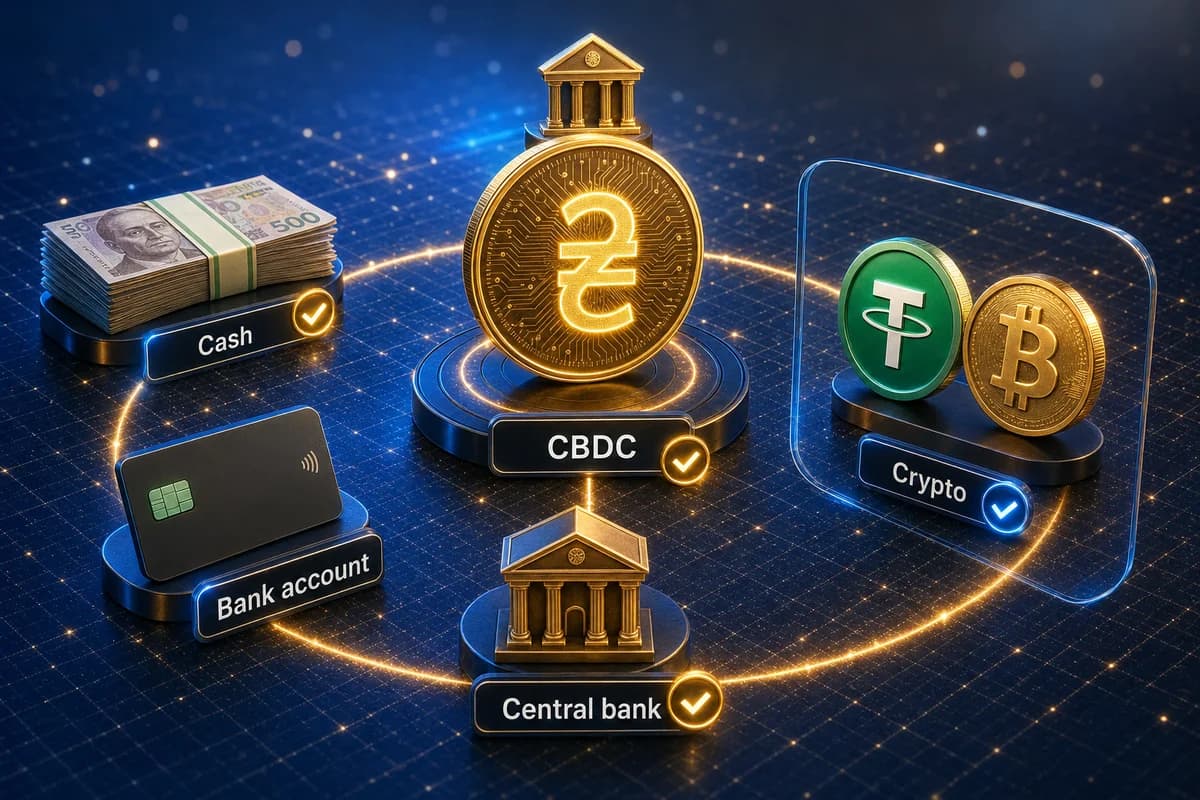
A CBDC (Central Bank Digital Currency) is a digital currency of a central bank: an electronic form of the national monetary unit that the central bank issues itself and is directly liable for. Put simply, a CBDC is the same national currency, but it exists in digital form from the start rather than as an entry in a commercial bank account. The word “currency” is misleading here: a central bank digital currency has nothing to do with cryptocurrencies, even though the news keeps mixing the two up.
Three forms of national money. The easiest way to place CBDC is through the structure of the modern money system. Cash is a liability of the central bank in physical form: a banknote is issued and guaranteed by it. Non-cash money consists of entries in accounts and on cards, that is, a client’s claim on a commercial bank, which must return the funds on request. CBDC forms a third type: digital, but with the same issuer as cash. Fiat money – the traditional money of a state, not backed by gold or other assets – thus gains a version in which an electronic payment is combined with a direct link to the central bank. The term “fiat” is defined in the Crypto Guide.
Features of a central bank digital currency. The same set of properties appears in most projects:
- the issuer is the central bank, not a private company or a network of independent participants;
- the denomination matches the national currency: one unit of CBDC equals one unit of ordinary money, so the rate does not fluctuate;
- the liability lies with the central bank, and the holder bears no credit risk of a commercial bank;
- the rules for issuance, circulation and storage are set by the regulator, not by the market;
- the technology is chosen by the central bank: a blockchain is not required for a CBDC.
Money in an account vs CBDC. The difference shows up in the risks. Funds in a bank account are a claim on the bank, and their safety depends on its stability and on the deposit guarantee system. A CBDC is a claim on the central bank, which cannot go bankrupt in the sense a commercial bank can. In its properties, a digital currency is therefore closer to cash, even though it exists in digital form. The National Bank of Ukraine describes the e-hryvnia in the same terms: as the hryvnia in digital form, issued by the NBU.
Why a CBDC is not a cryptocurrency. A cryptocurrency has no central issuer, and its price is set by the market. A CBDC has a single issuer, and its rate is fixed to the national currency. Stablecoins such as USDT sit between these categories: they are issued by private companies, and the dollar peg is held up by reserves. A detailed comparison of all three categories follows in a separate section below.
Clarifying the terms. The phrase “digital currency” is used for everything from bitcoin to a bank’s e-wallets. For precision, it is worth distinguishing:
- digital money of the state – that is CBDC;
- electronic money – entries with payment operators, backed by bank accounts;
- cryptocurrencies and stablecoins – private or decentralized assets.
These categories work under different rules, and mixing them up creates false expectations, for example the belief that a digital hryvnia will earn income or “replace” USDT.
The situation today. As of the second half of November 2026, the picture is as follows. According to the Atlantic Council tracker, more than 130 countries and currency unions are exploring a CBDC, and it is fully launched in three countries: the Bahamas, Jamaica and Nigeria. The digital euro is at the legislative stage: in July 2026 the European Parliament adopted its position for negotiations with EU governments, and the ECB pilot is planned for the second half of 2027, with possible issuance around 2029 provided the regulation is adopted. In Ukraine, according to the NBU governor, the digital hryvnia project has been created and is formally at the testing stage, but its rollout has been postponed until martial law ends, and the regulator is studying the EU’s experience. In the US, the 21st Century ROAD to Housing Act, which took effect in July 2026, prohibits the Federal Reserve from issuing a CBDC or similar digital assets until 31 December 2030, directly or through intermediaries; the restriction does not apply to private stablecoins. Information in this area keeps changing, so details for each country are given in the relevant sections.
How CBDC differs from cryptocurrencies, stablecoins and electronic money
Four categories of digital assets are easy to mistake for one another: in every case the money exists electronically and moves within seconds. The differences lie in the legal nature of the asset: who issues it, what backs it, how its rate is formed and who has the right to restrict transactions.
Issuer. A CBDC has one issuer: the central bank. A stablecoin is issued by a private company, electronic money by a bank or a payment operator. A cryptocurrency has no issuer: coins are created by the protocol under predefined rules, and the network is maintained by independent participants.
Backing. A CBDC is backed by the central bank’s liability, a stablecoin by the issuer’s reserves, electronic money by funds in the operator’s accounts. A cryptocurrency has no backing: its value is determined by demand.
Rate. One unit of CBDC and one unit of electronic money equal one unit of the national currency. A stablecoin stays close to its pegged currency but allows deviations if confidence in the reserves weakens. A cryptocurrency’s rate floats and can change significantly within a day.
Transaction limits and legal status. A CBDC usually receives legal tender status, and restrictions are set by the central bank. Electronic money is governed by payment legislation, and the operator may suspend transactions within the rules. A stablecoin is not legal tender, and its issuer can block individual addresses. In most jurisdictions cryptocurrencies do not have that status either, and no one can restrict transactions at the network level.
CBDC and cryptocurrency: different functions. Comparing a CBDC with bitcoin in terms of returns or volatility is not meaningful. A central bank digital currency has no mining and no price swings, and all its rules are set by the regulator. It is a payment instrument, not an asset whose price is set by the market.
CBDC and stablecoin: the source of the guarantee. Both assets aim for a stable value, but their guarantees differ. A stablecoin holder relies on the company keeping enough reserves for redemption. A CBDC is money itself, not a promise to pay it out, and the liability lies with the central bank. How the most widely used stablecoin works is explained in the article “What is Tether (USDT)”. Calling a CBDC a “state stablecoin” is inaccurate: a stablecoin by definition needs backing, while central bank digital money does not.
The digital dollar and USDT. These two are often confused. USDT is a private token pegged to the US dollar. A digital dollar in the CBDC sense would be a liability of the Federal Reserve: no such currency exists, and the Fed is barred by law from issuing one until the end of 2030. USDT operates as a market instrument on several blockchains, and its issuer may block individual addresses under its own rules.
Digital currency and electronic money. Everyone knows electronic money from payment app wallets: it is an entry with the operator, that is, the client’s claim on that operator. A CBDC is a claim on the central bank. In normal circumstances the difference is invisible, but if the operator runs into trouble, funds are returned through its obligations, whereas a CBDC has no such intermediary.
What the differences mean in practice. The assets solve different problems and do not replace one another. A CBDC is designed for payments within the national system under the regulator’s control. USDT is needed where settlements in dollar terms and transfers between countries are required without being tied to banking hours. Cryptocurrencies like bitcoin form a separate asset class. This matters for exchange practice too: the rules for working with USDT are set by the service, not by the central bank. At Coinmoneyhub the rate and the service fee are visible at once: the final amount for exchanging USDT to hryvnia is shown in the calculator before you create an order, with no hidden fees or floating rates, and rates for all directions are listed on the rates page. Hryvnia is paid out to a card of any Ukrainian bank.
How a CBDC works: retail and wholesale, “account” and “token” models, wallets and offline payments
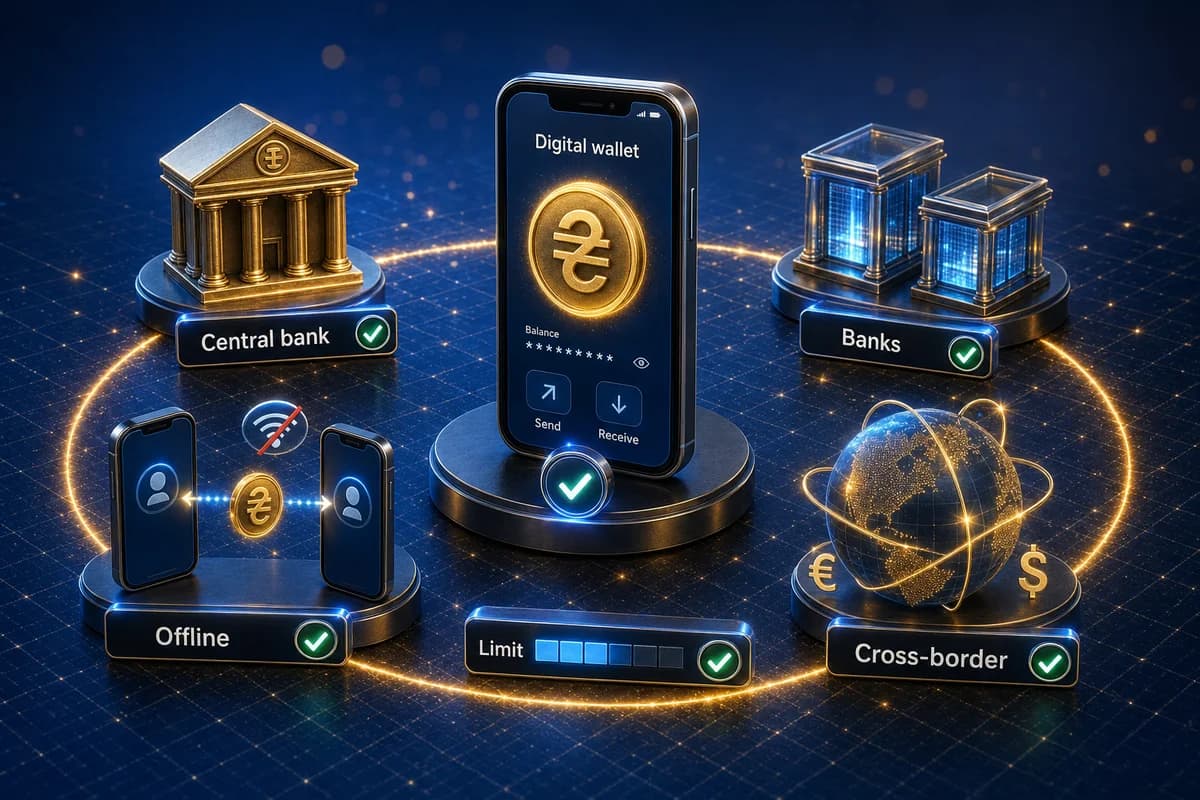
To understand how a central bank digital currency works, you need to answer four questions: who it is for, how ownership is confirmed, who serves the users and what technology the platform runs on. The answers vary from project to project, but the choice is made from a limited set of designs.
Retail and wholesale CBDC. A retail CBDC is meant for the public and businesses: people pay with it in shops, send money to one another and receive payments. In purpose it is closer to cash in digital form. A wholesale CBDC is used for settlements between banks and other financial institutions. Banks have long held balances in accounts at the central bank, and the wholesale model moves those settlements onto a new technology platform. For an ordinary person, the two types differ in accessibility: a wholesale CBDC is not available to them, while a retail one is designed precisely for them. When the news talks about a digital hryvnia or a digital euro, it usually means the retail version.
“Account” and “token” models. They determine how the right to use the money is confirmed:
- in an account-based model, the owner is identified in every transaction, as in a bank: the system checks who is sending and who owns the funds;
- in a token-based model, the digital asset works like a bearer instrument: the authenticity of the token itself is checked rather than the identity of the holder, which is closer to the logic of cash.
In practice, most retail projects combine both ideas, and the degree of anonymity depends on the regulator’s decisions and the law, not on the technology itself.
A two-tier service model. In most projects the central bank only issues the money and runs the platform, while banks and payment providers handle the clients: they open wallets, carry out identification and accept payments from merchants. The digital hryvnia pilot was designed the same way: according to the NBU, it involves banks, payment providers, merchants and real users. For a client, this means dealing not with the central bank but with a familiar financial institution.
The technology platform. The central bank chooses the architecture itself: it may be a distributed ledger or a centralized database. A blockchain is not required for a CBDC. According to the NBU, the digital hryvnia pilot was planned on distributed ledger technology. How such a ledger works and why its records cannot be changed retroactively is explained in the article “Blockchain and Its Role in Cryptocurrency”. An important difference from public cryptocurrencies: network participants are chosen by the central bank, not open to anyone.
The central bank digital wallet. A CBDC is held in a wallet that is usually provided by a bank or payment provider, and in some projects by the central bank’s own app. It differs from a crypto wallet in that the owner usually does not hold the private key alone: access can be restored through the service provider. This is more convenient for people, but it means they do not have full control over the keys, as they would with self-custody of cryptocurrency.
Holding limits for digital currency. To prevent money from flowing out of bank deposits into CBDC on a mass scale and undermining lending, designers set caps on balances. Such limits are being discussed for the digital euro. In some models, any amount above the cap is automatically moved to a linked bank account. In most projects no interest is paid on CBDC balances: it is meant as a means of payment, not a way to save. The exception is the digital yuan, covered below.
Offline CBDC payments. To stay resilient during connection outages, projects include an offline mode: transferring money between devices without internet access. This feature is planned for the digital euro. Offline payment amounts are usually limited, and the balance syncs with the system once the connection is restored.
The overall scheme looks like this: the central bank creates and controls the platform, banks and providers serve the clients, and the user works with a wallet subject to limits and rules set by the regulator. By design this is fundamentally different from public cryptocurrencies, which have neither a single issuer nor service intermediaries.
Why states create CBDCs: payment infrastructure, financial inclusion and cross-border payments
Central banks have no single motive: the set of reasons depends on the structure of each country’s economy. Still, four themes recur in regulators’ public documents: payment system resilience, access to central bank money in the digital environment, financial inclusion and simpler international settlements.
Payment infrastructure. In most countries domestic payments run through networks of private operators, often foreign ones. For the European regulator this is one of the main arguments for the digital euro: the ECB points to dependence on payment systems outside the euro area as a problem and sees a pan-European platform as a way to reduce it. The second argument is resilience: a CBDC with an offline mode allows payments during connection failures and operator outages. The third is cost: a shared platform under central bank control could lower fees for merchants.
Access to central bank money. The use of cash is declining, while non-cash money remains a liability of commercial banks. If cash is pushed out, people will lose the option of holding money that carries no private bank risk. A CBDC is seen as a way to preserve that option in digital form: the central bank gives the public its own payment instrument, whatever happens to the market.
Financial inclusion. This motive is strongest where a large share of the population has no bank account or lives in hard-to-reach areas. The Bahamas launched the Sand Dollar for residents of islands where bank branches are scarce, and Nigeria launched the eNaira to widen access to payments. In several such projects, a phone and a wallet are enough to receive CBDC, with no bank account or nearby branch required.
Cross-border payments. An international transfer passes through a chain of correspondent banks: each link adds a fee and time, and the final cost and timing are hard to predict in advance. That is why international settlements have become the subject of separate pilots in which central banks test platforms for direct settlement without intermediaries. One example is the mBridge project: according to public data, its core consists of the central banks of China, Hong Kong, Thailand and the UAE, and the Bank of Mongolia joined in 2026. The private sector tackles the same problem with its own tools: XRP is positioned as a bridge for interbank transfers, and its comparison with SWIFT is covered in the article “Ripple (XRP): a coin for interbank transfers”.
A response to the rise of stablecoins. Regulators see the spread of private digital money, above all dollar stablecoins, as a challenge to the national currency: if people and businesses keep savings and settle in a foreign currency, the central bank has fewer tools to manage money circulation. A CBDC is one response: it gives the national currency a digital form that can compete with private alternatives on speed and convenience. The higher the share of stablecoins in a country’s settlements, the stronger this motive.
What sets the priority. For advanced economies, sovereignty over payment infrastructure and competition with stablecoins come first; for island and developing countries, access to payments; for countries with large external settlements, the speed of international transfers. That is why digital currencies of different states have similar names but different goals and parameters.
Privacy and control: what the state sees and how it compares with anonymity in crypto exchange

Privacy is the issue that raises the most questions among people who are just learning about central bank digital money. The concern is simple: if all money is digital and issued by the state, it will see every purchase. The answer depends on the architecture of the specific project and on the law, so it is more accurate to separate technical capability from legal access to data.
What the state can see. How much data is visible depends on the service model. If the central bank runs wallets directly, it technically gains access to all transactions. In the two-tier model, which prevails in most projects, personal data stays with banks and payment providers, and the central bank works with anonymized information. Who may obtain information, and in which cases, is governed by data protection and financial monitoring laws, not by the name of the currency. Cash differs from both models: a transaction leaves no record at all.
Three approaches to privacy in projects. Central banks choose between them deliberately:
- Full identification. The wallet is tied to its owner, and transactions work just as with a bank account. Privacy is governed by bank secrecy law.
- Tiered identification. Wallets with minimal checks are allowed, but their limits on amounts and number of transactions are lower, and access to larger sums requires identity verification. The People’s Bank of China describes a similar model for the digital yuan as “managed anonymity”.
- Privacy in offline mode. A payment passes between devices without the network, and the data stays only with the parties to the transaction. According to the ECB, in offline mode the digital euro will offer privacy close to cash, while for online payments users’ personal data stays with intermediaries.
Programmable money. The term is used in two senses. In the first, the payment is programmed: automatic settlement on a condition, such as payment upon confirmed delivery. This simplifies business processes and does not affect privacy. In the second, the money itself is programmed: restrictions are placed on it by time, recipient or spending category. An example is a targeted benefit that can only be spent on certain goods. This raises questions: who sets the restrictions and who has the right to change them. Some central banks state that they will not restrict how money is used, while others allow targeted payments. The extent of restrictions is determined by the law and the regulator’s decisions, and this is the parameter on which projects differ most.
Arguments on both sides. Supporters of CBDC point out that identification reduces the risk of money laundering and fraud, simplifies tax control and makes settlements more transparent. Critics note the risk of citizens’ data piling up in one place and the possibility of restrictions as programmability expands. Three questions matter when assessing a specific project: what data is collected, who has access to it and what safeguards are written into law. The answers differ from country to country.
Privacy in crypto exchange. In cryptocurrency exchange the picture is different, although there is no complete invisibility there either. The blockchain is public: addresses and transfer amounts are visible to everyone. The bank sees its part of the chain, and the service keeps the order in the account. At Coinmoneyhub, registration requires only a name and an e-mail, identity verification is triggered only when coins have a high risk score, and when paying by bank card, ownership of the card is confirmed once. What exactly is hidden, what is visible and where the line of privacy runs is covered in detail in the article “Anonymous crypto exchange: myths and reality”.
The fundamental difference. With a CBDC, the level of privacy is set by the regulator for the whole system at once, and the user cannot choose it. In crypto exchange, each party sees its own fragment of the transaction: the blockchain sees addresses, the bank sees the card payment, the service sees the order. A user’s level of privacy depends on the chosen format and their own habits, not on the decision of a single issuer.
The world map of CBDC: launched projects, pilots and research
Central bank digital currency projects are at different stages, and headline numbers without a breakdown by stage explain little. Countries studying the topic and countries where a CBDC is already in circulation differ in the same way an idea differs from a working product. So the map is easier to read by four stages: research, development and pilot, full launch, and suspension. Some projects started in different years have been shut down or frozen, and that is part of the picture too.
Countries with a launched digital currency: the Bahamas, Jamaica, Nigeria. Three countries have taken their project to a public launch. The Bahamas issued the Sand Dollar, which became the first fully launched CBDC. The island nation’s main goal was to provide payments to residents of remote islands with few bank branches. Jamaica launched JAM-DEX, and Nigeria launched the eNaira, designed to widen public access to payments. The experience of these countries shows that a launch alone does not guarantee mass adoption: according to reports, user activity remains limited, and wide adoption requires convenience, incentives for merchants and trust.
China: the largest pilot. The digital yuan, or e-CNY, is being tested in retail payments in regions with a very large number of participants. It is the largest project by user reach among major economies. The Chinese model is two-tier: the currency is distributed by authorized banks, and the level of privacy depends on the wallet type, as described above. Since January 2026, the People’s Bank of China has treated e-CNY wallet balances as deposits of the operating banks, and interest is paid on them. In effect, the digital yuan has moved away from the “digital cash” model, which sets it apart from most other projects.
India: parallel retail and wholesale pilots. The Reserve Bank of India runs digital rupee pilots in both directions: for interbank settlements and for payments by the public. A country with a large number of mobile payment users is testing how well a CBDC can coexist with a developed private payment infrastructure.
The euro area: legislative preparation of the digital euro. The digital euro has not been issued yet: the regulation is being negotiated between EU institutions, and the ECB is preparing for a pilot. The project focuses on the resilience of the region’s payment infrastructure and on complementing cash, as discussed above. For readers following the crypto market, the project is notable because the EU combines CBDC development with separate regulation of stablecoins and crypto-assets.
The United Kingdom: design work without a launch decision. The digital pound is at the design stage: the Bank of England and HM Treasury are studying whether the project is needed and what its parameters should be. According to public data, no final decision on issuance has been made.
The US: a ban on CBDC and a bet on private stablecoins. The country took a different path. Issuance of a digital dollar by the Federal Reserve is banned by law until the end of 2030, and in parallel the GENIUS Act was passed, setting rules for payment stablecoins. As a result, the role of digital dollar money in settlements is played by private tokens, including USDT. It is the only major economy where the state has deliberately chosen private issuers over a currency of its own.
Why projects move at different speeds. Speed is determined by four factors. In countries with hard-to-reach areas, the main motive is financial inclusion, so launches happen quickly. In economies with developed payment systems, a CBDC competes with ready-made private solutions and has to prove it is needed. Privacy criticism and the risk of restrictions slow down legislative processes, as in the EU and the US. Finally, in a number of countries the role of banks remains an open question: too fast a shift of money into CBDC could undermine their lending function, which is why limits and phased pilots are introduced.
What this means for cryptocurrency users. All these projects address the needs of national payment systems and are mostly intended for residents of the issuing country. None of them replaces cryptocurrencies or changes how USDT is exchanged for fiat. For a comparison with other kinds of digital assets, see the article “What Is Cryptocurrency? Types of Cryptocurrencies”.
The digital hryvnia: legal definition, NBU concept and pilot status
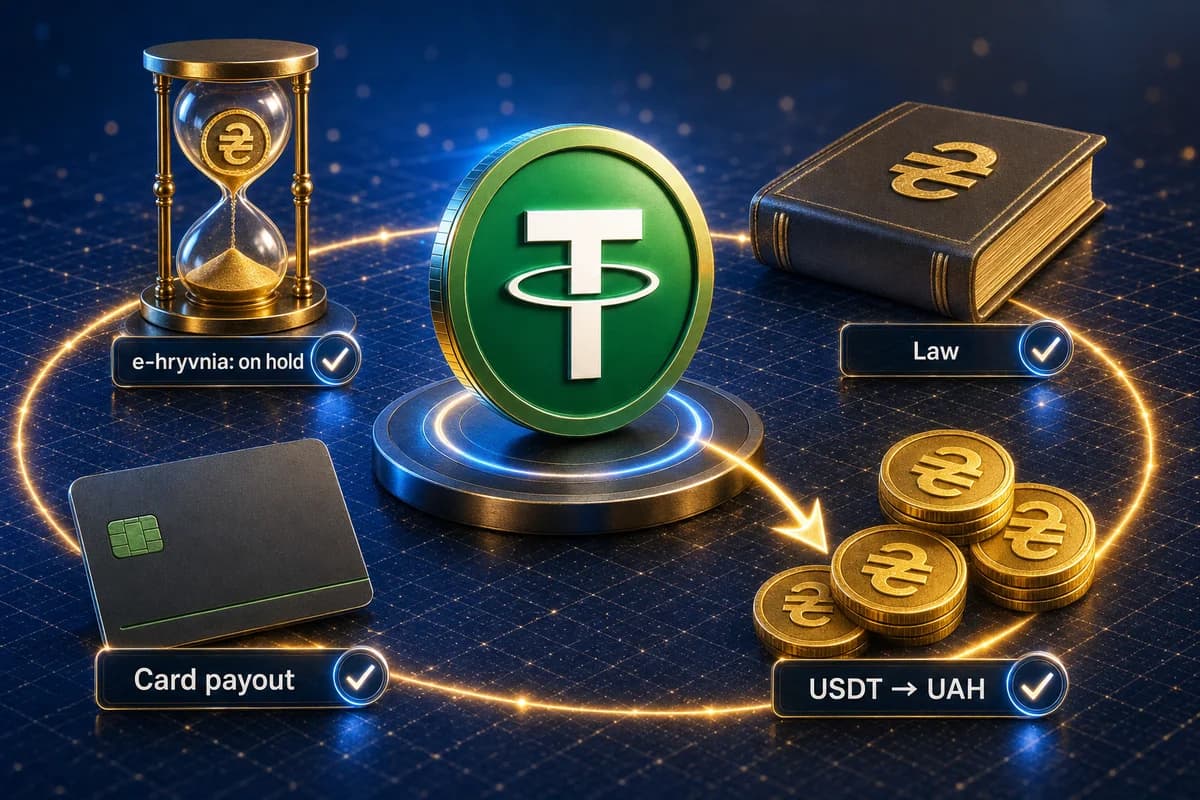
The digital hryvnia, or e-hryvnia, remains Ukraine’s only CBDC project, and it is worth looking at it on three levels: what is set out in law, what is described in the National Bank’s concept and what is happening now. The first is defined, the second is developed, and the third is in preparation with no decision on issuance.
Definition in law. Ukraine’s Law “On Payment Services” (No. 1591-IX) defines the digital money of the National Bank as an electronic form of Ukraine’s monetary unit issued by the NBU. Several points follow from the law and the regulator’s explanations:
- if a decision on issuance is made, the digital hryvnia will become legal tender;
- it will exist only in non-cash form and will complement cash and non-cash money;
- the law separates it from electronic money, that is, entries with payment operators;
- the procedure for issuance, storage and redemption is set by the NBU in its regulations, and use is allowed in cases provided for by laws and the regulator’s acts.
The legal framework therefore exists, but there is no decision on issuance.
The NBU concept. The “E-hryvnia” project was launched in September 2021 to assess whether large-scale issuance of a digital form of the national currency makes sense, and the concept was presented in November 2022. In the regulator’s words, the digital currency should perform all functions of money and be convenient and accessible for the public, businesses, government bodies, banks and non-bank payment institutions. The NBU considers three areas of use:
- retail non-cash payments, including programmable money features: targeted social benefits, control over the intended use of funds and settlement automation through smart contracts;
- circulation of virtual assets: exchange, backing of issuance and other operations where the e-hryvnia could become part of the market infrastructure;
- cross-border payments, which should become faster, cheaper and more transparent.
At the same time, the regulator stresses a balanced approach that takes into account the impact of the innovation on the financial system.
Project status. No decision has been made to put the digital hryvnia into circulation. The pilot was being prepared on distributed ledger technology. According to the NBU governor, speaking at a public dialogue within the “30 Years of the Hryvnia” project, the project has been created and is formally at the testing stage, but its rollout has been postponed until martial law ends. After that, the regulator will assess the results of the EU project and set the timeline.
Digital hryvnia launch timeline. There is no specific date, and it depends on two conditions: the end of martial law and the results of the digital euro. Publications naming an exact launch year are therefore not backed by official decisions.
The e-hryvnia and cash. Under the law, the digital hryvnia complements cash and non-cash forms rather than replacing them. No decision to abolish cash has been made.
What this means for citizens now. There is no digital hryvnia in circulation: it cannot be received, bought or exchanged. Offers to “buy e-hryvnia”, “move funds into the digital hryvnia” or “open an NBU digital wallet” have nothing to do with the regulator and serve as a scheme to obtain money and personal data. Card payments, cash transactions and cryptocurrency exchange continue to work as before.
Until the digital hryvnia appears, the national currency exists in familiar forms: cash and non-cash funds on cards. Exchanging USDT to hryvnia at Coinmoneyhub works with exactly these: the payout goes to a card of any Ukrainian bank or in cash in Kyiv, and the rate is fixed at the moment the funds arrive. The exchange procedure is described in detail in the article “Sell USDT for UAH”.
CBDC and the cryptocurrency market: different roles of assets and what changes for USDT users
Whether a CBDC will replace cryptocurrency comes up in any discussion of state digital money, and the answer depends on which function is being considered. A central bank digital currency and cryptocurrencies solve different problems, so it is more accurate to talk not about replacement but about a division of roles.
The roles of the assets. A CBDC is a payment instrument of the national currency under the regulator’s control: people use it to pay in shops, receive payments and transfer money within the country. Cryptocurrencies are market assets used to store value, to invest and to settle outside the banking system. Stablecoins sit in between: a token with a stable price for settlements in dollar terms and transfers between countries. Each class meets its own need, and the arrival of one does not cancel the others.
The replacement scenario: what a CBDC displaces and what it does not. In its payment function, a CBDC competes with bank cards, transfers and private payment apps, and partly with stablecoins, as noted above. There is no competition with cryptocurrencies like bitcoin: their supply is set by the protocol, and they have no central issuer and no peg to a national currency. Nor does a central bank digital currency offer an investment alternative to bitcoin: its value does not grow, and it is not meant for investment.
Decentralization and state infrastructure. A CBDC network is run by the central bank, its participants are defined in advance, and the rules are changed by the regulator. Decentralized finance works differently: transactions are executed by code, anyone can take part, and there are no intermediaries. This model is described in detail in the article “DeFi: What it is and how decentralized finance works”. The two designs do not overlap within one system: a CBDC does not displace DeFi, and DeFi does not replace state money.
The impact of CBDC on the USDT rate. There is no direct mechanism of influence. The value of USDT is determined by its peg to the US dollar, and the USDT to hryvnia rate is made up of the dollar-hryvnia ratio on the market and demand for exchange. If a digital hryvnia is issued, it will be the same national currency at face value and will not by itself change the hryvnia’s value against the dollar: that is driven by monetary policy and market factors. An indirect effect is possible through people’s behavior: if a digital currency makes payments easier, demand for alternative instruments may change, but such an effect cannot be assessed before launch.
Regulation of virtual assets in Ukraine. Alongside the discussion of the e-hryvnia, the NBU speaks publicly about the need to legalize the virtual asset market, so that it is transparent, does not threaten monetary sovereignty and is not used to launder criminal proceeds. The legislative process is ongoing. These areas are related in meaning but move separately: the digital hryvnia concerns the national currency, while the regulation covers crypto-assets, including USDT. The NBU concept allows for the e-hryvnia to become part of the virtual asset market infrastructure, for example for settlements during exchange, but that is a scenario in the concept, not current practice.
What stays the same for USDT users. As long as there is no digital hryvnia, the exchange procedure does not change: USDT is exchanged for hryvnia to a card or in cash, the rate is set by the market, and verification rules are set by the service under its own AML policy. If a regulatory framework for virtual assets appears, it usually sets requirements for services: client identification, reporting and licensing. The characteristics of USDT itself remain the same.
State digital money and cryptocurrencies develop in parallel. The former strengthens the national payment system, the latter remains a tool for settlements and storage outside it, and users choose an asset for a specific task.
Myths about CBDC and what lies behind them

Myths about state digital money arise for two reasons. The term sounds like cryptocurrency, and the topic touches on cash, privacy and control over money – things that concern everyone. Below are the most common claims and what is known from laws and regulators’ documents.
Myth: “Cash will be abolished.” Reality: under Ukrainian law, the digital hryvnia complements cash and non-cash forms rather than replacing them, and no decision to abolish cash has been made. In the EU, alongside the digital euro proposal, the European Commission proposed a separate regulation on the legal tender status of euro cash, so cash is being reinforced in parallel. The myth stems not from a document but from the assumption that a new form of money will push out the old one.
Myth: “The state will see every purchase.” Reality: how much data is visible is determined by the project’s architecture and the law, not by the name of the currency. In the two-tier model, personal data stays with banks and payment providers, while the central bank works with anonymized information. An offline payment passes between devices without the network. There is no complete privacy either: a CBDC adds no secrecy, but it is not required to create total visibility. By comparison, non-cash payments are already visible to banks today, which analyze transactions and react to unusual patterns, as described in the article “Card blocked over cryptocurrency transactions”.
Myth: “Banks will disappear.” Reality: in most projects banks remain intermediaries. They open wallets, identify clients and accept payments, and holding limits are introduced precisely so that money does not leave bank deposits en masse. The role of banks is preserved; only the division of tasks between them and the central bank changes.
Myth: “You can buy the state’s digital currency and profit from it, like cryptocurrency.” Reality: one unit of CBDC equals one unit of the national currency, the rate does not change, there is no mining, and interest, where it is paid at all, as on the digital yuan, is comparable to a bank deposit, not to market returns. Offers to “invest in the digital hryvnia” or “buy e-hryvnia before launch” are fraudulent schemes, especially since there is no digital hryvnia in circulation.
Myth: “The digital hryvnia will devalue USDT or replace it.” Reality: there is no direct mechanism. The value of USDT is determined by its dollar peg, and its rate against the hryvnia is set by the market. CBDCs and stablecoins solve related but different problems, as noted above.
Myth: “The state will be able to block money or restrict spending at any moment.” Reality: the ability to freeze funds by decision of the competent authorities already exists for bank accounts, so by itself it is nothing new for a CBDC. What remains controversial is programmability: restrictions by time, recipient or spending category. Projects differ: some regulators reject such restrictions, others allow targeted payments. It is more accurate to judge a specific project by what is written into law: what data is collected, who has access to it and what restrictions are allowed.
Where myths come from and how to check them. Myths arise for three reasons: confusion of terms (CBDC and cryptocurrency), politicization of the topic and headlines that call a project “new money” without details. Checking is simple: read the law and the regulator’s documents, not retellings. In Ukraine these are the Law “On Payment Services” and NBU materials; in the EU, the draft digital euro regulation and ECB documents.
A practical guide for users: how not to confuse CBDC with cryptocurrency and how to exchange USDT to hryvnia now
The topic of state digital money concerns users in two ways: as information about where the payment system is heading, and as a set of actions that do or do not need to be taken today. These two parts are worth keeping apart, because confusing them leads both to needless worry and to the risk of falling for a fraudulent offer.
What matters now. There is no digital hryvnia in circulation, so there is no registration, wallet or exchange connected with it. The familiar forms remain in effect: cash, non-cash money on cards and cryptocurrencies, including exchanging USDT to hryvnia. CBDC development worldwide and the debate on the digital euro do not change how such an exchange works.
What belongs to the future. The digital hryvnia and the digital euro depend on regulators’ decisions, and the timing is determined by legislative processes and pilot results. A real launch will be accompanied by an official NBU announcement, a procedure for issuance, storage and redemption, and a list of institutions that issue wallets. Until such documents appear, there is nothing to prepare for, and any offers to “get in early” have nothing to do with the regulator.
How to tell a CBDC from a cryptocurrency in a minute. Five questions are enough:
- Who is the issuer? For a CBDC it is the central bank, for a stablecoin a private company; bitcoin has no issuer.
- Does one unit of the asset equal one unit of the national currency? For a CBDC always; a cryptocurrency’s rate floats.
- Who sets the rules? For a CBDC the regulator, for a cryptocurrency the protocol and community, for a stablecoin the issuer.
- Is income promised? A central bank digital currency does not produce market returns, and such a promise points to a scheme.
- Are you offered to “buy in advance”? It is impossible to buy a currency that is not in circulation.
The last two signs appear in fraudulent mailings more often than the others.
How to exchange USDT to hryvnia. A current exchange takes four steps:
- Create an order. In the exchange calculator, choose the direction – to a card of any Ukrainian bank or cash in Kyiv – and enter the amount. The rate, the service fee, the final amount and the minimum and maximum are shown before you create the order.
- Get the payment details. The network and address for the transfer appear in the order details. Do not use addresses from messages, chats or previous orders.
- Send USDT. Transfer the coins using the order details. The rate is fixed at the moment the funds arrive, and if a different amount arrives than stated, the payout is recalculated automatically based on the amount actually received.
- Receive hryvnia. Card payouts are processed automatically. If you are collecting cash in Kyiv, a manager will arrange the place and time of the handover.
Before sending funds, make sure the network in your wallet matches the network in the order: funds sent over a different network cannot be recovered. How cash payouts work is explained in the article “Exchanging USDT for cash”.
Service rules. It is better to read the terms before paying, not after. At Coinmoneyhub, the rules and regulations are set out in a separate document: it is available on the website at any time, and you confirm your agreement with it by ticking a checkbox when creating an order.
How to follow the topic of digital money. The regulators themselves are the sources: the Law “On Payment Services” and NBU materials for Ukraine, ECB and European Parliament documents for the digital euro, and the Atlantic Council tracker for the overall picture by country. News without a link to a document is worth checking against these sources. If launch decisions are made, it is regulation and payment infrastructure that will change, not the mechanics of cryptocurrency exchange.
The digital hryvnia is tomorrow, USDT is today: what to remember
A CBDC is not a cryptocurrency but national money in digital form: the issuer is the central bank, its rate equals that of the ordinary currency, and the rules are set by the regulator. Only three such currencies are fully launched worldwide, the digital euro is at the legislative stage, the US has banned a digital dollar until the end of 2030, and the digital hryvnia is waiting for martial law to end.
Three simple conclusions follow for users. You cannot buy, exchange or “invest” in a digital hryvnia today, and any such offer is fraud. The arrival of CBDCs does not change the value of USDT or how it is exchanged. And for a current exchange, what matters is the network, the amount, the payout format and the service rules: today only exchanging USDT to hryvnia is available, and it should be done in its own order.
