
The difference between USDT and USDC: which to choose for storage, payments and exchange
USDT and USDC are the two largest stablecoins, and both are worth one dollar. That is why people often treat them as the same thing, even though different companies, different reserves and different rules stand behind them. In this article we look at how USDT and USDC differ, which one is more reliable in terms of reserves and regulation, which networks to send them on, where each is accepted for payments, how to store them and which token is more convenient for exchanging to hryvnia in Ukraine.
What USDT and USDC have in common and where the line between them lies
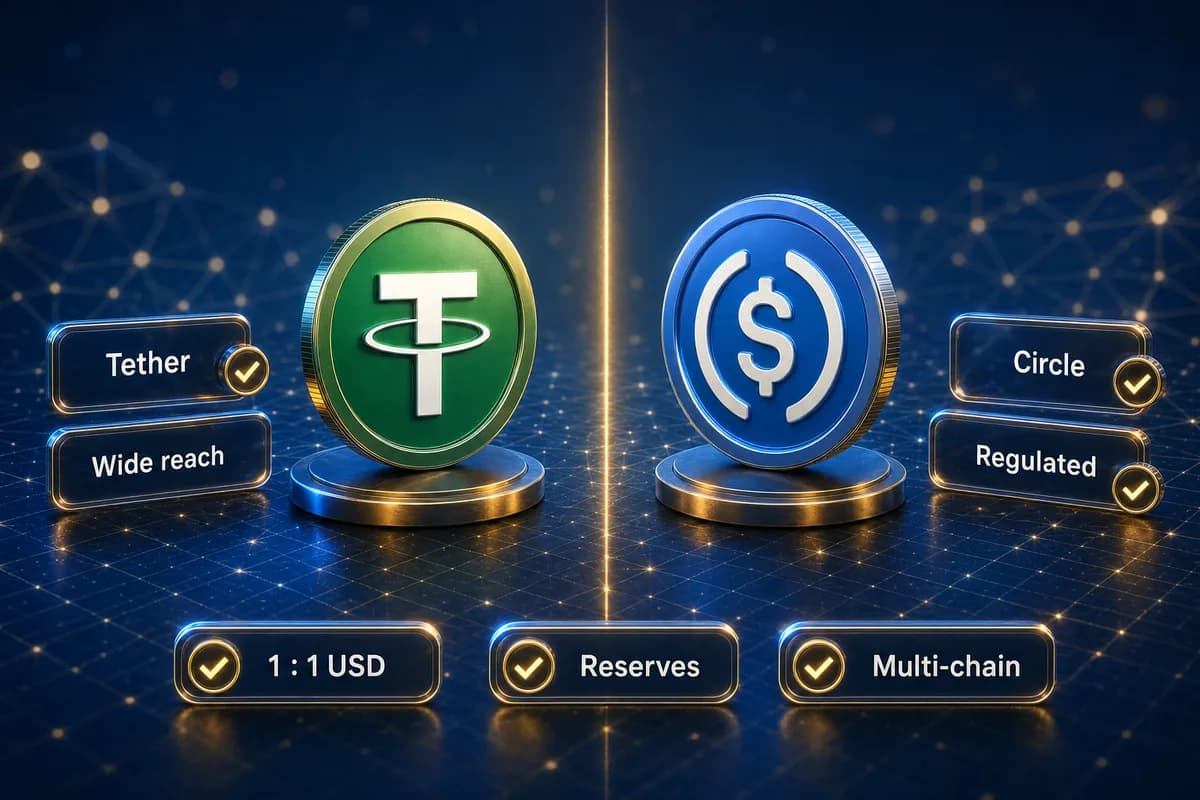
USDT and USDC are among the most widely used digital assets and do the same job: they offer a stable price in a market where other coins fluctuate. Because of this similarity, they are often seen as interchangeable. Yet the difference between USDT and USDC lies not in the rate, but in who stands behind the token, what backs it and which rules it operates under.
What a stablecoin is. A stablecoin is a digital token whose price is pegged to a fiat currency, most often the US dollar. Backed tokens all work the same way: the issuer accepts money, issues the same number of tokens, holds reserves and undertakes to redeem each token at face value. It is the reserves that keep the price close to one dollar. USDT and USDC both belong to this type. Algorithmic stablecoins, where the price is held by software rather than reserves, work differently and are not part of this comparison.
What USDT and USDC share.
- Both are pegged to the US dollar one to one.
- Both are issued by centralised companies responsible for issuance and redemption.
- Both are backed by reserves, whose composition and reporting differ.
- Both exist on several blockchain networks at once.
- Both are used for payments, storing value and exchange.
A misconception: USDC and the euro. Many people mistakenly believe USDC is pegged to the euro or designed for the European market. This is not true: like USDT, USDC is pegged to the US dollar, and one token equals one dollar. The confusion comes from two things. Circle, the issuer of USDC, holds an e-money licence in the EU and the token complies with the European MiCA regulation, covered in detail below, while USDT is restricted on European platforms. In addition, Circle issues a separate token, EURC, which is pegged to the euro and has a similar name. These are different assets. USDC's link to Europe is regulatory, not monetary, and this is worth keeping in mind whenever euro payments come up.
Where the line between the tokens lies. The differences fall into five areas:
- Issuer and jurisdiction. USDT is issued by Tether, USDC by the US company Circle.
- Reserves and reporting. The composition of assets and how often data are published differ; details are in the section on reserves.
- Regulation. The legal status of the tokens in the US and the EU has diverged, and this is what determines whether a token is available on some platforms.
- Liquidity and reach. USDT is more widespread in global payments and emerging markets, while USDC is more often used in the regulated environment of the US and the EU.
- Networks and use. The tokens are issued on different networks with different fees and transfer speeds.
The same thing or not. No. For the user both tokens mean a dollar, but the guarantees behind them differ: a different issuer, different reserves, a different regulatory status. On an ordinary day these differences do not affect the price, but they show up in unusual situations: when a token needs to be redeemed, when it is unavailable on a particular platform, or when proof of reserves is required. These areas shape the choice discussed below.
To learn more about who issues USDT, how the token came about and how it works, read our separate article – “What is Tether (USDT)”.
Market size and liquidity: what depth means for an ordinary user
Market size matters not for rankings but for practical things: how quickly an exchange goes through, whether the direction you need exists and how wide the gap is between the buying and selling price. So it makes sense to compare USDT and USDC by scale together with what that scale means for someone who exchanges, stores or sends tokens.
Where things stand today. According to DefiLlama, at the end of November 2026 the stablecoin market is worth about $280 billion. USDT's market capitalisation is about $175 billion, or around 62% of the market, and USDC's is about $69 billion, roughly a quarter. Together the two tokens account for more than 85% of the whole market. Euro stablecoins, including EURC, make up less than one percent: their combined value is estimated at under $1 billion. The figures change daily: in spring USDT exceeded $190 billion, and over the autumn its supply shrank by almost $9 billion, so rounded values are given here.
USDT and USDC by market size. The 2.5-fold gap is explained by history. USDT appeared in 2014, four years before USDC, and became the base unit of account for the digital asset market. It is issued on more networks, is more widely available in exchange directions and has traditionally been in demand where access to dollar accounts is limited: in international transfers between individuals, in freelancing and in payments between countries with different currencies. Among the coins most often requested for exchange, USDT remains the main benchmark, as our overview of popular cryptocurrencies for exchange shows. In recent years USDC has grown faster in relative terms: it is chosen where regulatory certainty and institutional requirements matter, and that audience is expanding.
What stablecoin liquidity is. Liquidity is the ability to buy or sell an asset quickly without moving the price. For a stablecoin it depends on the number of participants and the supply: the more people want to exchange a token and the more of it is in circulation, the easier it is to find the other side. In practice this shows up in four ways:
- exchange speed: with many participants a matching offer is found faster;
- the gap between buying and selling price: it is narrower for a highly liquid token, which makes exchange cheaper;
- range of directions: services open directions and hold reserves first of all in the most popular assets;
- large amounts: a substantial volume can be exchanged in one operation without changing the rate.
Liquidity at an exchange service. Here it takes the form of the reserve for a direction: how many units of an asset the service can pay out right now. An insufficient reserve limits the maximum amount of an operation, even if the token itself is widespread. So for a practical assessment you look not at global market capitalisation but at what is available in the specific direction: the rate, minimum, maximum and reserve.
Size and reliability are different properties. A large market capitalisation means high liquidity and wide acceptance, but says nothing about the quality of reserves, the transparency of reporting or the legal protection of holders. These parameters determine the risk of holding a token, and each is assessed separately, in the sections on reserves and regulation.
Reserves and transparency: what backs the tokens and how it is verified
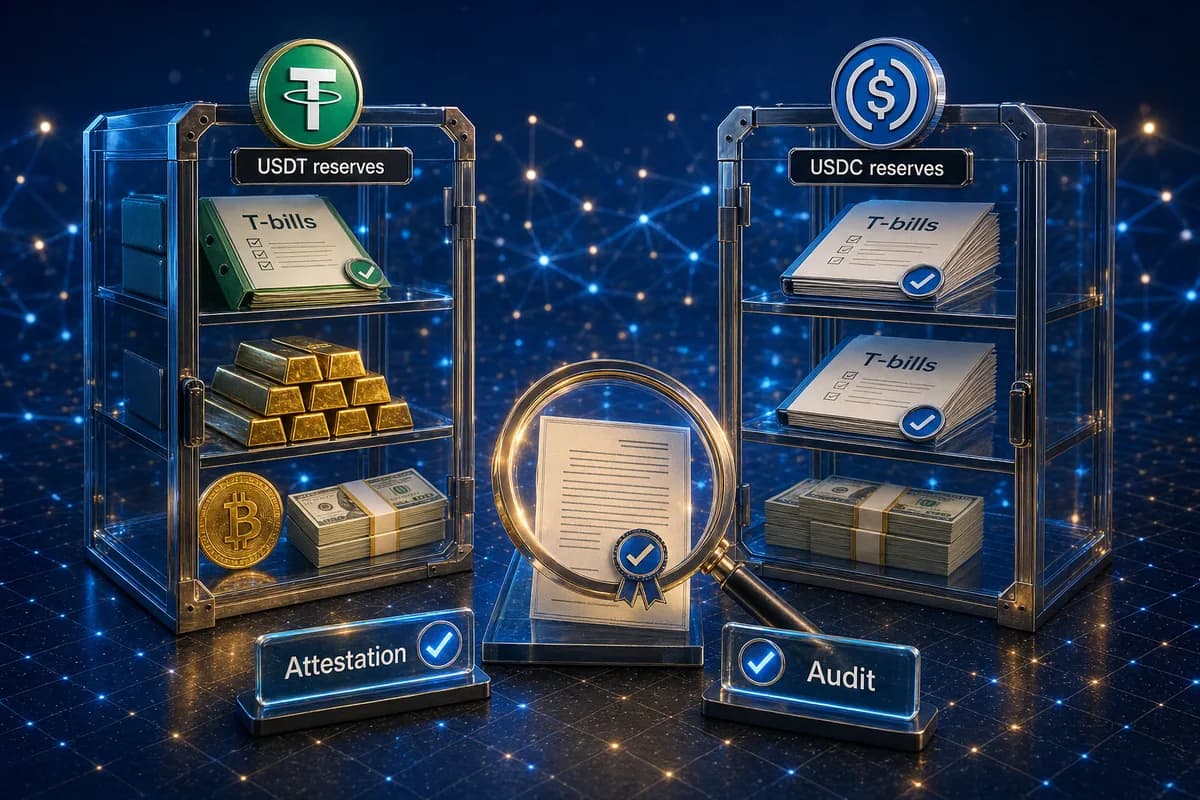
A stablecoin's price is held by its reserves, which is why they are the basis for judging a token's reliability. It is important to understand what the backing of USDT and USDC consists of and how it is confirmed.
Tether's reserves. A large share of USDT reserves consists of short-term US Treasury bills, but the composition does not stop there. The reserves also include gold, bitcoin and secured loans, that is, assets with different levels of risk and liquidity. The safety margin is the excess of assets over liabilities: according to the latest quarterly attestation it stands at about $8 billion against liabilities of around $183.5 billion.
USDC's reserves. Circle follows a more conservative model. Its reserves consist of cash and short-term US government securities: part is held through a regulated money market fund and the rest is kept in banks. There are no volatile assets in the mix, so the value of the backing hardly depends on market swings.
Attestation and audit: the difference. These two terms are confused most often, although the depth of the check differs:
- attestation: an independent firm confirms that on a given date the issuer's assets are not less than its liabilities; it checks a specific set of data on a specific day, not the financial statements as a whole;
- audit: all financial statements for a period are examined, including the balance sheet, income statement, cash flows, internal controls and asset valuation; the result is an opinion, and an unqualified opinion means there are no material findings.
How reserves are confirmed today. In August 2026 Tether announced the completion of its first full audit, carried out by KPMG for 2025. The opinion was unqualified, the excess of assets over liabilities at the end of 2025 was about $6.8 billion, and every gold bar was physically counted. The company did not publish the audit report itself but disclosed its key figures. Before that, for about ten years Tether published only quarterly attestations. The latest of them, as of 30 September 2026, shows assets of about $191.5 billion against liabilities of about $183.5 billion. Circle publishes the composition of its reserves and monthly attestations and, as a public company, also reports audited financial statements. Still, neither an audit nor an attestation answers whether the reserves meet the requirements of the US law on payment stablecoins, which is covered in the section on regulation.
What a token holder gets and what they do not. Holders' rights are limited, and it is worth knowing them in advance: there is no insurance, and deposit guarantee schemes do not cover tokens. Direct redemption with the issuer is, as a rule, available only to verified customers, while most people exchange tokens through intermediaries. Income from investing the reserves goes to the issuer; holders receive no interest.
How to check reserves yourself. Five steps are enough:
- Open the transparency page on the issuer's website where reports are published.
- Find the latest report and check its date: the data refer to a specific day, not to today.
- Compare total assets and liabilities: assets should not be less than liabilities.
- Assess the composition: the share of cash and Treasury bills versus other items.
- Identify the type of document: an attestation or an audit.
Reliability by reserves: comparing approaches. USDC's composition is simpler and more conservative. USDT has a larger scale and a bigger absolute buffer, but its structure includes assets with price risk: bitcoin and gold fluctuate in price, and secured loans depend on counterparties. A universal answer to which stablecoin is more reliable does not follow from reserves alone. Regulation and the token's behaviour in a crisis complete the picture.
Regulation: the GENIUS Act, MiCA and why USDC is associated with Europe
The rules for stablecoins in the US and the EU have diverged in their requirements for issuers, and this is what shaped the position of USDT and USDC in different markets. For a user in Ukraine these rules apply indirectly, but they explain why the tokens are not equally available everywhere.
The GENIUS Act in the US. The payment stablecoin law adopted in 2025 sets uniform requirements for issuers. Key provisions:
- Reserves are held one to one and only in a limited list of assets: cash, insured deposits, short-term US Treasury bills, repurchase agreements backed by them and government money market funds.
- The issuer publishes the composition of its reserves and undergoes independent review.
- Holders have the right to redeem tokens at face value.
- Paying interest to holders is prohibited.
The law is being introduced in stages: in autumn 2026 US regulators are finalising the rules, which will start taking effect in 2027. The composition of USDC reserves – cash and short-term government securities – fits the list. USDT reserves include gold, bitcoin and secured loans, so, according to industry publications, today's USDT does not qualify as a permitted payment stablecoin. For the US market, in January 2026 Tether launched a separate token, USAT, issued by a regulated US bank. Why the US chose to regulate private stablecoins instead of creating its own digital currency is explained in our separate article – “CBDC: central bank digital currencies”.
The MiCA regulation in the EU. MiCA sets rules for tokens pegged to a single currency and allows only licensed entities to issue them: credit institutions or e-money institutions. The issuer must hold full reserves, ensure redemption at face value and publish reports, and paying interest to holders is likewise prohibited. Circle obtained an e-money licence in France and USDC complies with MiCA, while Tether has no such authorisation. Hence the image of USDC as a “European” token: its link to Europe is legal, while its currency remains the dollar.
USDT and restrictions in Europe. The claim that “USDT is banned in Europe” is inaccurate. MiCA does not prohibit holding the token; it restricts regulated services: platforms licensed in the EU may not offer clients from the European Economic Area tokens that do not meet the requirements, so USDT has been removed for European clients on such platforms. The regulation does not affect storage in your own wallet.
What this means in Ukraine. MiCA does not apply in Ukraine. Ukraine's own draft law on virtual assets, No. 10225-d, modelled on MiCA, has passed its first reading and in November 2026 is still awaiting the final vote in parliament. The practical conclusions are:
- exchanging USDT for hryvnia works as before, and EU restrictions do not apply to Ukrainian directions;
- when dealing with European counterparties and platforms, USDC is more convenient because it is available where USDT is not;
- the choice depends on where the token will be used: exchange in Ukraine, services in the EU or payments to partners in the US.
Regulation and reliability. Compliance gives the issuer legal obligations regarding reserves and redemption, but does not remove market risks. The absence of a licence does not make a token unreliable, and having one does not guarantee a stable price, so status should be assessed together with reserves, liquidity and the token's track record in crises.
Reliability under stress: depegs, lessons from past crises and assessment criteria
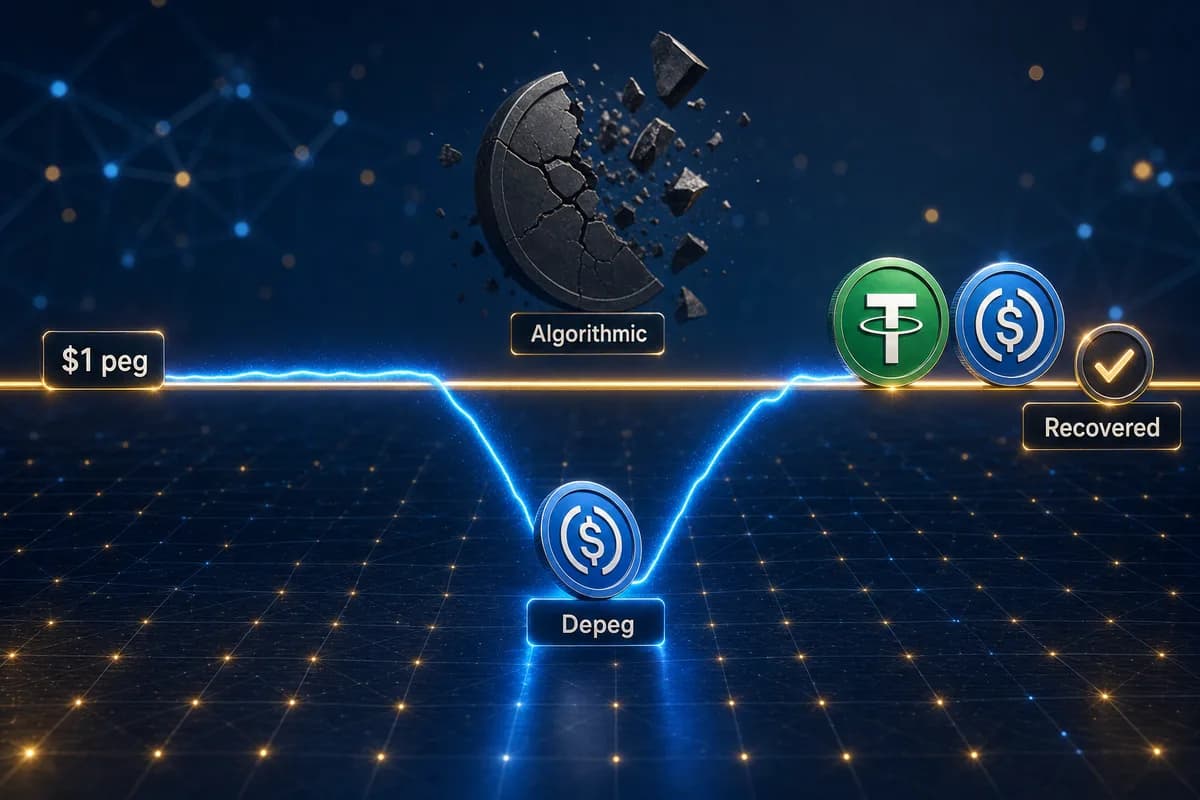
A stablecoin's reliability is tested not on an ordinary day but at a moment of stress: when the market is falling, banks are closed and holders all want their money back at once. At such times the token's price can drift away from the dollar. This is called a depeg, from the word peg.
What a depeg is. A depeg is a deviation of a stablecoin's market price from its face value: instead of one dollar, the token trades at, say, 0.95 or 0.88. The cause is almost always trust. If participants doubt that reserves are available, they sell the token faster than the issuer can redeem it, and the market price falls. A depeg can be temporary, when the price recovers within hours or days, or permanent, when the peg is lost for good.
USDC in 2023. In March 2023 Circle reported that about $3.3 billion of its reserves, roughly 8% of the total, were held at Silicon Valley Bank, which regulators had shut down. Within a day USDC fell to about $0.88, and because of the weekend redemptions through banking channels were limited. The peg returned a few days later, after the US authorities decided to protect the bank's depositors. The lesson: reserves in Treasury bills and cash are safe in themselves, but part of the cash is held in banks, and their condition also affects the token.
USDT in 2022. In May 2022, after the collapse of TerraUSD, USDT briefly fell to about $0.95. Tether redeemed billions of tokens in a short time, and the peg returned within a few days. The lesson: a token with deep liquidity withstood a sharp outflow, although the opacity of its reserves at the time remained a subject of criticism.
TerraUSD: a permanent depeg. UST was an algorithmic stablecoin: its price was held not by reserves but by a mechanism linked to its sister token LUNA. When trust was lost, the mechanism went into a spiral, the token fell almost to zero, and the market lost tens of billions of dollars. This is a separate type of design that has nothing to do with USDT and USDC: they have reserves, and UST did not.
Criteria for assessing reliability. A stablecoin is assessed on six parameters:
- Composition and excess of reserves.
- Transparency: type of report, frequency of publication, independence of the reviewer.
- The issuer's jurisdiction and regulatory status.
- The token's behaviour in a crisis: how far it deviates and how quickly the price recovers.
- Liquidity and breadth of use.
- Concentration of risk: which banks and counterparties hold the reserves.
Why there is no universal answer. USDC has simpler reserves, but in 2023 bank risk materialised. USDT has a broader composition that includes assets with price risk, yet the token has survived several serious stress events. So the question of which stablecoin is more reliable is answered not by a ranking but by a set of risks: each token is vulnerable in its own place.
Signs of approaching stress. Signals include a persistent price deviation on the market, delays or suspension of redemptions, reports of problems at the issuer's partner banks, a lack of recent reports and sharp outflows. One signal does not mean a crisis, but several together deserve attention.
How to reduce risk. Decentralised finance protocols are a separate risk zone: stablecoins serve as collateral there, so a price deviation immediately triggers liquidations. How these protocols work is explained in our separate article – “DeFi: what it is and how decentralised finance works”. In other cases simple measures help:
- do not keep all your funds in one token or with one intermediary: splitting between USDT and USDC reduces dependence on a single issuer;
- hold a stablecoin for as long as you need it for a task, not indefinitely;
- follow official announcements from issuers and check news against primary sources;
- do not make hasty decisions in a panic: temporary deviations usually correct themselves, while a rushed sale locks in a loss.
Transfers: networks, fees and speed for USDT and USDC
USDT and USDC exist not in one version but on several blockchain networks at once, and this matters more than it seems. The network determines how much a transfer costs, how quickly it arrives and where it can be sent at all. The tokens have the same price on different networks, but they are not compatible with each other: USDT on Tron cannot be received at an Ethereum address.
Where USDT and USDC are issued. Most USDT is on Tron (TRC-20) and Ethereum (ERC-20), and the token is also issued on BNB Chain, Solana, TON and a number of other networks. USDC is issued on dozens of blockchains, but most of its payments go through Ethereum, Solana and Ethereum-based layer-2 networks. Why Tron became the main channel for USDT transfers is explained in our separate article – “Tron (TRX): network overview, rate, advantages and exchange to hryvnia”.
What the fee consists of. The fee for processing a transfer is charged by the network, not by the token issuer, and is paid in the network's own coin. Its size depends on load: on Ethereum the gas fee fluctuates and rises noticeably at peak times, while on Tron and Solana it is lower and more stable. How a network with fees of fractions of a cent works and what its limitations are is described in the article “Solana (SOL): speed and low fees”. Before sending, the wallet shows the fee, and that is the figure to compare networks by, not past experience.
What you need in your wallet to pay the fee. You cannot send a token from your own wallet without the network's native coin: TRC-20 needs TRX or an energy reserve, ERC-20 needs ETH, Solana needs SOL and BNB Chain needs BNB. If the address has no native coin, the transaction will not go through, and this is the most common reason beginners' transfers fail. The fee is taken from the native coin, not from the token amount, so the recipient gets exactly the amount you specified. When withdrawing from an exchange, the exchange usually deducts the fee itself.
Comparing networks in practice:
- TRC-20: low and predictable cost and confirmation within a few minutes, which is why the network remains the standard for frequent transfers of small and medium amounts;
- ERC-20: the broadest infrastructure and acceptance among institutional participants, but the fee depends on load and can be much higher;
- Solana and layer-2 networks: low fees and high speed, more often used for USDC and in decentralised application ecosystems.
Confirmation speed. Tron and Solana confirm a transfer within seconds or minutes, Ethereum usually within minutes and longer at peak times. For an exchange service the number of confirmations matters: an order moves on once the transaction has received the required number, and this is what determines the actual exchange time.
Networks for exchanging to hryvnia. The recipient decides the network. On Coinmoneyhub, USDT for hryvnia – to a card or in cash – is accepted on the TRC20 network. USDT on ERC20, TON and Solana can be exchanged for other cryptocurrencies, for example for USDT TRC20. The network is shown in the order, and the address to send to is taken from the order details. The most common mistake is sending USDT on a network that does not match the one in the order: the transfer is confirmed on the blockchain but never reaches the order address, and in most cases the tokens cannot be returned. There is only one safeguard here – the network and address from the order.
Cross-chain transfers of USDC and USDT. A token can be moved from one network to another through third-party bridges, but this means extra risk and an extra fee. For USDC, Circle has its own CCTP protocol: the token is burned on one network and minted on another, without wrapped versions. For exchanging to hryvnia this is not needed: it is simpler to send the token straight away on the network the recipient accepts, or to exchange it for USDT TRC20 at an exchange service.
How to choose a network. Four parameters decide: which network the recipient accepts, how much the transfer costs, where your funds already are and how important speed is. For small and frequent transfers a low-fee network is suitable, for payments in the Ethereum ecosystem you need ERC-20, and when switching networks always compare the total fee with the transfer amount. Typical mistakes when sending are covered in the article “How to avoid losing cryptocurrency when transferring”.
Payments and settlements: where each token is accepted and when you need a euro stablecoin

Three things matter for payments: whether the recipient accepts the token, which network they expect it on and how much will go on converting it into the currency the person actually spends. Both tokens are pegged to the dollar and do the same job, but their range of use differs, and this affects the choice.
Freelancing and payments to counterparties. In payments between individuals, freelancers and small businesses, USDT is more common: clients and contractors are used to it, it is available in almost every exchange direction, and a transfer on the Tron network is cheap. The main reason is simple: the recipient wants to turn the token into local currency quickly, and for USDT such directions are the most accessible. That is why the stablecoin for payments in this market is chosen by liquidity and habit, not by reserve composition.
International transfers. A stablecoin for international transfers solves two problems: it removes the chain of correspondent banks and dependence on banking hours. A blockchain transfer goes through in minutes at any time of day, and its cost is set by the network fee. For payments between countries with limited access to dollar accounts, USDT remains the main tool. A different approach, where the intermediary is not a stablecoin but a separate coin, is described in the article “Ripple (XRP): a coin for interbank transfers”.
Paying for services and goods. Paying in stablecoins is common among services that work with foreign clients: hosting, software, subscriptions, advertising. The seller specifies which token and network they accept. In most cases USDT is on the list, while USDC appears where the payment infrastructure is built around regulated providers.
Which token is more convenient where. The differences come down to three points: USDT is more often accepted in payments between individuals and in emerging markets, USDC is more often chosen by companies and payment institutions that need regulatory certainty, and both tokens are used in decentralised application ecosystems. USDC is especially convenient for payments where the counterparty operates in the US or the EU and requires a token that meets local rules.
What the issuers have in common. Both Tether and Circle can freeze an address at the request of the authorities. For an ordinary user the risk is low, but when dealing with unfamiliar counterparties remember that tokens coming from an address with a suspicious history may end up restricted, and this applies equally to both tokens.
When you need a euro stablecoin. USDT and USDC are pegged to the dollar, and if your revenue, taxes or expenses are counted in euros, every conversion creates an exchange rate difference. For such cases there are tokens pegged to the euro. The largest regulated one in the EU is Circle's EURC: it is backed by euro reserves, redeemable one to one at face value and issued on Ethereum, Solana, Base, Avalanche and Stellar. It is useful for those who receive payments from European clients, keep accounts in euros or want to avoid double conversion. The euro stablecoin market is still small: such tokens have fewer exchange directions, lower liquidity and a narrower range of services that accept them. In this sense the question “USDT or USDC for euro payments” has no basis: neither is pegged to the euro, and euro payments call for a different token.
How to choose a token for a payment:
- Ask the recipient which token and network they accept: this determines the choice first and foremost.
- Compare the total cost: the network fee plus conversion into the currency you need, not just the quoted rate.
- Make sure your wallet holds the coin needed to pay the fee on the chosen network.
- If payments are in euros, consider whether conversion is justified or whether it is simpler to accept payment in a euro stablecoin.
Storage: where to keep USDT and USDC and which risks to consider
Storing a stablecoin comes down to one question: who controls the keys. It determines what happens in case of a mistake, a hack or problems at an intermediary. The choice between USDT and USDC hardly affects this question, so the storage method is worth deciding before the token itself.
Two ways to store. Custodial storage means the tokens sit in an account with an intermediary, and you access the balance through your account. This is convenient, but access to funds depends on the intermediary's rules and stability. Non-custodial storage means your own wallet, where the keys belong to you: nobody can restrict access, but nobody can restore it without a backup either. An exchange service falls into neither category: it sends tokens to the address you specify, and storage remains your responsibility. The types of wallets and how to choose a reliable one are covered in our separate article – “What is a crypto wallet and how to choose a reliable one”.
Which wallet suits USDT. The choice depends on the amount and how often you use it:
- a hot wallet (an app on a phone or in a browser) is convenient for frequent transfers and small amounts, but the keys are stored on an internet-connected device;
- a hardware (cold) wallet keeps the keys on a separate device without a permanent connection and suits amounts you do not need every day;
- splitting by purpose: one wallet holds a working balance and another the main part, so if one is compromised only a small share is affected.
A wallet for USDT must support the network on which the token will be received: a Tron address starts with the letter T, and an Ethereum address with 0x.
The seed phrase is the only backup. A set of 12 or 24 words restores access to all the funds in a wallet. As long as you have it, losing a device is not a disaster, while anyone who sees it gets full access. Hence four rules: write the phrase on paper or a metal plate, keep it offline in several secure places, never photograph it and never enter it into third-party services. Support teams of genuine wallets and services never ask for this phrase, and any request for it means a fake.
The main storage risks. They are the same for both tokens:
- Losing the seed phrase: without it the funds cannot be recovered.
- Fake apps and pages: download a wallet only from official stores and check links for an exact match – this is the main defence against phishing.
- Address substitution by malware: check the whole address after pasting, not just the first characters.
- Restrictions by the issuer: an address can be frozen at the authorities' request even with self-custody, because control of the keys does not override the token's own rules.
- Intermediary risk: when tokens are held on a platform, access to them depends on its stability and withdrawal rules.
Store USDC or USDT. There is no universal answer, because the choice depends on factors unrelated to the storage method: where the token will be used, which issuer you trust more in terms of reserves and regulatory status, and which exchange and payment directions you need. Some users hold both tokens so as not to depend on a single issuer. This is general information, not investment advice, and the decision depends on your goals and acceptable risk.
How to store stablecoins long term. The token itself earns nothing: its price equals a dollar, and its purchasing power is determined by dollar inflation. Interest that some platforms offer for holding is paid not by the token but by a counterparty, and it always comes with extra risk on their side. For long-term storage simple measures help: keep the wallet app updated, periodically check access to your backup, start with a small test transfer when moving a large amount, and do not keep everything on one device.
Safe USDT storage: the essential minimum. The seed phrase is kept offline and shared with no one. The network and address are checked before every receipt. The main balance is kept separately from the working one. The wallet is downloaded only from the official source. This is enough to cover most practical risks.
Stablecoins in Ukraine: why USDT dominates exchange to hryvnia and when USDC makes sense
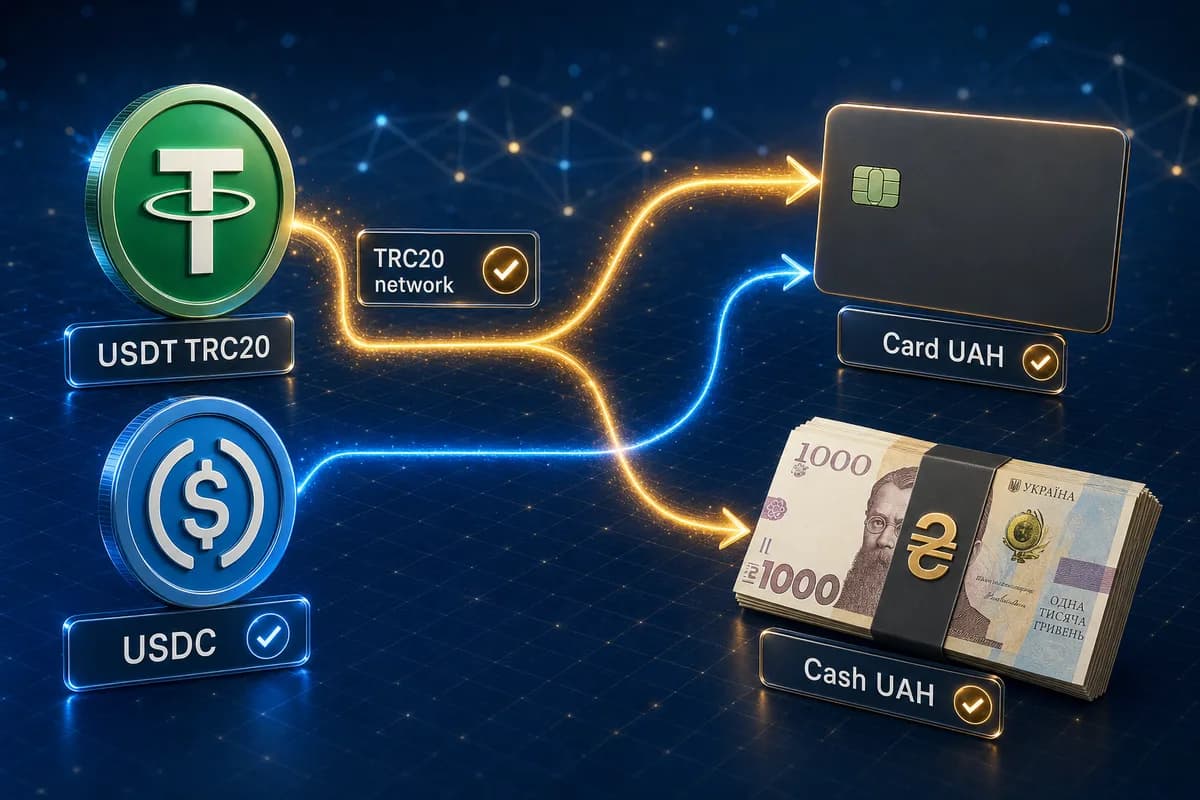
For a user in Ukraine, choosing a stablecoin comes down to a practical question: which token is easier and cheaper to convert from hryvnia and back. Here the picture differs from the global market, where USDC is growing faster: in exchange directions to hryvnia USDT remains the main token.
Why USDT dominates exchange to hryvnia. There are several reasons, and they work together. First, deep liquidity: the more people want to exchange a token, the closer the rate is to the market. Second, the Tron network with its low and stable fee, convenient for small and frequent transfers. Third, market habit: services open directions and hold reserves first of all in the most popular assets. Fourth, the absence of European restrictions: they remove USDT from EU platforms but do not apply to Ukrainian directions. As a result, USDT is the main stablecoin in most directions to hryvnia, and cash for cryptocurrency is, as a rule, paid out only for USDT.
How exchanging USDT to hryvnia works. On Coinmoneyhub the exchange takes four steps:
- Create an order in the calculator: choose USDT TRC20, a bank or a city for cash, and enter the amount and your card.
- Get the details – the address to send USDT to on the TRC20 network.
- Send USDT to this address on the network shown in the order.
- Receive hryvnia to a Ukrainian bank card or in cash in the chosen city.
The calculator shows the rate and service fee right away, with no hidden fees, and the rate is fixed when the funds arrive. Card payouts work daily from 8:00 to 22:00 Kyiv time. If you send less than stated in the order, the payout is automatically recalculated based on the amount actually received. Which banks are supported and how the payout works is explained in our separate article – “Sell USDT for hryvnia”, and the reverse operation in the article “Buy USDT with hryvnia”. Current rates, reserves and limits for each direction are shown on the rates page: the values change, so check them before every operation.
USDC to hryvnia: what to consider. Overall there are fewer directions for USDC on the market than for USDT. On Coinmoneyhub, USDC can be exchanged for hryvnia directly to a card, as well as for USDT TRC20 or another cryptocurrency. Cash is not paid out for USDC: for cash, the token is first exchanged for USDT TRC20. If a service does not accept USDC directly, exchanging through an intermediate coin is a separate operation with its own fee and rate, so compare the final amount in advance.
When USDC makes sense in the Ukrainian context. The token is justified where external conditions, not hryvnia, are decisive:
- a counterparty from the EU or the US requires a token that meets local rules or works only with USDC;
- payments go through platforms and protocols where USDC is the main settlement token;
- you need diversification between two issuers so as not to depend on one, as discussed in the section on depegs;
- preference is given to a token with a more conservative reserve composition and regular reporting.
USDT or USDC for Ukraine. For exchange to hryvnia and payments within the country, USDT is more practical: it is more liquid and available in more directions. For working with foreign partners, USDC may be more convenient. Some users hold both tokens: USDT as a working exchange tool and USDC as a settlement token for foreign counterparties. The best stablecoin for exchange to hryvnia is determined not by a market cap ranking but by where the token ends up.
What to look at when choosing a direction. Five checks before placing an order:
- Whether the service accepts the chosen token and network.
- What final amount the calculator shows.
- What reserves and limits are stated for the direction.
- Which payout method is available: card or cash.
- How much the network fee will be when sending.
Choosing for the task: storage, payments, exchange and large amounts
There is no single best stablecoin: USDT and USDC are equal in price but differ in issuer, reserves, regulatory status, liquidity and networks, and the weight of these differences depends on the task. Below is a breakdown by scenario: what to choose and what to look at. This is general information, not investment advice: the decision is yours and depends on the amount and acceptable risk.
Exchange to hryvnia. For this task USDT on the TRC20 network is more practical: it has deeper liquidity, more directions and a lower transfer fee, and this is the network on which Coinmoneyhub accepts USDT for hryvnia payouts to a card and in cash. Before sending, open the exchange calculator: it shows the final amount before you create an order, and the rate is fixed when the funds arrive. The exchange sequence from choosing a direction to receiving the money is described in the article “How to exchange USDT for hryvnia?”.
Storage. For the short term, while the token is needed for a specific operation, choose the one you plan to exchange or pay with. For the long term, what matters most is not the choice of token but the storage method and diversification: some users split their funds between USDT and USDC so as not to depend on one issuer. USDC appeals with its conservative reserves and regular reporting, USDT with its scale and liquidity. The token itself pays no interest, so holding it preserves the dollar but does not grow it.
Payments and settlements. Here the recipient decides. If the counterparty in the EU or the US works through regulated providers, USDC is more convenient. If payments are between individuals, in freelancing or with partners from countries with limited access to dollar accounts, USDT is more often accepted. If your obligations and accounts are in euros, consider a euro stablecoin to avoid paying for double conversion.
Large amounts. With large volumes a mistake costs more, so four rules apply:
- split storage by purpose: keep the working balance separate from the main one and, if you wish, divide the main part between two tokens and two wallets;
- exchange with a single order within the direction's limit: splitting the amount into parts does not help and raises unnecessary questions at the bank – more on this in the article “Card blocked for cryptocurrency transactions”;
- check limits and reserves in advance: the minimum, maximum and available reserve for a direction are shown in the calculator before you create an order;
- start with a small test operation on a new network or with a new recipient.
Working with decentralised protocols. Both tokens are used as collateral and as a unit of account, and USDC is more common here. The main risk in such cases is not the choice between tokens but the protocol itself and a possible deviation of the price from the dollar: a smart contract may trigger forced liquidations during a depeg.
If you are just starting. The simplest path looks like this: define your task, create a wallet that supports the network you need, store the seed phrase offline, make a small test exchange and only then move on to larger volumes. For exchange to hryvnia, USDT on the TRC20 network is suitable; for other tasks you can switch tokens when a specific need arises.
The order of choice. For any scenario the sequence is the same:
- Define the task: exchange, storage, payment or settlement with a partner.
- Find out which token and network the recipient accepts.
- Choose a network by fee, speed and where your funds already are.
- Check the final amount: the network fee plus conversion, not the quoted rate.
- Do a test operation with a small amount and only then the main one.
You can change your choice of token at any time: exchanging USDT for USDC and back is easy. What cannot be fixed is a transfer on a network the recipient does not support. So the main practical takeaway from everything covered here is not about the token's name but about the network and address stated in the order.
